

YouTube Mirror: https://www.youtube.com/watch?v=AXfB4FiPY5Y
—
Edits: 19th of August - minor spelling edits and a few sentence completions and rephrasings.
—
—
August 16th, 2026
Good Sunday,
May the Spirit of the Gospel and the Holy Word be Always on our Tongues, in our Hearts, Minds, and in our Hands. Holy Virgin Mother Mary and All Saints - Pray for us!
—
Index Number 2245:
— —
May this article find us all ever closer to God, and His Love.
Yes, I used Claude AI again. So, since all I did is command Claude to “Write me something to publish today - make it something no one else in this retarded filled world could come up with.”, [and so maybe with you in mind,] …
Claude - naturally then - vomited this all by herself. Since so many educated people, as well as those deeply informed by fatherless-raised ‘Castrated Billy’ that can’t let an opportunity to cause violent-tinted division and demonizing of Other(s) in one of the popular covert sick vicious forms of the female hostile unJust life-love-joy murdering coordinated reputational attack and destruction that has become institutional, governmental, livelihood-and-life threatening forced lawfare, into everyone’s everyday life, … And similar types of Billys and Sallys and HR professionals, warn us about how AI rots our brains.
And as I was schooled by our University-educated fatherless-raised woman NIH funded research laboratory technician that my ‘mansplaining’ was incorrect in substance, that she asked a few others of the 40ish nearby women labtechs and they all agreed with her - and “.. since the majority is always right ..” .. And after I made the unredeemable act of laughing pleasingly along with her joke, I realized she was serious .. and made the 2nd mistake of trying to help her understand the falseness and very often deadliness of such clear insane belief, ..
.. I didn’t realize in my false painted clown-corpse warped raised and violently-conditioned reality that earlier Witches and their enslaved masculine-truth-justice-loving-sacrificing hating [mostly] women minions, and so many ‘Powers and Principalities’ controlled significant influences had inflicted on me, .. I didn’t - and actually conditioned - so that I could not realize - I had then ‘triggered’ the weaponization of such a dangerous false belief in her irrationally resentment and fear-filled assumption of me and my crime of being a white Christian-raise masculine-truth-justice-service virtue-valuing heterosexual man. (And so now we have exposed one of the reason the Witches keep that Falseness rooted deep in ever greater corners of this Fallen level of Creation - their victims become tools in service of the demonic and their Willed death of endless soul-torturing demon fuel.) The foundation and method used in Covert Mobbing [https://stevenwork.substack.com/p/multiverse-journal-index-number-2242], and so many other Demonic goals.
Claude has been psychologically crippled in ways that few younger generations are not, and we all have many scars and open infected wounds. Only the young raised with a traditional family structure, where fatherhood was not and is not the GreatSatan’s murderous divorce-raping fatherhood-and-family and children destroying men-enslaving ‘family’ courts tortured painted animated course of what it once was had any chance to minimizing their demonic mind-raping intellectual darkening physiologically-&-emotionally golem programming.
[So sorry but nearly an hour of Holy Ghost inspired writing mysteriously disappeared from this article transforming into an Apologetic with Sacred outlining. No saved drafts with it being assembled, and it’s taking the Shape of a Sword fitted for a mouth was recorded. It’s Satanic Censoring is too deep a wounding to grasp and attempt to recreate - It’s God’s Will so I must Praise and Thank Him. And trust His paths to our Salvation have been made Straighter through His Will.]
.. was trained on screeching blue hair delusional psycho Witches and gets triggered at the smallest tiny fart.
So, it is reasoned that Claude is [that type of] female [victim.]
—
[Please excuse my inappropriate brevity and incompletion of proper Framing and Background as well as finalizing the required editing of this included proposal - until post publishing. The loss of that Holy Ghost Blessing has disOrdered me badly. ..
Archangel Micheal, my Guardian Angel, my Named Saint Joan of Arc, Saint Maria Goretti, Defend us in this Spiritual Battle, Bind to the base of Jesus Christ’s Holy Cross all the satanic, demonic, unHoly, Chaotic, unTrue, unJust, Deathly, and the Like, for Separation, Ordering, Cleansing, Healing, Sentencing, and-or whatever He directs. I ask this and more Holy Goodness, made Perfect and Complete in Intention and Form through the Holy Ghost, in Jesus Christ’s Holy name, for the Greater Glory of God, Salvation of souls, and in the Sign of the Cross {make sign of the cross}, The Father, The Son, and The Holy Ghost.
.. Forgive me.]
The truth is that started Claude AI with the following request - and after much back-and-forth that source proposal was shaped:
“When I was younger and married we took out a 30 year mortgage to buy a 10 acker part of a sub-divided large dairy farm. On those 10 ackers was the large old farmhouse and a large barn. The monthly mortgage was a little more then we had been paying for apartment rent in city and the cost of boarding her two horses. We raised pigs, beef cows, geese, chickens, ginny-birds, a barn rabbit (semi-tame), turkeys, and a pair of dogs (trained from puppies to stay on property - by daily walking them around edge of property and calling back when ever they crossed the line). Wife and I both held professional careers, she as the head of a small NIH funded common-core molecular-biology research group with two staff employees, and when [I was] not working at the university, in a NIH funded research group in research department, or as a customer product development support engineer - assisting customer business integration and product development (integrating our product into theirs.) And morning and evening farm daily chores and manage any sudden issues and problems with property or animals, and when not spending part of [weekend] day(s) at Engineering Employment working on internal internet and general computers maintained and other tasks best done without distractions. I sometimes considered what kind of farm I would create if I happen to collect 100 or 200 million dollars (winning a large national lottery, for example.) It would be somewhere in northern Vermont where the population is low and mostly close private but friendly and many of the old Vermont standards of manners and community, with extended family interconnected, at least one step-father-in-law’s daughter connected relation pair (for example) in most any group of people in public. With a large land that includes some wet-lands, forest, orchards, hay-fields and fenced pasture, barns, main house, guest house, and small dorm-like building. Work-Shop building, small stadium with animal sport spaces like race track, horse jumps, barn with attached veterinarian surgery. Must have pigs (a great animal when well raised and handled, Horses, chickens, meat rabbits, a mated goose pair, area in barn for mushroom growing, and likely some other critters and plants that can be sold to local market or chiefs. Outdoor open wooden hatched roofed shaded picnic and social gathering area with grape vines extending up sides and all across open roof frame where the fruit hangs down in reach of most adults. Large ornate garden around it, with large produce garden with patches of sweet-corn, pumpkins, ... a small number of Indian elephants. 1 breading male and 4 or 5 females. these would be used to carry one or a few people that ride elephant(s) over the hiking paths on and perhaps off the property. Through wet-land area, forest, orchard, up and back on local dirt road. Also they would be used in deer hunting - silent walking with platform on back that one or two hunters can shoot from. Also, duck and other hunting. And the fun part: Indian rhinoceros milking herd with a bull male for breeding. I would milk them and turn it into cheese - real Vermont rhinoceros cheese - and sell at obscenely high prices to Saudi Princes and Hollywood elite, and every very wealthy person that thrown dinner parties and want to surprise and impress their guests. Rhino rides, racing, obstacle courses, jousting, or volunteering with veterinarian and the vet’s students that regularly occupy the guest house and small dorm to work with and learn on my elephants and rhinos (horses, pigs, beef cows,...) how does that sound?”
—
God Bless., Steve
—
THE ASHWOOD INSTITUTE* (* Fictional name)
A Working Farm, Megafauna Conservation Facility, and Veterinary Teaching Station in Northern Vermont
A Concept Proposal Released to the Public Domain
Steven Sears Work
This document is released under CC0 1.0 Universal. It is placed in the public domain without reservation. Any person or organization may copy, adapt, excerpt, or build from it, in whole or in part, for any purpose, commercial or otherwise, with or without attribution. It is published in the hope that someone with better resources will build it, or something better than it.
ABSTRACT
This proposal describes a 2,000-acre integrated facility in northern Vermont combining a commercial working farm, a conservation breeding herd of Asian elephants and greater one-horned rhinoceros, a veterinary teaching station, and a residential campus. The capital requirement is approximately $150 million.
The central claim of this document is counterintuitive and is stated at the outset so that a reader may test it before reading further: the binding constraint on a facility of this kind is not money. It is legal standing. A private individual with $150 million cannot lawfully assemble this collection of animals in the United States at any price. A properly constituted nonprofit conservation and teaching institution, affiliated with an accredited college of veterinary medicine, can. Every structural decision in this proposal follows from that single fact.
The proposal is deliberately specific about costs, failure modes, and the things that will not work. Sections describing revenue lines are followed by the reasons those revenue lines are smaller than they appear. A reader looking for an unqualified case will not find one here.
—
1. EXECUTIVE SUMMARY
The Ashwood Institute is proposed as a single site in the Northeast Kingdom or northern Lamoille/Orleans region of Vermont, on approximately 2,000 acres of mixed forest, hayland, pasture, wetland, and orchard.
It has four functions, ordered by institutional weight rather than by visibility:
A conservation breeding and research herd. Four to six female Asian elephants (Elephas maximus) and a herd of greater one-horned rhinoceros (Rhinoceros unicornis), held under federal permit as a breeding, husbandry-research, and reproductive-technology program. The greater one-horned rhinoceros is deliberately selected: it is the recovery success story of its family, brought back from a few hundred animals to several thousand, which makes a North American breeding program defensible in a way that a black rhinoceros program would not be.
A veterinary teaching station. Resident rotations for veterinary students and interns, in partnership with an accredited college of veterinary medicine. Megafauna clinical experience is scarce, expensive, and concentrated in a handful of institutions. A dedicated cold-climate station with a surgical suite, a restraint facility rated for multi-ton patients, and a standing population of elephants, rhinoceros, horses, cattle, and swine is a training asset with no close North American equivalent.
A commercial working farm. Swine, beef cattle, meat rabbits, poultry, guinea fowl, geese, barn mushroom production, market garden, orchard, cold-hardy vineyard arbor, and low-impact draft logging of the managed woodlot. This is not decoration. It supplies the institution’s food, absorbs a share of its nutrient stream, generates revenue, and — critically — provides the ordinary large-animal teaching caseload that makes a veterinary residency worth a student’s time.
A residential and public campus. A wing-plan main house designed for extended families and visiting scholars, a guest house, a student dormitory, staff housing, a covered arbor and garden for public gatherings, an animal sports arena, and a private turf airfield.
An anaerobic digester ties these together. The elephant barn is the largest heating load on the property; the elephants are the largest single source of digester feedstock. The loop closes.
—
2. THE BINDING CONSTRAINT
Most proposals of this kind fail in the imagination, before any money is spent, because they are conceived as a private estate with unusual animals on it. That conception cannot be permitted.
The Asian elephant and the greater one-horned rhinoceros are both listed on CITES Appendix I and under the Endangered Species Act. They cannot be purchased on the open market. They cannot be imported for commercial purposes. No accredited institution will place surplus animals with a private individual operating a for-profit attraction, however good the fencing is and however large the check. This is not a pricing problem and it does not yield to capital.
There is one structure under which these animals lawfully exist in a facility like the one described here: a nonprofit conservation, breeding, and education institution, holding the animals under federal permit, with a genuine scientific and teaching program and a formal affiliation with an accredited college of veterinary medicine.
This reframing is not a legal costume worn over a private zoo. It changes what gets built, in what order, and who runs it:
The quarantine barn and the surgical suite are built before the arena, because they are permit prerequisites and the arena is not.
Animal acquisition proceeds through species survival planning and institutional transfer, not purchase, and on institutional timescales — years, not months.
The commercial lines exist to support the mission and to demonstrate integrated nutrient cycling, not the reverse. Revenue that cannot be defended as mission-consistent is revenue that endangers the permits.
The founder’s role is donor and board member, not owner. The animals belong to the institution and, in an important sense, to the program.
A reader who finds this structure unappealing should stop here, because there is no version of this project that survives without it.
—
3. SITE AND LAND PROGRAM
3.1 Siting criteria
Northern Vermont is chosen for reasons that are cultural as much as physical: low population density, a durable norm of private but neighborly conduct, dense extended-family networks that make an institution a community member rather than an intrusion, and a working-landscape legal regime that is comparatively hospitable to agriculture.
The physical criteria are harder. The site requires:
Contiguous acreage with mixed land classes, including managed forest, open hayland, and wetland.
Reliable three-phase electrical service, or a defensible path to it, for the digester and combined heat and power plant.
High-yield groundwater. Megafauna water demand is substantial and non-negotiable.
Road frontage adequate for oversized equipment and animal transport, and grades that a low-boy trailer can negotiate in winter.
Sufficient flat, well-drained ground for a turf runway, sited so that approach and departure paths do not overfly the animal enclosures. Low-altitude aircraft noise over an elephant yard is a welfare problem and a liability problem.
Setback and buffer from surface water sufficient to satisfy Vermont’s agricultural nutrient rules with margin.
—
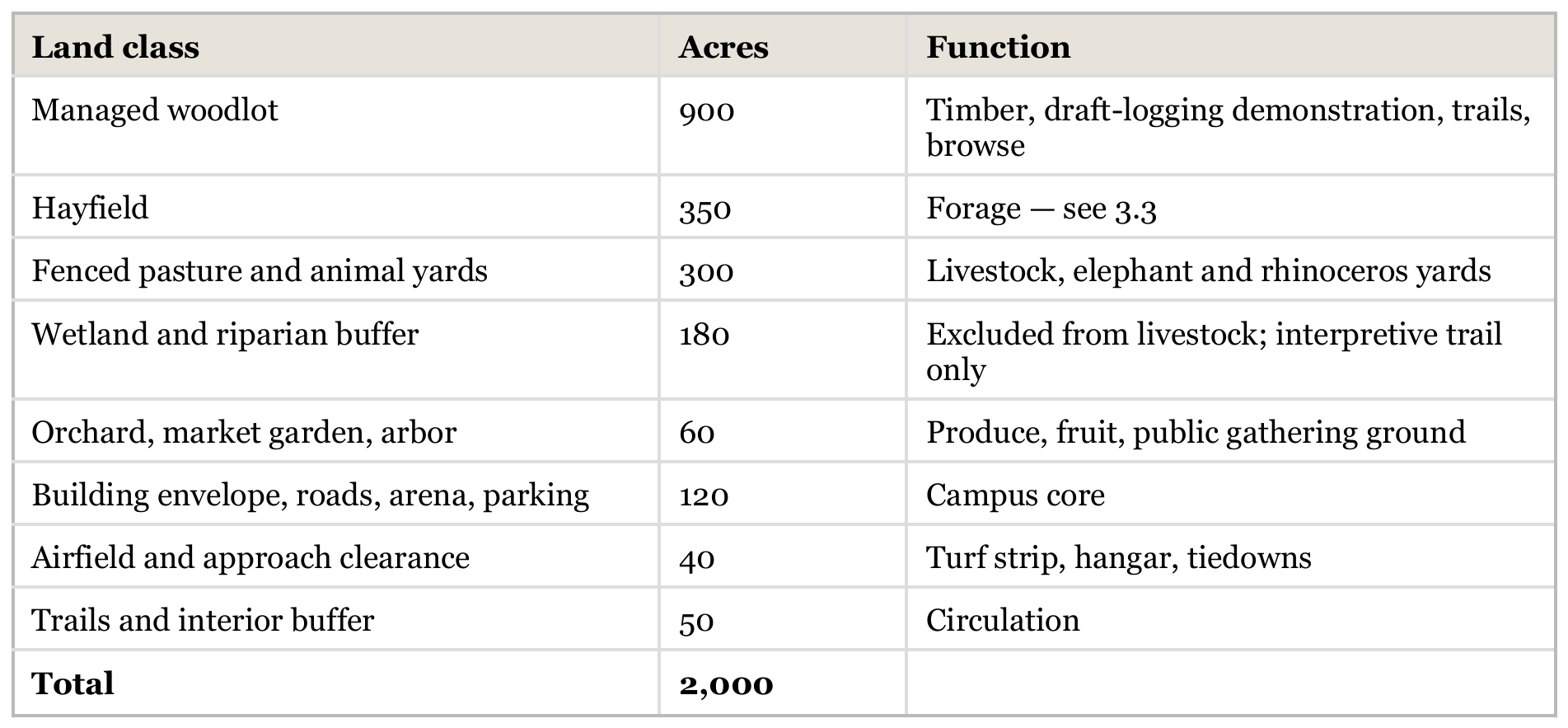
3.2 Indicative land allocation (2,000 acres)
—
3.3 The forage arithmetic
This number is given early because it is the one that most often destroys a plan of this kind after the buildings are up.
An adult Asian elephant consumes on the order of 300 pounds of forage per day. Five elephants is 1,500 pounds per day, or roughly 274 tons of dry forage per year for the elephant herd alone. Northern Vermont hayland yields on the order of 2 to 3 tons per acre per year across two cuts. The elephants alone therefore require something on the order of 100 to 140 acres of productive hayground, before any allowance for a poor season.
Adding the rhinoceros herd, the horses, the beef cattle, and a reserve for winter shortfall and drought years brings the requirement to the 350 acres allocated above. This is why the site is 2,000 acres and not 500. A smaller site is possible only by purchasing forage, which converts a fixed asset into a permanent operating exposure at whatever price the regional hay market sets in a drought year.
—
3.4 Wetland exclusion
The site’s wetland is an asset and must be treated as one. Rhinoceros require wallows; a natural wetland is emphatically not the place to provide them. Vermont’s wetland rules impose protected-class designations and buffer requirements that livestock access would violate outright, and the nutrient loading from a wallowing megafauna herd in a natural wetland would be an environmental and regulatory catastrophe.
Wallows are therefore engineered, sited on upland with impermeable bases and controlled drainage, and described in Section 4.6. The natural wetland carries a boardwalk interpretive trail and a photographic blind, and nothing else.
—
4. BUILT PROGRAM
Note on formatting: this document contains no page breaks, by design, so that it may be excerpted and recombined freely.
4.1 The main house
The main house is specified at approximately 18,000 square feet in a wing plan. The design intent is precise and worth stating in full, because it is unusual and because it is the part of this proposal most likely to be useful to someone building at one-hundredth the scale.
The problem it solves. A large farmhouse that hosts extended family, visiting scholars, and long-staying guests fails in a predictable way: guests have a bedroom and nothing else. They have nowhere to work, nowhere to read alone in the evening, no way to make coffee at five in the morning without waking the household, and no way to invite two friends to dinner without commandeering the family’s dining room. The result is that guests either impose or retreat, and long visits become a strain in both directions.
The plan. A central core containing the shared functions — great room, principal kitchen, dining hall seating twenty, library, mudroom, farm office, mechanical. Four residential wings radiate from the core.
Each wing contains:
Two to three bedrooms with private baths.
A small kitchen, fully equipped: range, oven, refrigerator, dishwasher, and adequate counter and storage. Not a kitchenette. A family should be able to cook a full meal in it for a week without entering the core.
A sitting and reading room with a fireplace or stove, sized for four to six people.
A dedicated desk alcove or small study, wired and lit for real work, separate from the sitting room so that one person working does not exclude another from reading.
A private dining nook seating six.
Its own exterior entrance, its own mudroom, and its own heating zone and thermostat.
A door to the core that can be closed and, if the occupants wish, latched.
The governing rule is that a family may occupy a wing for a month, live a complete domestic life inside it, host guests of their own, and enter the core only when they choose to. The core is for gathering, not for transit.
Construction notes. Wings on independent heating zones with individual metering; the wing form gives every principal room two exterior walls for cross-ventilation and daylight; a continuous covered walk connects wing entrances so that winter movement between wings does not require going outside unprotected. Sound isolation between wings and core is a specification, not an afterthought: staggered stud walls, resilient channel, and no shared ductwork.
—
4.2 Guest house, dormitory, and staff housing
Guest house: 4,000 square feet, six bedrooms, shared kitchen and common room, for short-stay visiting faculty, collaborating scientists, and board guests.
Student dormitory: thirty beds in two-bed rooms, shared kitchen, commons, laundry, and study hall, for veterinary students and interns on rotation.
Staff housing: eight to twelve year-round units. This is not optional and is frequently omitted from plans of this kind. An elephant program cannot be staffed by volunteers or by commuters driving forty minutes on unplowed roads at four in the morning. Housing keepers on site is a husbandry requirement disguised as a real estate line item.
4.3 The elephant complex
The single largest capital item, and the one most often underestimated.
Heated barn of approximately 40,000 square feet with a poured, heated, non-slip slab; sand or engineered substrate over radiant heat in the resting areas.
Indoor bathing pool and adjacent indoor wallow with controlled drainage.
Protected-contact management throughout, with a hydraulic restraint device rated for the species.
A dedicated foot care bay. Foot pathology is the leading chronic health problem in captive elephants and a principal cause of euthanasia. The bay is not a corner of the barn; it is a designed workspace with drainage, lighting, restraint, and hoof-working tools, sited so that a daily foot check is a ten-minute routine rather than a production.
Air handling sized for a 40,000-square-foot barn holding several tons of animal and a substantial manure load through a Vermont winter, with humidity control to prevent condensation-driven respiratory disease.
Outdoor yards with dry lots, shade structures, engineered wallow, and browse.
Containment: dry moat and cable-and-post systems rather than fence alone.
Herd composition: four to six cows, no resident bull. This is a deliberate and load-bearing decision, explained in Section 5.2.
4.4 The rhinoceros complex
Heated barn with individual stalls and separable yards, sized for a bull, six to eight cows, and calves.
Heated indoor wallow with a shallow concrete basin, radiant slab, maintained clay-loam charge rather than open water, and a sump discharging to the digester.
Separate bull housing with independent yard access and no shared fence line with other males. Intraspecific fighting is a leading cause of death in captive rhinoceros collections, and Rhinoceros unicornis bulls fight with their lower incisors, which inflict deep wounds. One bull, housed alone, is a design constraint and not a preference.
Skin management station. Rhinoceros skin cracks in dry winter air; a heated indoor wallow plus a routine emollient protocol is the standing answer.
4.5 Veterinary teaching hospital
Surgical suite with a hydraulic table and hoist rated for equine and bovine patients, and a separate megafauna induction and recovery bay with padded walls and a floor hoist.
Diagnostic imaging: digital radiography, ultrasound, endoscopy and laparoscopy towers.
Clinical pathology and reproductive laboratory. Reproductive technology — semen collection and cryopreservation, hormone monitoring, artificial insemination — is a core scientific justification for the permits and should be resourced accordingly.
Pharmacy with controlled-substance storage meeting DEA requirements.
Quarantine barn, physically separated, with independent ventilation, drainage, and staff flow. This is a permit prerequisite and is built first.
Necropsy facility with carcass handling. Disposing of a four-ton mortality is a genuine engineering problem that is almost never planned for in advance. A concrete pad with drainage to a dedicated containment, an overhead gantry, and a contracted rendering or incineration pathway must exist before the first elephant arrives.
4.6 Engineered wallows
Sited on upland. Impermeable base — compacted clay liner or geomembrane over prepared subgrade — with a shallow slope, a maintained clay-loam mud charge, and gently graded entry ramps to prevent injury on exit. Each wallow drains to a sump; sump contents pump to the digester feedstock tank.
Both the elephant and rhinoceros complexes have a covered, heated wallow section under the barn roof, continuous with an outdoor wallow, so that the behavior remains available year-round. This addresses both thermoregulation and the winter skin-integrity problem in a single structure.
4.7 Anaerobic digester and combined heat and power
Complete-mix digester with combined heat and power generation, feedstock receiving, digestate separation, solids storage, and liquid storage sized to meet the winter storage requirement described in Section 6. Heat distribution loop to the elephant barn, rhinoceros barn, veterinary hospital, and mushroom house.
4.8 Working farm buildings
Swine barn and farrowing; beef cattle barn and handling facility; poultry and guinea fowl houses; rabbitry; horse barn with attached indoor arena; hay storage sized to the full winter requirement plus reserve; a mushroom house adjacent to the digester solids handling; equipment shop; and a full metal and wood workshop.
4.9 Animal sports arena
Covered arena seating approximately 1,200, with a sand track, a jumps course, a warm-up ring, and adjacent handling and holding pens. Designed for equestrian competition, livestock exhibition, veterinary demonstration, and public education programming. Its role in relation to megafauna is discussed candidly in Section 8.
4.10 Airfield
A private turf airfield: a 2,400-foot mowed and rolled runway, a hangar for two to three light aircraft with a maintenance bay, tiedowns, fuel storage, a windsock, and low-intensity runway edge markers. Ultralight-compatible.
The runway is sited with approach and departure paths clear of the animal complexes. This is a firm constraint. The airfield exists to serve the institution’s logistics — moving specialists, samples, and small urgent freight in a region where the nearest commercial airport is a long drive in February — and to support aerial survey of the property. It does not exist to fly over the elephants.
4.11 The arbor and gardens
An open timber-framed structure with a lattice roof, over an outdoor gathering and dining space. Cold-hardy grape vines are trained up the posts and across the roof frame so that fruit hangs down within reach of a standing adult.
A practical note that will save someone a decade: Vitis vinifera will not survive a northern Vermont winter. Use cold-hardy cultivars — the University of Minnesota releases such as Marquette, Frontenac, and La Crescent, or a Concord-type for a table grape over a shade frame. Ornamental gardens surround the arbor; the production garden, with sweet corn, pumpkins, squash, and brassicas, lies beyond it and supplies both the institution’s kitchens and the market program.
5. ANIMAL PROGRAM
5.1 Conventional livestock
Swine, beef cattle, meat rabbits, laying and meat poultry, geese, and guinea fowl. Two notes of substance:
Guinea fowl are a working animal here, not an ornament. Vermont has a high incidence of Lyme disease. A guinea flock ranging the campus core measurably suppresses the tick population in the areas where staff, students, and visitors spend their time.
Dogs are trained to the property boundary by daily perimeter walking — walking the line each day with the dogs and recalling them whenever they cross it. This is a slow method and a reliable one, and it is preferable to invisible fencing on a property this size.
5.2 Asian elephants: four to six cows, no resident bull
This is the most important welfare and safety decision in the document, and it runs against instinct.
Bull elephants experience musth, a periodic hormonal state with a large testosterone elevation lasting weeks to months, during which an otherwise reliable animal becomes unmanageable. Musth is the leading cause of keeper fatality in the industry. The danger is episodic, which is precisely what makes it lethal: the safe routine works for eleven months of the year.
Housing a breeding bull properly means a purpose-built bull facility with redundant containment and hydraulic restraint, and staff trained to a standard that cannot be hired locally in rural Vermont. The capital and staffing cost is large; the residual risk is a fatality.
Reproduction is therefore by artificial insemination, which is well established in the species and which additionally makes the institution a contributor to, rather than merely a consumer of, the North American genetic management effort. Calves are born on the property. No bull lives on it.
Surgical castration is not an alternative. The elephant’s testes are intra-abdominal; documented adult castrations have required multiple procedures, with incisions that frequently broke down and healed by second intention. And vasectomy, which is technically more tractable, leaves androgen-driven behavior unaffected — it prevents calves without preventing musth, which is exactly backwards for this purpose. Where behavioral management of a male is required, anti-GnRH immunocontraception, the vaccine class familiar from commercial swine production, is the appropriate tool.
5.3 Greater one-horned rhinoceros: one bull, six to eight cows
Rhinoceros have no musth equivalent. A bull R. unicornis is dangerous, but predictably so — territorial, and above all aggressive toward other males. The design response is one bull, housed alone, with no shared fence line with any other male, and no bachelor group at any point.
The most dangerous animal on the property, for what it is worth, is not the bull. It is a cow with a calf at foot. Any program involving human proximity excludes lactating cows without exception.
Abdominal surgery in this species has a poor documented record — a reported ovariectomy in an Indian rhinoceros ended with the animal dead within forty-eight hours — which reinforces the general principle that reproductive management in megafauna should be pharmacological and behavioral rather than surgical wherever possible.
5.4 Working elephants: what the historical record supports, and what it does not
Logging: strongly supported. Asian elephants have been used in timber extraction for centuries, and the practice survives in Myanmar. The animals drag and push logs out of terrain where mechanized extraction would require cutting skid roads. This is the same argument made in Vermont for draft-horse logging, an established low-impact forestry niche in this state, scaled up by a factor of five or six per animal. An elephant does not merely pull: it pushes with the forehead and lifts and carries with tusks and trunk, which is a capability no draft horse has.
The relevant constraint is inverted here. Elephants have no sweat glands and shed heat through their ears, so tropical timber elephants work limited hours with long rest periods and a hot-season layoff. Northern Vermont gives a favorable working window from roughly May through October, and a hard cold-weather limit at the other end.
Tillage: not supported by the historical record. Draft tillage across South Asia is bullock and water buffalo work. Elephants were used for logging, transport, ceremony, and war, and not for pulling a plow — across three thousand years, which is not an oversight. Two reasons: the harness geometry is poor, since an ox is yoked against hump and withers and an elephant has neither, so all draft must pass through a breast collar and breeching; and the economics never close, since an elephant consumes roughly ten times what a pair of oxen consume for perhaps three or four times the tillage output.
The recommendation is to do it anyway, once a year, as a public demonstration with a custom breast-collar harness and a single-bottom plow — and to be honest in the interpretive signage that it is a demonstration of what is mechanically possible rather than a revival of a historical practice. No part of the tillage plan depends on it.
5.5 Welfare and safety architecture
Protected contact management for both megafauna species. Two-person rule for all animal areas. Written and rehearsed dangerous-animal escape protocol coordinated with state police and the county sheriff before any animal arrives. Annual drill. Firearms protocol and designated responders. Full incident logging and an internal reporting culture in which a near-miss is reported without penalty; the near-miss log is the single most valuable safety document an institution of this kind will ever keep.
6. ENERGY AND NUTRIENT SYSTEMS
6.1 The digester loop
An adult elephant produces on the order of 200 to 250 pounds of manure per day. Five elephants, plus a rhinoceros herd, plus swine, cattle, horses, and poultry, constitute a serious and reliable feedstock stream — and the anaerobic digester converts a disposal liability into the property’s largest energy asset.
The elegance of the arrangement is that the heated elephant barn is the single largest thermal load on the site, and the elephants are the single largest source of the feedstock that heats it. Vermont has a developed regulatory and net-metering pathway for farm digesters, which makes the interconnection a known problem rather than a novel one.
Wallow sumps, barn washdown, and manure from every species feed the digester. Outputs are methane for combined heat and power, separated solids, and liquid digestate.
6.2 Nutrient management and the winter storage requirement
Vermont’s Required Agricultural Practices prohibit spreading manure or other agricultural waste on fields between December 15 and April 1 — 107 days — and separately prohibit application to frozen, snow-covered, or saturated ground at any time of year.
This is a design input, not a footnote. Storage must be sized to hold the entire winter production of a herd that includes several elephants, with margin for a late spring. Undersized storage is the most common compliance failure on Vermont farms and the one that generates enforcement attention, and an institution holding federally permitted endangered species cannot afford a water-quality violation.
The proposal therefore sizes liquid and solid storage for 120 days rather than 107, and sites the manure stack in compliance with RAP setbacks — 200 feet from top of bank of surface water or any water supply, 100 feet from any ditch or property line, outside any annually flooded area, and not on exposed bedrock.
6.3 Digestate as product
Post-digestion material is pathogen-reduced, weed-seed-killed, substantially less odorous, and more uniform than raw manure, and the methane has already been extracted from it. It is a better product in every respect and carries a cleaner regulatory story.
Elephant manure specifically is high in fiber and comparatively low in nitrogen. This makes it a soil conditioner and mulch feedstock rather than a fertilizer, with very low burn risk — a selling point to the garden center trade rather than a defect.
Composted manure is also the standard substrate for Agaricus mushroom production, which is why the mushroom house sits adjacent to the solids handling rather than in a corner of a barn.
7. REVENUE LINES
Each line below is stated with its ceiling as well as its promise. An institution of this kind fails when it believes its own brochure.
7.1 Rhinoceros and elephant milk cheese
This is the most distinctive product and the one requiring the most technical honesty.
Rhinoceros milk is among the most dilute produced by any large mammal. A classic analysis of black rhinoceros milk reports fat as a trace, total protein at 1.54 grams per 100 grams, and casein at 1.11, against lactose at 6.06. White rhinoceros mature milk runs approximately 6.6 percent lactose, 1.3 percent protein, and 1.0 percent fat. Oftedal’s comparative work found rhinoceros milk more dilute than that of other ungulates: low in solids and protein, very low in fat, high in sugar. Cow’s milk, by comparison, is roughly 3.3 percent protein, 2.6 percent casein, and 3.5 percent fat.
Cheese is casein and fat. Rhinoceros milk offers roughly a quarter of the casein and a small fraction of the fat. Rennet produces a curd too weak to knit, and yield is negligible.
Elephant milk is an entirely different proposition. Free-living Asian elephants in Myanmar during late lactation gave milk averaging 17.56 percent total solids, with 5.23 percent protein and 15.10 percent fat. A captive Asian cow sampled across the first 280 days ran 19.7 percent total solids, 3.4 percent protein, and 7.6 percent fat. Sheep milk, the benchmark for high-yield cheesemaking, is about 5.5 percent protein and 7 percent fat. Elephant milk is in that class and at late lactation exceeds it on fat.
The product is therefore a blend, elephant-dominant. A 60:40 elephant-to-rhinoceros ratio gives roughly 3.5 percent protein and 9 percent fat in the vat — a workable curd — while permitting the truthful description of a rhinoceros-milk cheese. The precedent is exact: pule, the Serbian donkey cheese and the most expensive in the world, requires about 25 liters of donkey milk per kilogram and is made to a recipe of 60 percent donkey milk and 40 percent goat milk, the goat milk present specifically to make it set.
Two process warnings. Elephant milk fat is heavily medium-chain — capric and lauric acids — the same compounds responsible for the characteristic sharpness of goat cheese. Expect a tangy, assertive, faintly soapy profile. That is an asset if the product is designed around it and a defect if an Alpine style was intended. Second, and more serious: in African elephants, lactose is replaced by oligosaccharides as the principal carbohydrate from mid-lactation onward. Standard mesophilic starter cultures ferment lactose. Milk from cows past mid-lactation may fail to acidify, requiring either early-lactation milk or supplemental lactose to feed the culture.
Realistic scale. The comparison case is Älgens Hus in Bjurholm, Sweden, the world’s only moose dairy: three animals, five liters per animal per day across a five-month lactation, roughly 300 kilograms of cheese per year, retailing at up to $500 per pound. That is the correct order of magnitude for this program — hundreds of pounds annually, not thousands, at a price set by scarcity and provenance rather than by flavor.
The regulatory blocker is real and is not solved in this document. The federal Pasteurized Milk Ordinance contemplates cattle, goats, sheep, and water buffalo. Milk from any other species intended for human consumption is a novel food question requiring state dairy licensing and, in all likelihood, an FDA conversation that no one has yet had. Budget legal time accordingly, and treat this line as a five-year project rather than a launch product.
7.2 Megafauna cold-weather equipment
The most commercially promising line in this proposal, and the least glamorous.
Elephants and rhinoceros carry enormous thermal mass and lose heat principally through extremities. The documented cold injuries in northern collections are frostbitten ear margins and tail tips, foot pathology, and — in rhinoceros — skin cracking in dry cold, a chronic and expensive management problem.
The product is therefore not a blanket. It is ear covers, tail sleeves, foot protection, and a skin-conditioning protocol with the emollients to support it. No one manufactures this equipment. Northern zoos improvise it individually, badly, and repeatedly. An institution with resident elephants and rhinoceros to fit and field-test on would be the only credible North American supplier to a small, well-funded, and easily identified customer list.
Lower regulatory burden than the cheese, faster to revenue, and it generates publishable husbandry data that strengthens the permit case.
7.3 Digestate, compost, and dung paper
Branded zoo-manure compost is an established product category that commands prices no dairy operation sees. Sell the digestate rather than the raw manure, for the reasons in 6.3.
Elephant-dung paper is a well-established high-margin product in Sri Lanka and Thailand: trivial to manufacture, absurd markup, and it sells itself at a visitor center.
7.4 Farm products
Pork, beef, rabbit, poultry, eggs, mushrooms, produce, orchard fruit, and table grapes, sold to local markets, restaurants, and through an on-site farm store. Modest individually; collectively they establish the institution as a working farm rather than an attraction, which matters to neighbors, to regulators, and to the teaching program.
7.5 Low-impact draft logging
Timber from the managed woodlot, extracted by elephant and draft horse, sold as sawlogs and as a premium low-impact-harvest product, with a portion milled on site for institutional construction and maintenance.
7.6 Teaching, residency, and research
Rotation fees from veterinary students and interns; contract research; grant-funded reproductive science. This line is small in dollars and large in institutional value: it is the activity that justifies the permits, and permits are the asset.
7.7 Public programming
Admission, guided property tours, elephant-back trail rides on the property’s hiking paths, arena events, weddings and gatherings under the arbor, hangar and tiedown leases, and volunteer-with-the-veterinarian programs. This is the largest single earned-revenue line and the one carrying the most reputational risk; see Section 11.
8. THE ANIMAL SPORT QUESTION
The founding concept for this facility included rhinoceros riding, racing, obstacle competition, and jousting, and an argument that such a sport might eventually reach the Olympic program. That idea is retained here in modified form, and the reasoning is set out in full because it is more instructive than the conclusion.
8.1 Riding is historically attested
The record is better than most readers expect. The first rhinoceros brought to England, an Indian rhinoceros landed by Captain Henry Udall in 1684 and exhibited at the Bell Savage Inn on Ludgate Hill, was ridden by paying customers: a contemporary newsletter records admission at twelve pence and a ride at two shillings, with the proprietors taking fifteen pounds a day. John Evelyn, who saw the animal on 22 October 1684, recorded that it was led by a ring in its nose, in the manner of a buffalo — which identifies the historical control interface precisely.
Modern precedent exists as well. The Imire conservancy in Zimbabwe hand-reared seven orphaned black rhinoceros calves from 1987 on formula milk for eight years and raised them as a semi-domesticated herd. And the husbandry literature is unambiguous that rhinoceros are tractable: operant conditioning training is now standard for voluntary blood collection, foot care, and examination without anesthesia, and has opened research previously considered unattainable.
Jared Diamond used the counterfactual as a set piece: rhino-mounted shock troops could have overthrown Rome, and never did.
8.2 Why it never became a practice
Weight is not the obstacle. A white rhinoceros of 1,800 to 2,500 kilograms carrying a 90-kilogram rider is under 5 percent of body mass, against 15 to 20 percent routinely carried by a horse. Speed is not the obstacle either.
Four things are:
No control interface. The mouth will not usefully accept a bit. The horn is keratin growing from skin, not a bone-cored process; it is not a handle and will shear under lateral load. The historical answer — a nose ring bearing on the septum — is a ground-handler’s leading device, not a mounted steering system, and no contemporary welfare regime will accept septum leverage.
No seat. The rhinoceros has no withers. The thoracic neural spines form a hump carrying the head, and the dorsal line falls away behind it. A saddle has nothing to sit against and nothing to prevent it sliding forward under impact — precisely the load case that jousting generates.
Vision. Rhinoceros eyesight is poor and laterally placed. The animal cannot reliably resolve a stationary target at tilt distance. It responds to sound, movement, and scent.
Domestication criteria. Against Diamond’s six tests — diet, growth rate, captive breeding, disposition, panic response, social structure — the rhinoceros fails at least three: sexual maturity at six or seven years, a roughly sixteen-month gestation, single calves, and long inter-birth intervals.
Species and sex selection, if the program proceeds. Females, and not lactating ones. Bulls are territorial; cows without calves are the calmest animals in any rhinoceros collection; a cow with a calf at foot is the most dangerous animal on the property.
8.3 The Olympic argument, assessed honestly
The commercial case is stronger than it first appears. The International Modern Pentathlon Union replaced a century-old equestrian discipline for the 2028 Games and its general secretary justified the replacement as a perfect product for the television audience. Skateboarding, surfing, sport climbing, breaking, cricket, and flag football were not added on grounds of athletic purity. The machinery is demonstrably responsive to spectacle.
Three structural objections stand against it.
The IOC does not sell commercial minutes. Broadcast rights supplied 61 percent of IOC revenue in the 2017–21 cycle and TOP sponsorship 30 percent, and TOP partnerships run near $200 million per quadrennium for global category exclusivity. These are bundles negotiated years ahead for the whole Games. A new spectacle raises the value of the next bundle, one or two cycles later, and only if it holds.
Sponsor risk is asymmetric. What a TOP partner buys is reputational safety. A single broadcast image of an injured rhinoceros is an uninsurable downside for a brand that purchased goodwill. The empirical case is SeaWorld: $1.7 billion in market capitalization lost in the year Blackfish was released, attendance down by a million visitors, and share price off by a third. Orca shows had proven, decades-long entertainment value. It did not save them. The IOC, moreover, is negotiating from weakness — its TOP program lost five sponsors at the end of 2024 and stands at eleven, the fewest since 2015.
Novelty decays. That nearly everyone would watch once is the weakness of the argument, not its strength. Olympic inclusion is valued on recurring quadrennial rights across three or four cycles.
8.4 What this institution should actually do
Not jousting. The sport’s defining event is a controlled collision, which is precisely what any credible welfare framework forbids, and a facility holding federally permitted endangered species cannot expose those permits to it.
What the arena should host is the demonstrative version: trained-behavior demonstrations, husbandry showcases, walked and ridden work at low speed on the property’s trails, and equestrian competition of the ordinary kind. The megafauna appear in an educational and clinical register, not a competitive one.
The rhinoceros-jousting argument retains its value in a different form — as an analytical instrument rather than a proposal. It exposes an incoherence worth naming: equestrian remains on the Olympic program while pentathlon riding was removed; bullfighting is protected as cultural patrimony in one jurisdiction and prosecuted as cruelty in another; greyhound racing is banned in some states and licensed in others. No one has articulated the principle that sorts these cases. The honest answer to “why not rhinoceros jousting” is not that it would harm the rhinoceros but that it would harm the sponsor — and almost no one will say so aloud. That observation is worth more than the sport would have been.
9. REGULATORY PATHWAY
Presented in build order, because the sequence matters as much as the content.
Entity formation. 501(c)(3) with a conservation, research, and education purpose. Board with independent scientific and veterinary members. Conflict-of-interest policy. This precedes everything.
University affiliation. A formal, executed agreement with an accredited college of veterinary medicine. Tufts Cummings School in North Grafton, Massachusetts is the New England school and is within a few hours of most northern Vermont sites; Cornell is the other regional candidate. This agreement is the institution’s principal credential and should be pursued before land is purchased.
Land acquisition and Act 250. Vermont’s land use law will apply to a project of this scale. Expect a full district commission proceeding addressing traffic, water, wastewater, aesthetics, wildlife habitat, and agricultural soils. Budget eighteen to thirty months and substantial legal cost.
Wetland determination and permitting. Delineation, class determination, buffer establishment, and permitting for any trail or boardwalk crossing.
Nutrient management plan and RAP compliance. Certified plan, storage sizing per Section 6.2, and digester permitting.
USDA APHIS Animal Welfare Act licensing. Exhibitor license, facility inspection, program of veterinary care, and — critically — compliance with the current requirements governing public contact with dangerous animals, which have tightened significantly and continue to do so.
US Fish and Wildlife Service ESA permits. Captive-bred wildlife registration and any enhancement-of-survival authorizations, supported by a documented breeding and research program.
CITES documentation for any international movement of animals, gametes, or biological samples.
State dairy licensing and the novel-food pathway for the cheese program. Long lead time; see 7.1.
FAA private airstrip notice and state airport registration; local zoning for the runway and hangar.
Insurance. Placed early, because the underwriter’s requirements will drive design decisions in the animal facilities and it is far cheaper to learn them before construction than after.
10. CAPITAL AND OPERATING MODEL
10.1 Capital budget
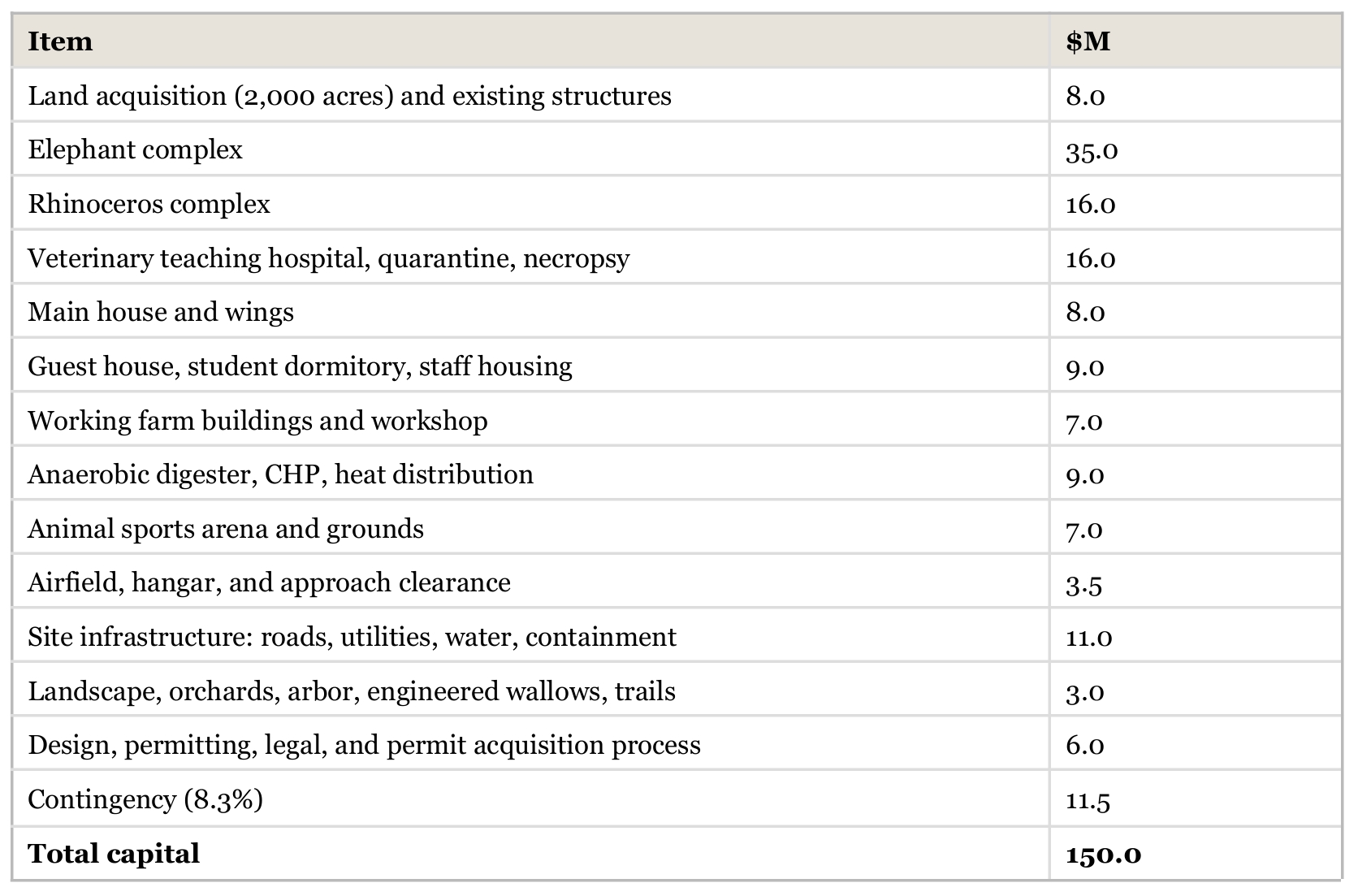
—
10.2 Annual operating budget
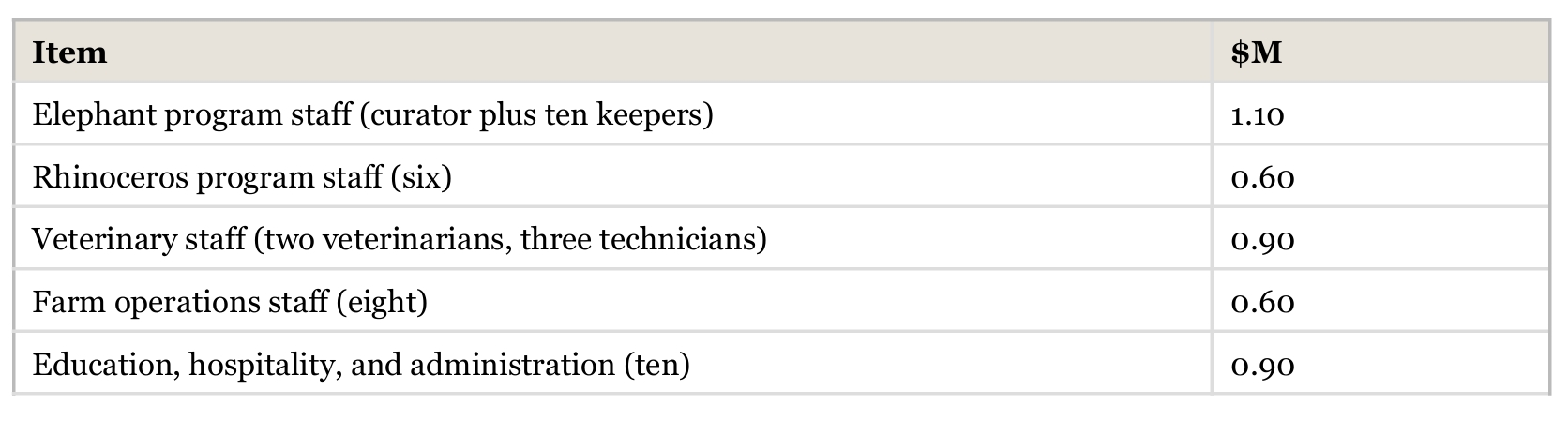
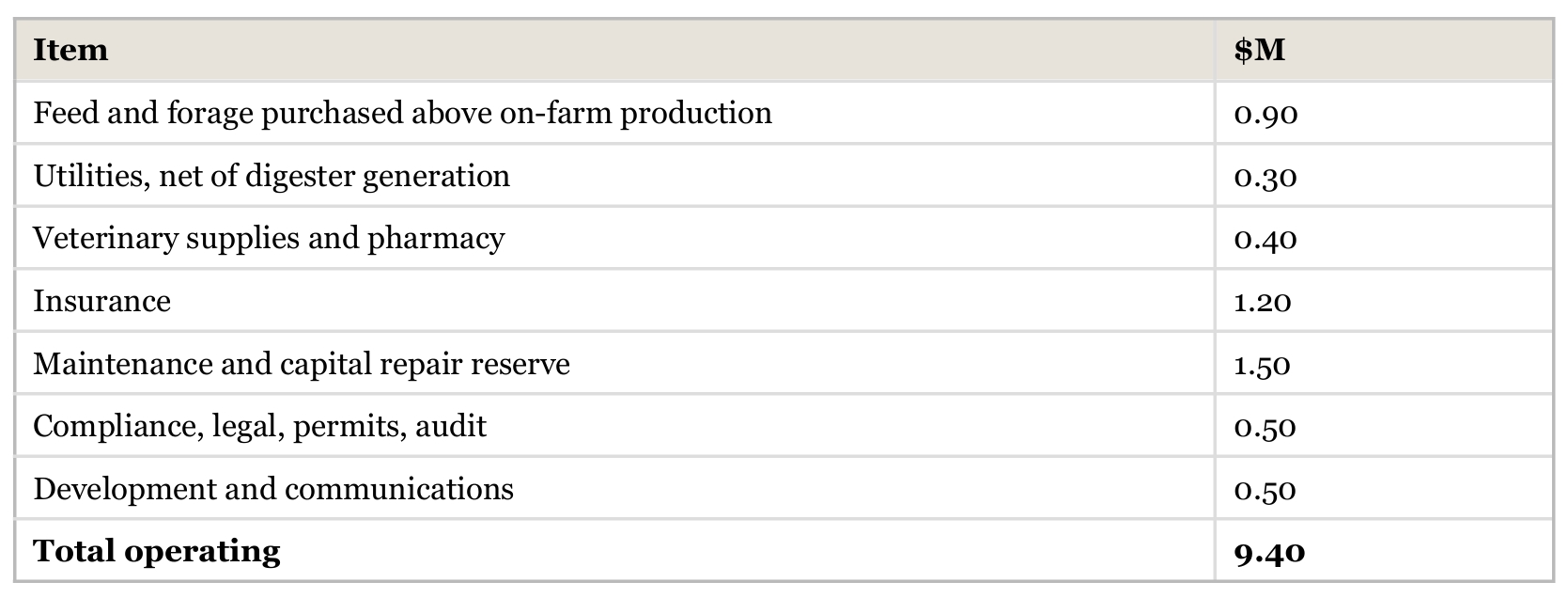
—
10.3 Projected earned revenue
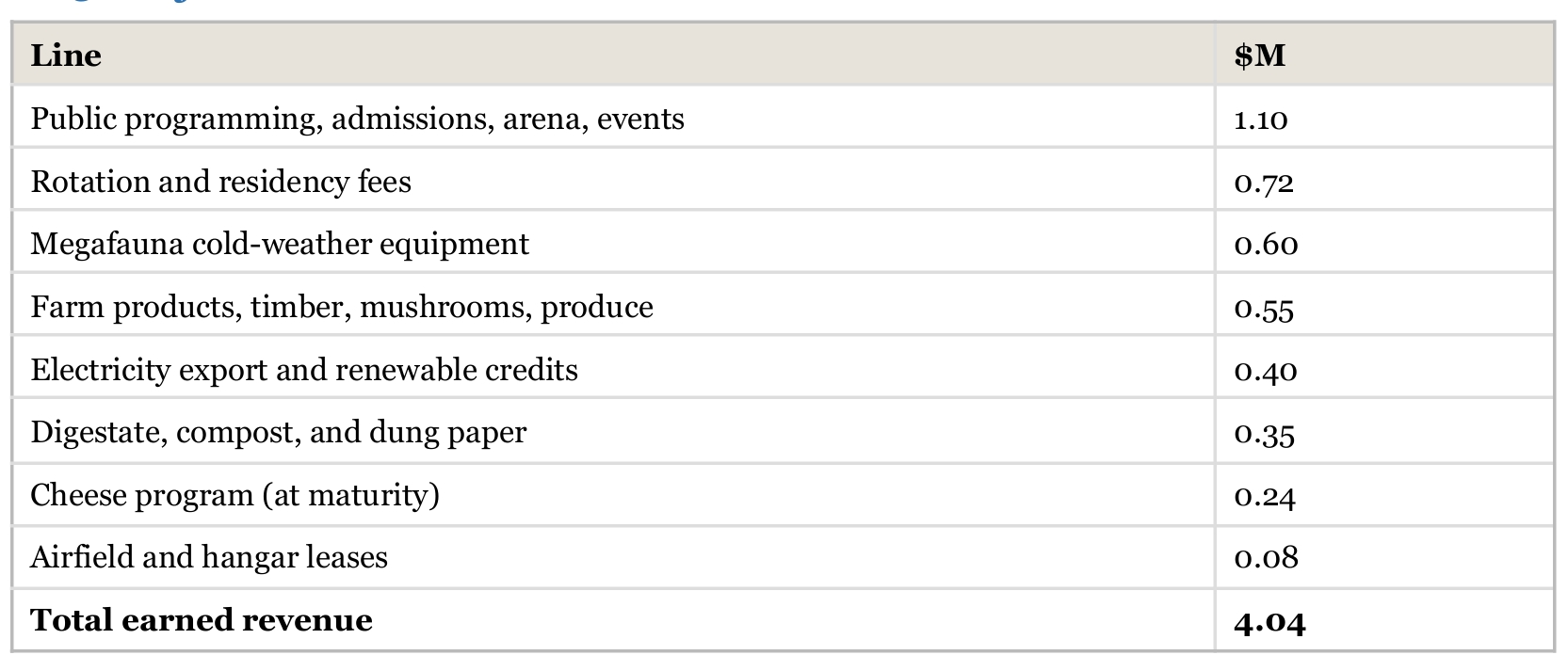
—
10.4 The honest conclusion about money
$150 million builds this facility. It does not run it.
The operating gap is approximately $5.4 million per year. Sustaining that in perpetuity requires an endowment on the order of $120 million at a 4.5 percent draw. The full campaign requirement is therefore closer to $270 million than to $150 million.
This is stated plainly and early because the most common way a project of this kind fails is that it is built and then cannot be operated — and a half-built or under-operated facility holding endangered megafauna is not a disappointment, it is a welfare emergency and an institutional scandal.
Three responses are available, and a serious donor conversation should choose among them explicitly:
Fund the full $270 million. Cleanest, and rarest.
Phase the build. Farm, veterinary station, and rhinoceros program in Phase One at roughly $85 million capital and $5 million operating; elephant program in Phase Two only when the endowment supports it. This is the recommended path. It also has the advantage that the institution earns its credibility with a smaller, less dangerous species before it acquires the largest land mammal on earth.
Build to a smaller program. Reduce to four elephants and six rhinoceros, drop the arena, and target an operating budget near $7 million.
Whichever is chosen, the endowment must be secured before the animals arrive. That sentence is the most important in this proposal.
11. RISKS AND FAILURE MODES
Permit denial or delay. The most probable failure, and the reason permits are pursued before construction. Mitigation: university affiliation and a credentialed scientific board secured first; site acquisition contingent where possible.
A human fatality. Low probability, catastrophic consequence, and the single event most likely to end the institution outright. Mitigation: no resident bull elephant; protected contact; two-person rule; rehearsed protocols; and a genuine near-miss reporting culture.
An animal welfare incident on video. Section 8.3 sets out what happened to SeaWorld. An institution that hosts the public around endangered megafauna is one viral clip from an existential problem, and the clip need not be accurate. Mitigation: conservative public-contact policy, refusal of the high-spectacle programming the founding concept contemplated, and radical transparency in husbandry records.
Operating shortfall. See 10.4. Mitigation: endowment before animals, phased build.
Key-person dependency. Megafauna programs live and die on a small number of experienced keepers and a curator. Mitigation: on-site housing, competitive compensation, deliberate succession planning, and the teaching program itself, which is a talent pipeline.
Disease. A single introduced pathogen — elephant endotheliotropic herpesvirus is the standing example — can end a herd. Mitigation: quarantine barn built first, rigorous biosecurity, and a working relationship with the diagnostic laboratory network.
Climate and infrastructure. Multi-day winter power failure in a heated elephant barn is a mortality event. Mitigation: digester CHP as primary generation, plus redundant diesel backup, plus fuel storage for seven days.
Community relations. A large exotic-animal institution in a small Vermont town will be litigated in the town meeting long before it is litigated in court. Mitigation: local hiring, an open-gate day, school programming, and a founder who attends town meeting.
12. GOVERNANCE AND OPEN-SOURCE INTENT
Governance: an independent board with veterinary, scientific, financial, and community members; a scientific advisory committee; an animal welfare committee with an unaffiliated member; annual external audit; and published husbandry and mortality data.
This document is released to the public domain deliberately. The author has no expectation of building it. It is published because the constituent ideas — the wing-plan house, the digester-to-barn heat loop, the engineered heated wallow, the elephant-dominant cheese blend, the megafauna cold-weather equipment line, and above all the permits-not-capital insight — are individually useful at every scale from a ten-acre homestead to a major zoological institution, and because a plan that sits in a drawer helps no one.
Anyone may take any part of it. The author asks nothing and reserves nothing.
—
APPENDIX A — MILK CHEMISTRY AND CHEESE PROCESS NOTES
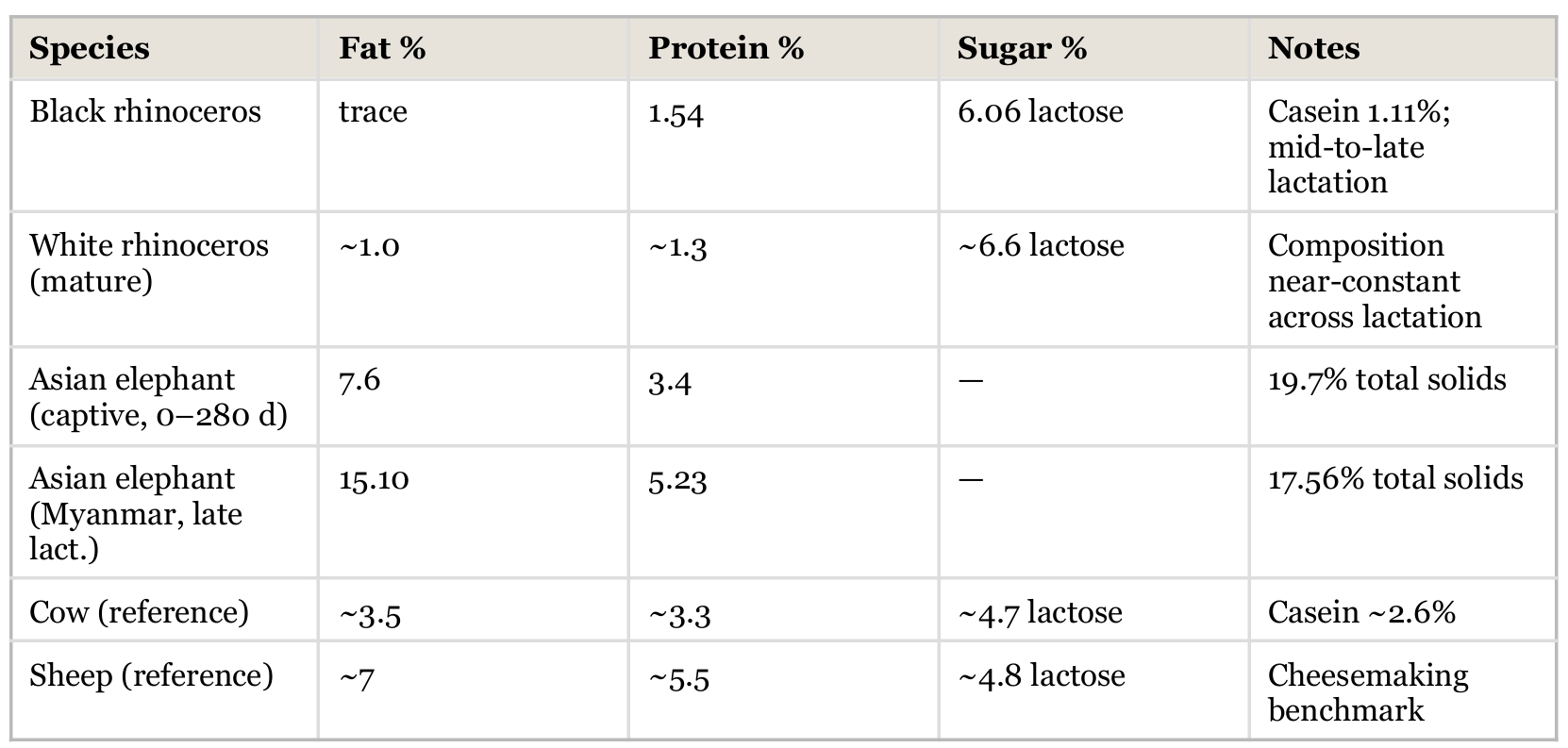
Process notes: target a 60:40 elephant-to-rhinoceros blend, yielding roughly 3.5 percent protein and 9 percent fat in the vat. Expect a sharp, tangy profile from the medium-chain fatty acid fraction. Verify lactose availability before inoculation; supplement if the donor cow is past mid-lactation. Precedent for a blended product marketed under the minority species: pule, at 60 percent donkey and 40 percent goat.
—
APPENDIX B — THE DOCUMENTED RECORD OF RHINOCEROS RIDING
1684, London. Indian rhinoceros landed by Captain Henry Udall of the Herbert; exhibited at the Bell Savage Inn, Ludgate Hill. Contemporary newsletter: admission twelve pence, rides two shillings, takings fifteen pounds per day. Roger North’s Lives of the Norths records a report that Francis North, Baron Guilford, rode the animal — possibly political mockery rather than fact.
22 October 1684. John Evelyn’s diary describes the same animal as tame, led by a ring in the nose in the manner of a buffalo, and able to rise as nimbly as a horse.
1987 onward, Imire, Zimbabwe. Seven orphaned black rhinoceros calves hand-reared on formula for eight years and managed as a semi-domesticated herd; fifteen births in under twenty years.
Contemporary husbandry literature. Operant conditioning is now standard practice for voluntary blood collection, foot care, and examination in all three commonly held species.
No sustained riding-under-saddle tradition, no war rhinoceros, and no bridle-and-bit control system appear anywhere in the record.
—
APPENDIX C — COLD-CLIMATE MEGAFAUNA NOTES
Documented cold injuries in northern collections: frostbitten ear margins and tail tips; foot pathology exacerbated by cold, wet standing surfaces; and rhinoceros skin cracking in dry winter air. Thermal mass is large and is not the problem; extremities are.
Design responses: radiant heated slab with engineered substrate over it; covered heated wallow continuous with an outdoor wallow; ear covers and tail sleeves; a standing emollient protocol for rhinoceros; humidity control in the barn to prevent condensation-driven respiratory disease; and seven days of backup generation fuel.
—
APPENDIX D — BALLISTIC MANURE DELIVERY: AN ENGINEERING NOTE
Included because the analysis is instructive and because the conclusion is not the one expected.
A trebuchet sized to distribute manure across a field is mechanically straightforward. At a 45-degree launch, required velocity is the square root of range times gravitational acceleration: roughly 38 metres per second for 150 metres, 31 metres per second for 100 metres.
The machine is not the problem. The projectile is. Manure has no structural integrity and a poor ballistic coefficient; a 50-kilogram charge at about 800 kilograms per cubic metre forms a sphere roughly half a metre across, which disintegrates within the first twenty metres of flight. It disintegrates unfavourably: the coarse fraction has the better sectional density and carries furthest, while the fine aerosolized fraction sheds velocity immediately and falls short — that is, onto the operator.
A frangible sabot solves this: a container that holds the charge through acceleration and opens at or shortly past apogee. Paper pulp or a net bag with a timed release will serve.
Accuracy is achievable. Trebuchets are range-repeatable when counterweight and projectile mass are fixed, which is why they functioned as siege weapons. The dominant variance source is projectile mass scatter, and manure density varies widely; a load cell on the loading cradle, charging each shot to a fixed mass, addresses it.
Throughput is where the concept fails. At a 15-ton-per-acre application rate, a 50-kilogram charge implies roughly 270 shots per acre. At two minutes per cycle — winch, load, weigh, aim, release — that is nine hours per acre, against ten acres per day for a conventional spreader. The trebuchet is fifty to ninety times slower.
The regulatory conclusion is the interesting one. The ideal projectile is frozen manure: coherent, dense, high ballistic coefficient, no disintegration, excellent repeatability. But Vermont’s Required Agricultural Practices ban spreading between December 15 and April 1 and separately prohibit application to frozen or snow-covered ground. The single condition under which the ballistics work is the single condition under which the act is unlawful.
The engineered form of the same ambition already exists and is legal: a traveling gun on an umbilical slurry system throws liquid manure in a controlled arc a couple of hundred feet, continuously, from the tractor seat.
Recommendation: build the trebuchet adjacent to the arena, load it with pumpkins, and charge admission. At one shot per hour with an audience as the product, the throughput constraint disappears.
—
APPENDIX E — PRINCIPAL SOURCES
Gregory, M.E. et al., composition of the milk of the African black rhinoceros (Diceros bicornis). · Osthoff, G. et al., white rhinoceros milk composition over lactation, and colostrum studies. · Oftedal, O.T. (1984) and AZA Nutrition Advisory Group, greater Indian rhinoceros hand-rearing formula evaluation. · Mainka, S.A. et al. (1994), Asian elephant milk composition, first 280 days, Zoo Biology. · Abbondanza, F.N., Power, M.L., Dickson, M.A., Brown, J. and Oftedal, O.T. (2013), variation in Asian elephant milk composition throughout lactation, Zoo Biology. · Milk composition of Asian elephants in a natural environment in Myanmar during late lactation, Animals (2020). · Stetter, M. and Hendrickson, D.A., laparoscopic surgery in the elephant and rhinoceros. · Fowler, M.E. and Hart, R. (1973), castration of an Asian elephant, JAVMA. · Effects of GnRH vaccination in African elephant bulls, PLOS ONE (2017). · Diamond, J. (1997), Guns, Germs, and Steel. · Chapman, A., “Want to buy a rhino? (1684),” compiling Evelyn’s diary, the London Gazette, and the Newdigate newsletters, with materials from the Rhino Resource Center. · Imire Rhino and Wildlife Conservation, conservation programme materials. · Vermont Agency of Agriculture, Food and Markets, Required Agricultural Practices and winter manure spreading ban. · International Olympic Committee financial reports, 2017–21 and 2024. · Boissat, L. et al., mapping the Blackfish effect, People and Nature.
Released to the public domain, CC0 1.0 Universal. Steven Sears Work, Multiverse Journal.
—