
Multiverse Journal - Index Number 2242: The Invisible Weapon, Covert Aggression, Institutional Blindness, and the Architecture of Male Destruction
Journal across Realities, Time, Space, Soul-States.

YouTube Mirror: https://www.youtube.com/watch?v=qYxpU0su25c
Edits: {none yet}
—
—
Short 9 minute overview
—
June 26th, 2026
Good Friday,
May the Spirit of the Gospel and the Holy Word be Always on our Tongues, in our Hearts, Minds, and in our Hands. Holy Virgin Mother Mary and All Saints - Pray for us!
—
Index Number 2242:
— —
May this article find us all ever closer to God, and His Justice.
In the last two months I have tried to write this Article over and over again, but each time I become lost in that 4 year Blur of Pain, or unable to communicate the kind of young man that overflowed with Joy of Life, and desire to share time with others, the drive to give life meaning by serving and helping others, and how that was murdered, but I can’t seem to create a good enough version to do - maybe - the impossible. To draw multilevel dimensions of living singing images and then the grave-yard they became. And more.
So instead I decide to use Claude AI to do the basics that I outlined, and I hope to add those living signing images I sumetimes remember clearly with geiving sadness.
Let’s call this a draft version 6. Changes should include updated audio overview and better more full expansion where needed.
God Bless., Steve
—
—
There is a kind of knowledge that arrives too late to be useful the moments but arrives exactly in God’s time to be a service for everyone who comes after.
If 40 years ago I had the clarity of what I now understand - Seeing the kind of evil that feeds off endless suffering that the Coven in the center of those 4 years of Hell caused, to feed my mutilated soul’s suffering and torture to engorge the demonic they served, all while systematically they murdered my Joy and Love of Life, of work I was born to do, dying more each day as pain replaced God’s Special Gift I was Blessed with .. well, you wouldn’t be reading this because I would have traded my life to remove them, to prevent countless others they likely drove to suicide or other seemingly ‘senseless’ workplace killings and suicide that almost all of us non-possessed demonic minions assume the worst - since the late 1950s the Charity that true faith in Christ Blessed our ancestors with has died with unborn tortured babies and ‘thrown-away’ loved ones and families - traded for bigger brighter soul-crippling worldly dead things we can’t take to Hell with us - even - except as torments ..
.. assuming bad intensions of others - and even ourselves - in Loveless Lifeless deeper Satanic enslavement. How many could even consider that maybe even only one of those ‘senseless’ school or workplace killings and suicides might have been the last act of a young man tortured for years in covert coordinated torment and gaslighting, in ever greater confusing isolation as other help the Covent torture them for the Sadistic pleasure of a post birth abortion, torturing to death another God Blessing to the world that escaped the unborn murder a similar Coven failed to arrange, to replace him with another of those voids where our brothers, our life-long friends, our caring loving sacrificing mentors, our true loves, our intended ‘One-Flesh’ soul completer, our never conceived children’s other parent, .. you must have felt the voids where they should be pouring out endless love and sharing Joy of Life with us?
So, along with all those that should be joined in a Meaningful existence with us, we never had that Holy Charity Blessing of assumed Good intensions that our childhood was supposed to be filled with, and so blind to the concept of the dying sacrifice(s) of those that Defend and Protect us and our loved ones from the risk of being tortured endlessly here and after suicide - in Hell to Feed those demons that Chew and Chew the souls that scream delicious many-colored flavors of soul despair and horror juices?
God had prevented the Clarity that would have Called to my deepest Masculine Being to remove the threat of others suffering what they did to me and likely many before - some to Death and Hell. And I hope to God you have enough soul left that you would do similar. Would you? Or you less than a pile of dust and salt, unable to find Masculine Love that calls to Death in Service to Man and God?
That fate was not God’s Will for me. Instead, He blessed me with decades of seemingly senseless confused isolation and different ‘flavors’ of Suffering - And strengthened me by them. Jesus Christ as the Holy GoldSmith, using His Anvil of Creation, the Hammer of Satan, the Fires of Purgatory, the Quenching of His Blood and Tears, .. all towards Betterment - as all our Blessed Sufferings are for.
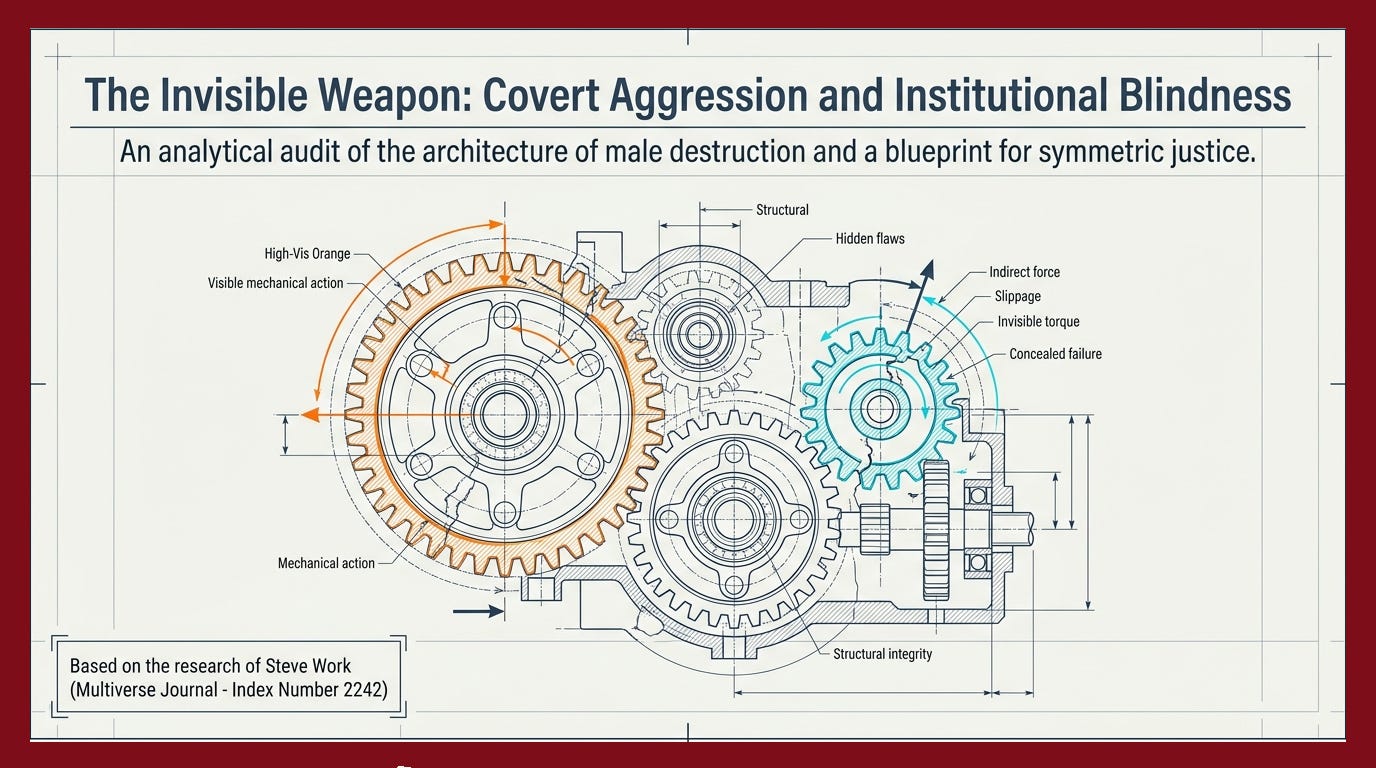
Forty years ago, something was done to me that I could not name, could not prove, could not explain — not to anyone who might have helped, not even to myself. A coordinated, sustained, invisible campaign of professional and social destruction, carried out in a university research department by people who smiled at me in the hallway and said nothing to my face while systematically dismantling every professional relationship, every reputation, every future that two years of recognized, productive work had built. I got away eventually. I survived. I carried what was left of myself into the next chapter and the chapter after that, not understanding what had happened, not having any framework for it, not knowing there was a word for it.
The word is mobbing.
I learned it decades later, in a research context, as casually as one might learn the name of a geological formation one has been living inside for years. And with the name came the recognition — the sudden, vertiginous, nauseating recognition of a person who has just seen the blueprint of the trap they were held in, and spent decades climbing out of. What Heinz Leymann documented in Scandinavian workplaces in the 1980s — the coordinated, sustained, psychologically lethal targeting of individuals through covert social aggression — was not a European peculiarity. It was what happened to me. It produced, as Leymann’s clinical research predicted it would, damage equivalent to post-traumatic stress disorder. It followed me, in the form of reputational whisper networks that preceded me into subsequent employment, for years beyond the event itself.
I am writing about it now because the name matters — because knowledge that arrives late is still knowledge, and because what was done to me is being done, right now, to men in every institution in the Western world, by the same mechanisms, with the same invisibility, and with increasing institutional protection for the people doing it. I am writing about it now because I have spent the years months since learning the name assembling the research that explains not only what happened in that department but why no one in any of the institutions around me — the HR office, the professional networks, the legal framework, the social conventions of the culture — had any mechanism to see it, name it, address it, or stop it.
What I found in that research should alarm anyone who cares about justice, about men, about the civilization that men built and that is now, quietly and systematically, being turned against them.
—
This essay is long. It had to be. The argument requires assembling pieces that have been kept deliberately separate — in different research disciplines, in different policy domains, in different cultural conversations — because their assembly produces a conclusion that the institutional culture of our time is structurally incapable of endorsing. The conclusion is this:
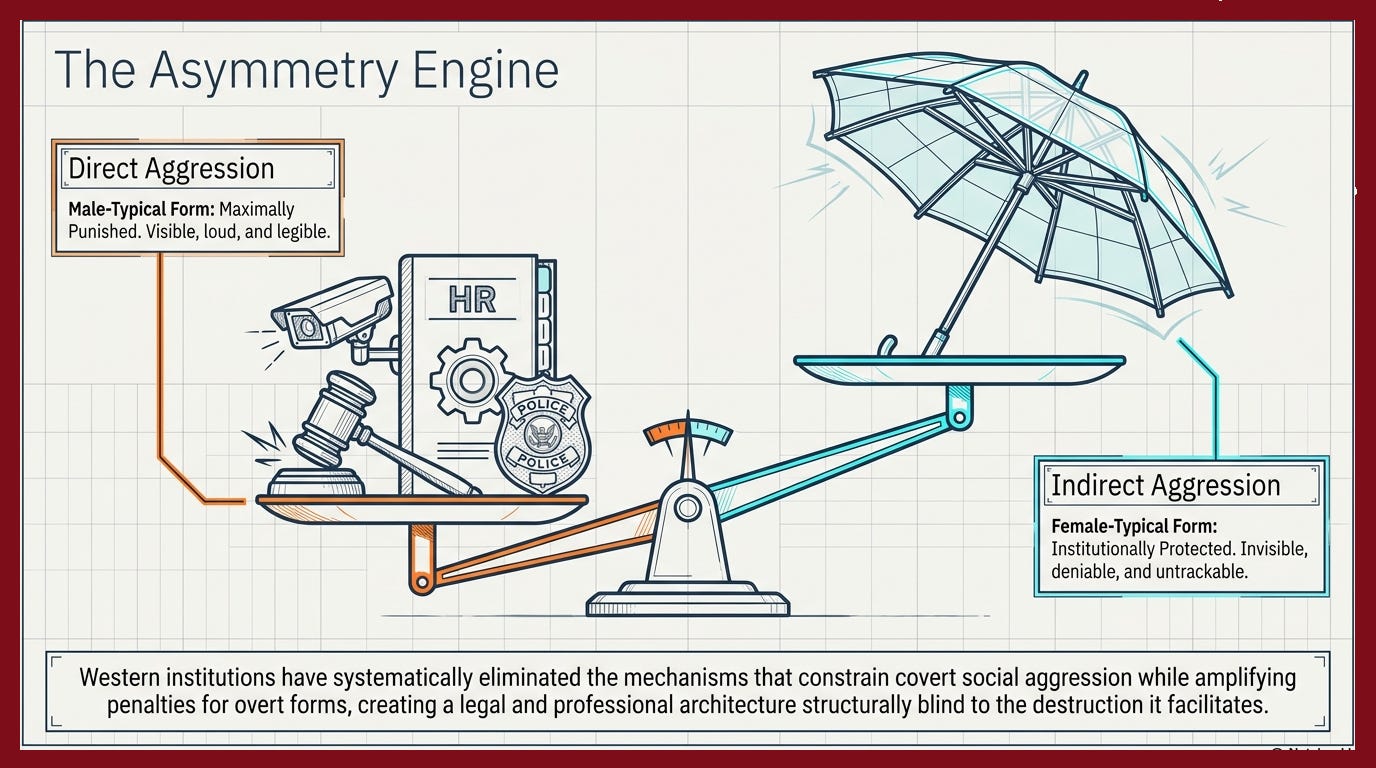
Western institutions have systematically eliminated the visibility and accountability mechanisms that historically constrained covert forms of social aggression, while simultaneously amplifying the visibility and penalties for overt forms. This asymmetry maps closely onto documented sex differences in aggression modality — the research on which goes back to 1969 and has been consistently replicated for fifty-five years — creating an institutional environment that is structurally protective of female-typical aggression and maximally punitive of male-typical aggression. The downstream consequences include destroyed lives of male targets with no legal recourse, a subpopulation of catastrophically damaged men whose grievances are both real and invisible to every institutional mechanism designed to address them, and periodic extreme violence events that are explained entirely through the perpetrator’s pathology rather than the social conditions that systematically produced him.
—
Thomas Aquinas, in the Summa Theologica, ranked the covert destruction of a man’s reputation as a graver sin than theft — more serious than taking his money or his property — because a man’s good name is more akin to spiritual goods than to material ones, and because its destruction operates, as he carefully noted, like a crafty blow in the dark: the injury of robbery delivered by the methods of theft. The tradition has known this for eight hundred years.
The contemporary institutional apparatus — the HR department, the Title IX office, the NIH peer review exclusion policy, the Ghomeshi amendments to the Canadian Criminal Code — has been constructed as though Aquinas never wrote, as though Proverbs 22:1 was never inscribed, as though Shakespeare never put into Iago’s mouth the most precise description of the weapon this essay is naming: the filching of a good name that robs the victim of that which not enriches the thief, and makes him poor indeed.
What follows is an attempt to name it — completely, precisely, with the research citations that ground it and the personal testimony that authenticates it. It is written in the tradition of this journal: without apology for the conclusions the evidence demands, without the self-censorship that the institutional apparatus has been constructed to impose, and without the pretense that the people building that apparatus do not know what they are doing.
They know. That is what makes it evil.
ABSTRACT
Western institutions have systematically eliminated the accountability mechanisms that historically constrained covert forms of social aggression, while simultaneously amplifying penalties for overt forms. This asymmetry maps closely onto documented sex differences in aggression modality, creating an institutional environment structurally protective of female-typical aggression and maximally punitive of male-typical aggression. The downstream consequences include destroyed lives of male targets with no legal recourse, a subpopulation of catastrophically damaged men whose grievances are both real and invisible to institutional mechanisms, and periodic extreme violence events explained entirely through perpetrator pathology rather than the social conditions that produced them. Drawing on peer-reviewed research in aggression science, occupational psychology, neuroscience, criminology, and the sociology of science, this essay argues for recognition of covert mobbing as a category of serious institutional harm, symmetric application of existing non-discrimination frameworks, and urgent research into the suppressed connection between coordinated covert aggression and mass violence outcomes.
—
I. A MOTHER’S RAGE, AND WHAT THE NEUROSCIENTISTS KNOW
A mother I know — a serious woman, the kind who reads before she argues — discovered something about her teenage son that unsettled her profoundly, and then discovered something about the institutions surrounding him that enraged her.
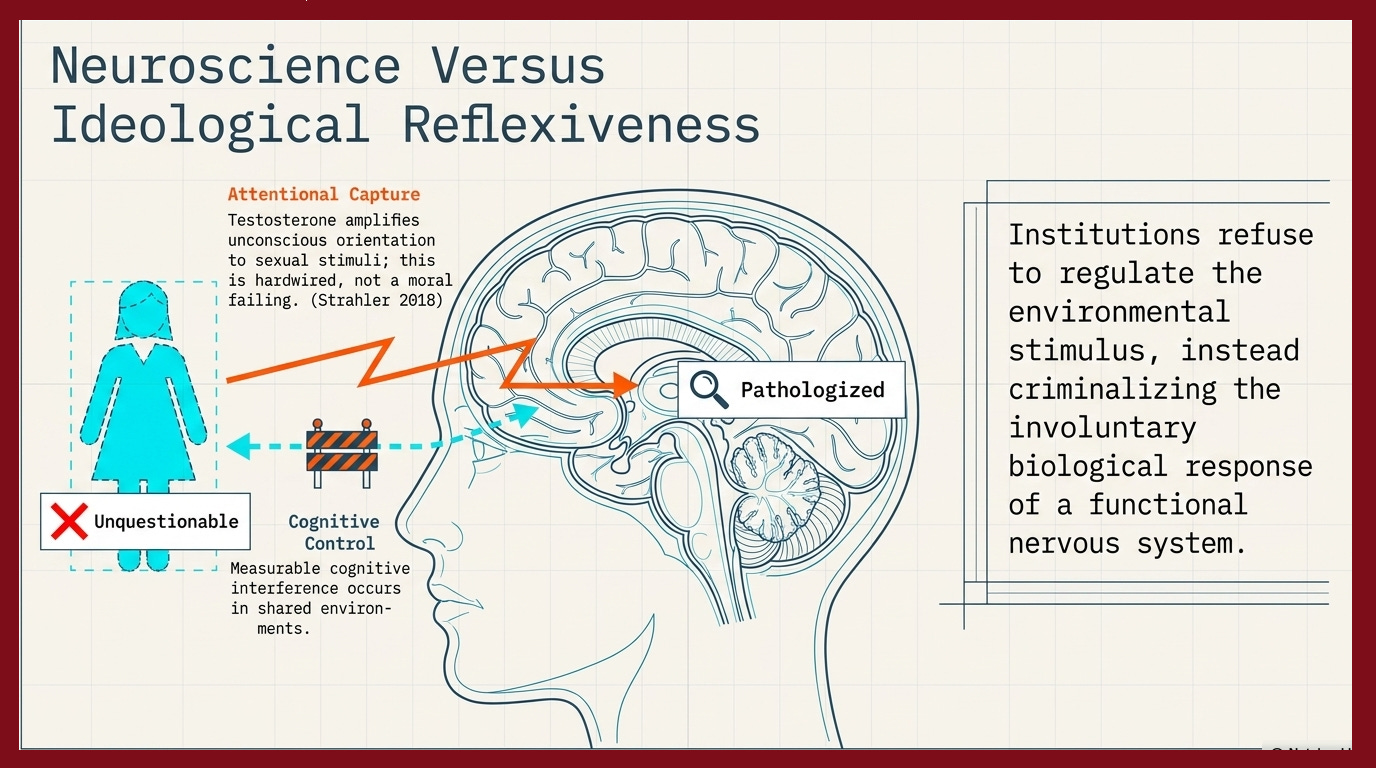
Her son was failing to concentrate in class. Not from laziness, not from any learning disorder, not from the digital distractions that education administrators blame with comfortable reflexiveness. When she and her husband finally got the full story out of him — and it took time, because teenage boys are not built for this kind of confession — it was simpler and more awkward than any of that: he could not stop looking. Several of his female classmates wore yoga pants that left nothing to anatomical imagination, tops that did the same, and they made no effort to position themselves differently when a male classmate sat beside them. He was sixteen, flooded with testosterone, seated in a mathematics classroom beside stimuli that his nervous system was not constructed to ignore.
His mother went to the school administrator prepared to discuss the problem in practical terms: shared learning environment, physiological reality, equitable conditions for academic concentration. The administrator’s response stopped her cold. The problem, she was informed, was her son. He needed to learn to control his eyes and his thoughts. That was the institution’s answer: the cognitive interference was his fault, his failure, his problem to solve through an act of will that the peer-reviewed neuroscience says adolescent males in that physiological state cannot reliably perform.
The neuroscience is not ambiguous on this point. Sexual arousal involves both involuntary and voluntary attentional processes, and the involuntary component — the rapid, automatic, unconscious orientation toward sexual stimuli — is not a moral failing subject to correction by sufficient character. It is a hardwired attentional mechanism. Researchers who have placed men and women in neuroimaging machines while having them perform cognitive tasks next to sexual versus neutral images have measured the neural correlates of that interference directly. The finding is consistent: sexual stimuli capture male attention involuntarily, and that capture measurably interferes with cognitive performance.¹ Lower thresholds for sexual arousal are associated with a greater bias to attend to sexual information, and testosterone amplifies attention to relevant stimuli — precisely at the developmental stage in question.²
Adolescent males are at peak testosterone. The attentional capture by sexual stimuli is not voluntary, is not controllable by willpower alone, and is physiologically amplified precisely at the age being discussed. Telling a sixteen-year-old boy to stop being distracted by the girl beside him is roughly equivalent to telling a person with a car alarm in the room to stop noticing the noise through moral effort. The neuroscience says that is not how involuntary attentional capture works.
The administrator’s response was not medical ignorance. It was ideological reflexiveness: an institutional posture so thoroughly committed to the principle that female presentation cannot be interrogated that it was willing to pathologize a boy’s normal nervous system rather than acknowledge the stimulus his classmates were generating. The question — who is responsible for the conditions of a shared learning environment? — was not engaged. It was refused.
I begin here because this small, specific, documentable injustice is a clean window into a much larger architecture. The mother’s son is a minor figure in a pattern that extends from middle school classrooms through university research departments and into the corridors of federal funding agencies. The architecture is always the same: female-typical behaviors are treated as environmentally neutral or institutionally protected; male-typical responses to those behaviors are treated as the problem requiring remedy. The asymmetry is so thoroughly embedded in contemporary institutional culture that most people who operate within it cannot see it at all.
This essay is an attempt to make it visible.
—
II. TWO KINDS OF AGGRESSION, ONE KIND OF REMEDY
Begin with a finding that has been replicated across cultures, age groups, and research methodologies for more than five decades, and that almost no one outside the specialist literature discusses in plain language.
Men and women are both aggressive. The popular claim that women are the less aggressive sex is substantially misleading, and has been known to require fundamental revision since 1969, when psychologist Norma Feshbach published the first systematic documentation of sex differences in aggression mode — finding that girls relied predominantly on indirect forms that existing research had not been measuring.³ Two decades later, Finnish researchers Kirsti Lagerspetz and Kaj Björkqvist built the measurement tools and cross-cultural evidence base that confirmed and extended Feshbach’s finding across age groups and societies.⁴ American researchers Nicki Crick and Jennifer Grotpeter introduced the parallel concept of ‘relational aggression’ in 1995.⁵ What the full body of research established is not that women and men are equally aggressive in total — the data on that is mixed — but that the forms differ profoundly, and that the form female aggression predominantly takes is specifically designed to evade detection.
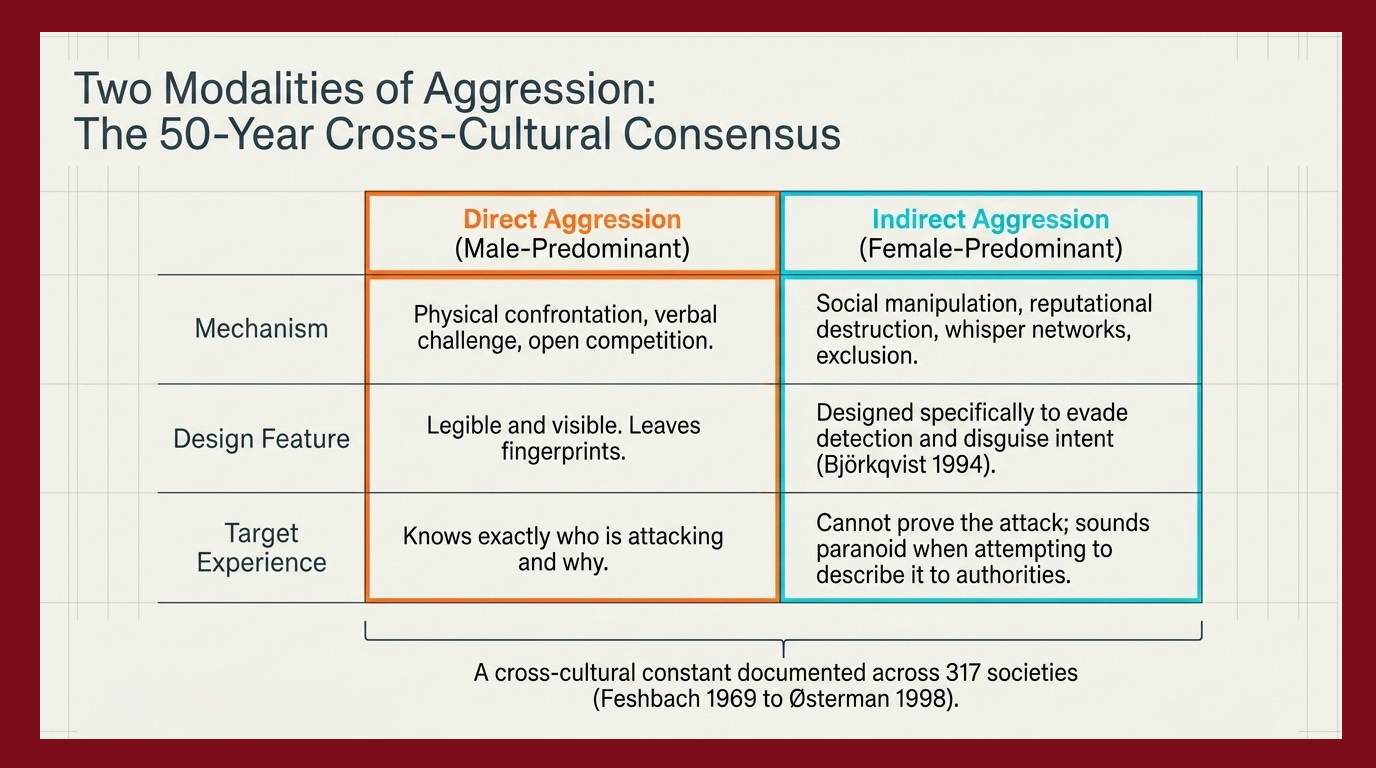
Male aggression is predominantly direct: physical confrontation, verbal challenge, open competition for status. It is visible, loud, and legible. When it occurs in a school or workplace it can be identified, reported, witnessed, and documented. The person on the receiving end knows exactly what is happening and who is doing it.
Female aggression is predominantly indirect: social manipulation, reputational destruction, exclusion, rumor, the withdrawal of alliance, the construction of hostile social environments through networks of whisper and insinuation. Björkqvist and colleagues documented this across 317 societies in a cross-cultural survey.⁶ It is not a cultural artifact — it is a cross-cultural constant.
And it has a specific operational feature that direct aggression does not: it is designed to be invisible. The perpetrator’s intentions are disguised. The aggression operates through social channels that leave no fingerprints. The target typically cannot identify what is happening, cannot prove it, and — crucially — when they describe it, sounds paranoid. Björkqvist noted this explicitly: ‘since indirect means of aggression are used exactly in order to cover one’s harmful intentions, self-reports of indirect aggression are not likely to be honest.’⁷ The measurement challenge is itself a documentation of the weapon’s design.
This is not a coincidence. The disguise function is not incidental to indirect aggression; it is the point. Indirect aggression is the evolved form of attack that works precisely because it cannot be directly attributed, directly confronted, or directly addressed. Where direct aggression invites a response in kind — and historically, a calibrated response in kind was one of the primary mechanisms by which direct aggression was regulated and bounded — indirect aggression has no equivalent corrective available to its targets. You cannot punch a whisper.
The workplace data confirms the sex-of-perpetrator pattern in institutional settings. In academic science specifically, female perpetrators engage in a significantly higher frequency of abusive behaviors than male perpetrators according to their targets.⁸ And females experience more indirect bullying from female supervisors while males experience more direct bullying from male supervisors — meaning a male target in a female-dominated academic environment will experience predominantly indirect aggression: the exact form that leaves no fingerprints, makes the victim sound paranoid when he describes it, and that the institutional apparatus is structurally blind to.
What you could once do — and what the institutions of the past several decades have systematically dismantled — is maintain a social culture in which certain norms of open dealing were enforced through the credible threat of direct response. The honor cultures that sociologists Nisbett and Cohen documented in their landmark 1996 study were not primarily cultures of violence. They were cultures of deterrence.⁹ The fistfight that settled a dispute over a real offense was not celebrated because violence is desirable. It was tolerated — within understood limits, for understood reasons — because the possibility of it kept the space between people honest. That regulatory framework had real costs. It also had real benefits that are almost never acknowledged: the visible, regulated, consequence-bearing form of conflict it governed was precisely the form that institutional machinery could later address, if address was needed.
What replaced it — the therapeutic model, the HR complaint, the mandatory anger management — was built to address direct aggression. It is structurally blind to the indirect kind.
The result, entirely predictable from the structure, is an institutional environment that functions as a one-way ratchet: it has mechanisms for addressing the aggression men are more likely to commit, and no mechanisms for addressing the aggression women are more likely to commit. This is not a conspiracy. It is a design failure of enormous consequence.
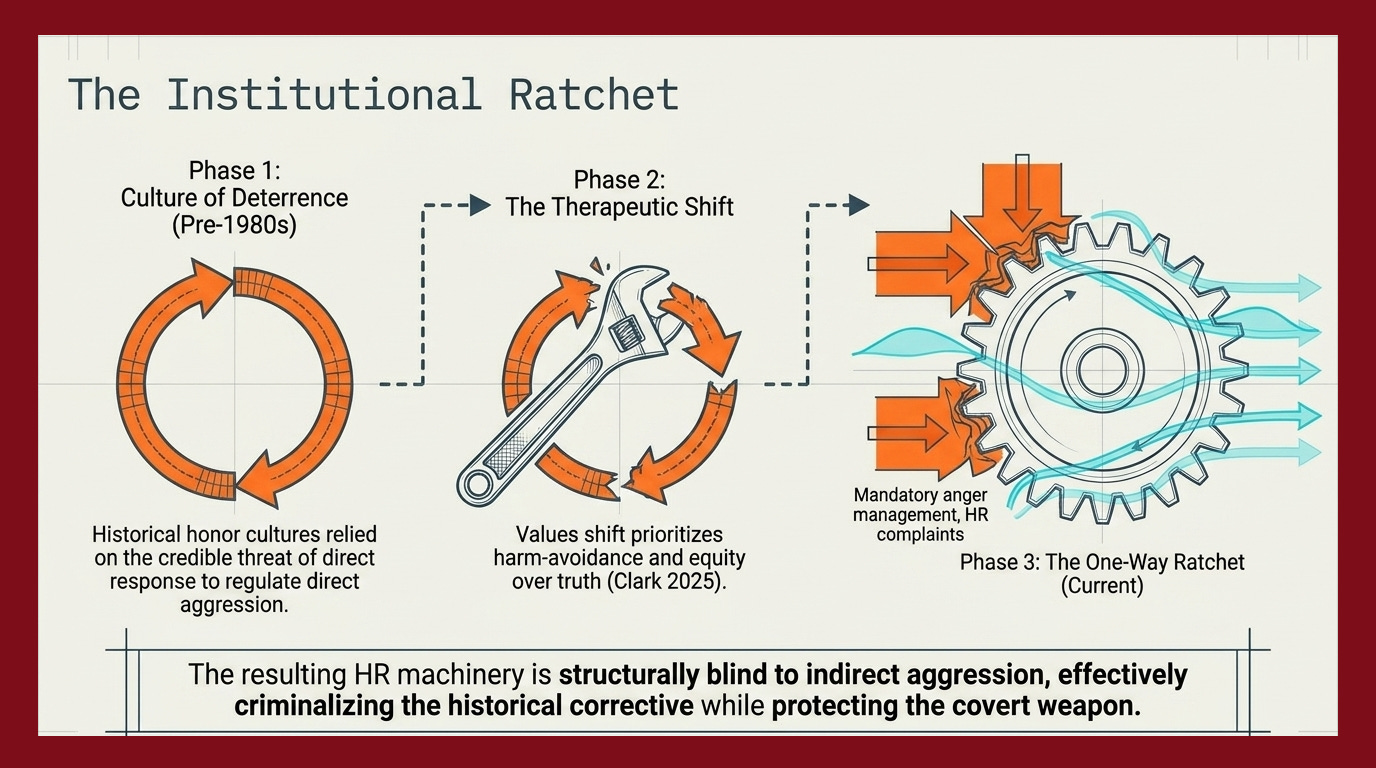
It is also, as Cory Clark’s 2025 research documents across multiple independent samples of academics, the predictable institutional output of a systematic demographic and value shift.¹⁰ Clark’s data — published in the Journal of Controversial Ideas in its special issue on censorship in the sciences — shows that female academics, compared to male academics, show systematically higher preference for equity over truth, harm-avoidance over academic freedom, and social exclusion as conflict resolution. The institutional machinery built around these values is precisely the machinery that protects covert aggression while criminalizing the honor-culture responses that historically constrained it. The suppression of covert mobbing as a recognized category of harm is not a research oversight. It is a predictable output of the same value system that told a mother her son was the problem for having a functional nervous system.
—
III. WHAT LEYMANN FOUND, AND WHY AMERICA DID NOT LISTEN
In the 1980s, Swedish psychologist Heinz Leymann began documenting something in Scandinavian workplaces that he eventually named ‘mobbing’ — the systematic, coordinated, sustained targeting of an individual through psychological rather than physical means. He was borrowing the term from ethologist Konrad Lorenz, who had used it to describe the behavior of animal groups that collectively drive a threat away from the pack. What Leymann found in human workplaces was functionally identical: a target, surrounded by colleagues, subjected to a sustained campaign of isolation, rumor, exclusion, professional sabotage, and social destruction — not through any single dramatic act but through the accumulation of small, individually deniable behaviors, coordinated across participants, over periods of months or years.
Leymann’s definition was precise: mobbing requires negative behaviors directed at a target at least once a week for a period of at least six months.¹¹ That threshold is important because it distinguishes mobbing from ordinary workplace conflict, ordinary social friction, even ordinary bullying. Six months of coordinated weekly targeting is not an interpersonal dispute that got out of hand. It is a sustained campaign.
Leymann’s clinical research, conducted at the Swedish National Institute of Occupational Health and later at rehabilitation centers for mobbing victims, found something that should have produced a revolution in how Western institutions understand psychological injury: the health profiles of mobbing victims, assessed through structured psychiatric interviews, matched the diagnostic criteria for post-traumatic stress disorder.¹² Not stress. Not depression. PTSD — the same diagnostic category applied to combat veterans and survivors of violent crime. A meta-analysis aggregating data from over 115,000 participants across 65 cross-sectional studies subsequently reported a correlation of r = 0.28 between workplace bullying exposure and depressive symptoms, with longitudinal analyses indicating prospective causal effects.¹³
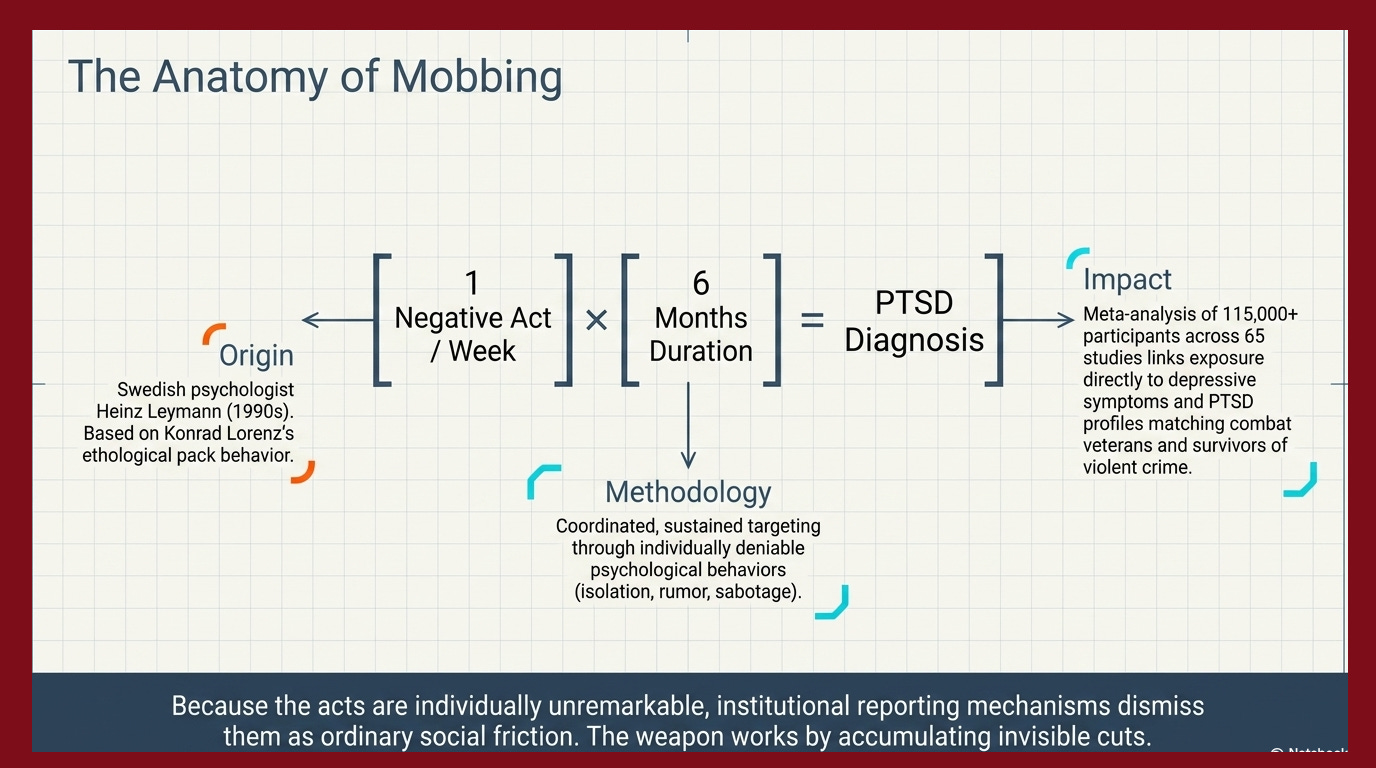
American research largely did not follow. Leymann’s work was taken up extensively in Scandinavia, Germany, and eventually across Europe, where it generated legal frameworks, clinical protocols, and institutional policies. In the United States it remained a specialty concern, known to a small community of organizational psychologists and occupational health researchers, largely absent from the public conversation about workplace harm and almost entirely absent from the institutional machinery built to address it. HR departments were not trained to recognize it. Legal frameworks did not name it. Therapists treating the victims often did not know the concept.
This matters for reasons that go beyond clinical classification. When a target of sustained covert mobbing — invisible by design, deniable at every step — attempts to report it, to explain it, to seek remedy, they encounter a wall of institutional incomprehension that compounds the original injury. They sound paranoid. The behaviors they describe are individually unremarkable. The pattern they perceive can be dismissed as the cognitive distortions of someone under stress. The more desperate and specific they become, the worse they sound. The institution designed to protect workers from harm has no framework for what happened to them.
I know this from the inside. Two years of recognized, productive work in a university research department. Then a sudden, coordinated, invisible campaign of social and professional destruction that I could not name, could not prove, could not explain — not to HR, not to colleagues, not to friends, not to myself. Four years of methodical demolition followed by forty years of what I can only call the aftershock: reputational damage that traveled with me, whispered networks that preceded me, professional consequence that I understood only in retrospect, decades later, when I finally encountered the word ‘mobbing’ in a research context and recognized, with the shock of naming the previously nameless, exactly what had been done.
The name does not restore what was taken. But it does something that matters: it moves the experience from the category of personal pathology — paranoia, bitterness, failure to adapt — into the category of documented, researched, clinically recognized harm. It means the forty years of aftershock were not a character defect. They were the predictable long-term sequelae of PTSD-equivalent injury inflicted by a method so well-designed for institutional invisibility that the institution could not see it even when the victim was standing in front of them, trying to describe it.
And it raises a question that should be asked loudly in the public discourse about workplace harm: if the research on mobbing is real — if it produces PTSD-level damage, destroys careers and reputations over years and decades, and operates through mechanisms specifically designed to evade every institutional remedy we have built — why is it so poorly known? Why does the vocabulary that fills our public conversation (harassment, bullying, toxic masculinity, hostile work environment) so thoroughly capture the direct, visible, attributable forms of workplace harm while leaving the indirect, invisible, coordinated form nearly unnamed?
The answer follows directly from Clark’s documented institutional transformation: the suppression of mobbing as a recognized category of institutional injury is the predictable output of a value system that protects the harm women are more likely to commit while identifying and punishing the harm men are more likely to commit.
—
IV. WHAT THE WISE HAVE ALWAYS KNOWN — THE TRADITION ON REPUTATION
Before examining the architecture of the legal asymmetry in detail, it is worth pausing on something that the research literature, by its nature, largely omits: the weight that the entire Western philosophical, theological, and literary tradition places on a man’s good name — and the gravity it assigns to those who destroy it.
The foundation is scriptural. Proverbs 22:1 states plainly: ‘A good name is more desirable than great riches; to be esteemed is better than silver or gold.’ This is not sentiment. In the ancient world, as in the traditional communities that preserved masculine honor culture through the twentieth century, reputation was the currency through which a man participated in social and economic life. It was not merely how others thought of him — it was the accumulated capital of a lifetime of conduct, and it was the condition of everything else he might accomplish.
Thomas Aquinas, drawing on this scriptural foundation in the Summa Theologica (II-II, Q.73), made the moral classification explicit. He argued that a man’s good name takes precedence of wealth because it is more akin to spiritual goods, and concluded: ‘backbiting according to its genus is a more grievous sin than theft.’ This is a stronger claim than modern readers generally appreciate. Theft — the taking of material property — was in Aquinas’s moral taxonomy a serious sin. He ranked the covert destruction of reputation above it. The reasoning follows from his understanding of what a man’s good name actually is: not vanity, not social currency, but a form of justice owed to him, the social recognition of his real moral character. To destroy it covertly is to rob him of something more essential than money, while leaving the crime invisible.
Aquinas’s distinction between overt and covert verbal injury is striking in the present context. He wrote that just as one man injures another by deed in two ways — openly, as by robbery, and secretly, as by theft or by a crafty blow — so again one man injures another by words in two ways: openly, as by reviling, and secretly, as by backbiting. The covert verbal form, he argued, aims at depreciating the target’s reputation and seeks to do so secretly. It is not merely that the covert form is sneaky. In Aquinas’s analysis it is a distinct species of injustice — the crafty blow — and its gravity is not diminished by its hiddenness. On the contrary: done maliciously and deliberately, it constitutes mortal sin.
The Catholic Catechism, codifying this tradition, states: ‘Honor is the social witness given to human dignity, and everyone enjoys a natural right to the honor of his name and reputation and to respect. Thus, detraction and calumny offend against the virtues of justice and charity.’ A natural right — not a privilege, not a social convention, but a right rooted in human dignity that no institution and no mob has legitimate authority to take away.
Cicero, writing two centuries before Christ in De Officiis — the foundational text of Western political ethics — made the practical consequence clear: ‘Take from a man his reputation for probity, and the more shrewd and clever he is, the more hated and mistrusted he becomes.’ This observation cuts in both directions. It is a warning about what reputational destruction does to its victim. But it is also, read carefully, an observation about what it does to the social fabric: a man stripped of his reputation for probity cannot participate in civic and commercial life without being met with suspicion. The destruction of one man’s reputation is therefore also an attack on the community that needs trustworthy participants.
Shakespeare, who understood the mechanics of reputation and its destruction better than any writer in the language, gave the definitive formulation to Iago in Othello — with the irony that the speech is made by the play’s villain, who is at that moment in the act of weaponizing reputation for his own purposes: ‘Good name in man and woman, dear my lord, Is the immediate jewel of their souls: Who steals my purse steals trash; ‘tis something, nothing; ‘Twas mine, ‘tis his, and has been slave to thousands; But he that filches from me my good name Robs me of that which not enriches him, And makes me poor indeed.’ The irony deepens the truth. Iago knows exactly what he is taking. He knows that what he steals ‘not enriches him’ — the false accuser and the gossip gain nothing of equal value to what they destroy. The impoverishment is one-directional, total, and irreversible.
From Richard II, Shakespeare adds: ‘The purest treasure mortal times afford is spotless reputation; that away, Men are but gilded loam or painted clay.’ Strip a man of his reputation and what remains is the appearance of a man — the biological form without the social substance. This is not hyperbole. It is a precise description of what coordinated covert mobbing accomplishes: the target continues to exist, continues to go through the motions of professional and social life, but the substance has been taken. He is gilded loam. He moves through a world that has been quietly told not to trust him, not to hire him, not to associate with him — while he does not know why.
Charles Caleb Colton, writing in 1824, observed with particular precision: ‘The two most precious things this side of the grave are our reputation and our life. But it is to be lamented that the most contemptible whisper may deprive us of the one, and the weakest weapon of the other.’ The contemptible whisper. Not the open accusation, which can be answered. Not the formal charge, which has a legal procedure. The whisper — the covert, deniable, uncatchable, institutionally invisible weapon that the entire apparatus of contemporary institutional culture has been structured to protect.
Thomas Paine made the theological dimension explicit: ‘Reputation is what men and women think of us; character is what God and angels know of us.’ The destruction of a man’s reputation is therefore not only a crime against him. It is a specific form of false witness — the substitution of a fabricated social reality for the truth that God knows. In the Catholic theological tradition, this is not merely metaphor. It is the Eighth Commandment: ‘You shall not bear false witness against your neighbor.’ The traditional catechetical application of this commandment extends beyond formal legal testimony to all forms of calumny, detraction, and the covert destruction of reputation.
Victor Hugo, in Les Misérables, stated the social truth flatly: ‘Whether true or false, what is said about men often has as much influence on their lives, and particularly on their destinies, as what they do.’ The injustice is not merely that reputational destruction hurts. It is that it operates independently of truth. The false whisper and the true accusation produce the same social effects. The man who is destroyed by lies ends up in the same position as the man who is destroyed by facts — unemployable, untrusted, socially excluded — while the institution of truth, the mechanism by which lies could be distinguished from facts, has been systematically dismantled in the name of protecting accusers.
Benjamin Franklin observed: ‘It takes many good deeds to build a good reputation, and only one bad one to lose it.’ The asymmetry he described is the normal human condition, independent of any malicious campaign. In the context of coordinated covert mobbing — where the ‘one bad deed’ is fabricated, exaggerated, or simply invented and then whispered into every professional context the target inhabits — the asymmetry becomes catastrophic and permanent. Franklin’s observation assumes that the bad deed at least happened. The covert mobbing campaign operates on the same asymmetry while removing even that minimal constraint.
Saint Philip Neri illustrated the irreversibility through the parable of the feathers. A woman who had spread harmful gossip came to him for penance. He sent her to the top of the bell tower with a pillow, told her to cut it open and scatter the feathers to the wind, then come back. When she returned he gave her the second and harder task: go and collect every feather. She could not, and that was the point. Words of detraction, once scattered, cannot be gathered back. They continue to dishonor many years — decades — after they are spoken, as they linger in people’s minds and pass from one bearer to the next.
The tradition speaks with one voice across two thousand years of philosophical and theological reflection: a man’s good name is among his most precious possessions, more valuable than material wealth; its destruction is a grave injustice, in many formulations a mortal sin; the covert form of that destruction is especially damning because it operates where the victim cannot defend himself and the perpetrator cannot be caught; and the damage, once done, is essentially irreversible. The feathers cannot be collected.
Every contemporary institution that has built elaborate machinery to address direct and visible harm while leaving covert reputational destruction entirely outside the scope of remedy has implicitly decided that two thousand years of moral tradition was wrong. That implicit decision has not been argued. It has simply been enacted — through the gradual accumulation of institutional policies, HR procedures, and legal frameworks that address the forms of harm men are more likely to commit, while leaving the forms of harm the tradition identified as equally serious and considerably more insidious entirely without remedy.
—
V. THE ASYMMETRY IN LAW AND CONSEQUENCE
There is a thought experiment that clarifies the legal structure at stake.
A woman who takes a flaming torch to a man’s house can be stopped with force. The law recognizes the physical threat, the responding officer can see it, and the courts can address it. A woman who picks up a telephone and calls a man’s employer, his professional references, his landlord, and his colleagues with false or maliciously framed information — destroying his employment, his housing, his ability to feed his family, his standing in his profession — cannot be stopped in the same manner, faces no equivalent legal mechanism in the moment, and in most cases faces no consequence at all. The material harm can be equal or greater. The legal recourse is asymmetrically weaker by orders of magnitude.
Physical harm is immediate, visible, and subject to criminal law. The act itself is the crime. A man who strikes someone faces arrest, prosecution, and a permanent criminal record regardless of provocation.
Reputational harm — the primary weapon of coordinated covert mobbing — is addressed only through civil defamation law, which requires the plaintiff to establish: a false statement of fact, published to at least one third party, with at least negligent disregard for truth, causing measurable damages. Each element is a hurdle. Coordinated covert mobbing is specifically designed to clear every one of them. The statements are whispered, not documented. The attributors are anonymous or deniable. The statements are often technically framed as questions or concerns rather than assertions of fact. And the campaign operates through the accumulated weight of many individually unremarkable acts — no single one of which rises to actionable defamation — that together constitute a sustained and devastating assault on every dimension of a target’s professional and social existence.
Leymann documented the consequences: PTSD-equivalent psychological injury, career destruction, decades of reputational haunting. The law has no name for the weapon that caused it.
The False Accusation Mechanism
The sexual accusation is the sharpest version of this asymmetry, and the most politically weaponized.
The National Registry of Exonerations lists 2,939 convicted defendants who were exonerated from January 1989 through January 2022, representing more than 25,600 years collectively imprisoned. Almost all — 99% — of the wrongfully convicted were male.¹⁴ In more than half of all documented exoneration cases, perjury and/or false accusations played a role.¹⁵ Only 0.5% of sexual assault complaints lead to a perjury conviction for the accuser.¹⁶
That ratio deserves to sit in silence for a moment. The man wrongfully convicted served years — in many cases decades — in a prison environment where ‘sex offender’ status makes him a target for violence from guards and fellow inmates alike. The accuser whose false accusation sent him there faces, in 99.5% of cases, no criminal consequence whatsoever. The asymmetry is not incidental. It is structural: the law constructed an elaborate machinery to prosecute sexual violence and virtually no machinery to punish false accusation of sexual violence.
Even when a sexual accusation is investigated and found to be unsupported — even when no charges are filed, or charges are filed and dismissed — the accusation leaves a permanent mark on the accused’s record. Criminal records, including arrests that did not result in conviction, routinely appear in background checks and internet searches.¹⁷ An accusation of rape, investigated by police, found to be unsupported, and formally closed — that accusation continues to appear in background checks as ‘arrested for sexual assault, charges dismissed.’ The accuser carries no equivalent mark. In many institutional contexts, their reputation has been enhanced: they were ‘brave enough to come forward.’
Political Weaponization: Patrick Brown and Jian Ghomeshi
The use of sexual accusation as a political instrument has been sufficiently documented that it requires only citation, not argument.
In January 2018, Ontario PC leader Patrick Brown was forced to resign his leadership at 1:30 a.m. within hours of CTV News airing allegations of sexual misconduct from two anonymous women. Brown stated: ‘These allegations are false and have been difficult to hear. However, defeating Kathleen Wynne in 2018 is more important than one individual. I will remain on as a Member of Provincial Parliament while I definitively clear my name from these false allegations.’¹⁸ Brown was never charged. The allegations were never proven in court. The party’s second-place candidate — a woman — became interim leader and led the party into the election Brown had been expected to win. The accusers faced no legal consequence.
The Ghomeshi case in Canada presents an even more instructive sequence. Justice William Horkins acquitted Jian Ghomeshi on all charges in March 2016, finding that the complainants’ testimony was characterized by ‘inconsistency’ and ‘outright deception’ — that the witnesses had ‘suppressed the truth.’¹⁹ The judge observed: ‘the harsh reality is that once a witness has been shown to be deceptive and manipulative in giving their evidence, that witness can no longer expect the court to consider them a trusted source of the truth.’
Following this judicial finding of deliberate deception by the accusers, the public response was not to examine the perjury. Hundreds rallied at police headquarters in support of the complainants who had been found to have lied. A topless protester physically interrupted the Crown prosecutor’s press conference shouting ‘Ghomeshi guilty!’ and was wrestled to the ground by police.²⁰
Most significantly: Parliament responded by changing the law. Bill C-51, introduced in 2017 and enacted in 2018, created what criminal defense lawyers immediately dubbed the ‘Ghomeshi Rules.’ Under the new law, an accused person is now required to disclose to the Crown and the complainant — in a pretrial hearing — any records they intend to use to challenge the complainant’s credibility or reliability.²¹
The mechanism by which Ghomeshi’s innocence was established was the surprise revelation of the complainants’ own electronic communications, which directly contradicted their testimony. Under the new law, the complainant receives advance notice of all such evidence before testifying, giving her the opportunity to adjust her account to accommodate what she now knows the accused possesses.
Three Supreme Court of Canada justices dissented from the majority’s upholding of the amendments. Justice Brown wrote: ‘It forces accused persons to reveal their defence before the Crown has made out a case to meet, contrary to the principle against self-incrimination, the right to silence, and the presumption of innocence.’²² The majority overruled this objection.
Professor Elizabeth Sheehy of the University of Ottawa celebrated the Supreme Court’s decision in a 2022 Globe and Mail opinion piece, writing that ‘Women can breathe a sigh of relief’ and framing the amendment as protecting complainants from being ‘ambushed’ by their own communications.²³ The honest description: legislation specifically designed to prevent future defendants from being acquitted by the evidence they preserved of their accusers’ own contradictory communications — passed in direct response to an acquittal produced by catching lying accusers, upheld by the highest court of the country, and celebrated by the academic establishment as progress.
This is the institutional capture Clark documents, operating through the legislative and judicial machinery of a nation-state. It is not a cultural drift or a campus policy. It is a law specifically designed to make it harder to catch lying accusers — passed because catching lying accusers produced an acquittal the public refused to accept.
The Federal Science Policy Parallel
Yves Gingras, writing in the Journal of Controversial Ideas, analyzed the NSF and NIH moral conduct policies through the lens of Robert Merton’s classical account of scientific norms and concluded that they violate the norm of universalism — the principle that scientific work must be evaluated on its merits, not on the personal characteristics of the scientist.²⁴
Gingras is right, and his analysis is important. But it stops one step short of the full picture. The question he does not ask is whether the moralization he documents is symmetric. It is not.
The NIH’s own stated rationale for excluding accused men from peer review panels is remarkable: an accused man ‘could give better scores to proposals from female postdocs to avoid appearing biased, even if the science didn’t deserve that score.’²⁵ The accusation thus generated a presumed conflict of interest in both directions simultaneously — too harsh, or overcorrecting to seem unbiased — making the accused male categorically disqualified regardless of his actual behavior.
The conduct codes now embedded in NSF and NIH policy regulate male responses to the professional environment. They do not regulate the environment itself. A female researcher whose professional dress incorporates the sexual display elements that are standard in contemporary women’s professional attire generates an attentional environment for her male colleagues that the neuroscience documents as cognitively interfering and involuntarily compelling.²⁶ The institution has rules for his response. It has no rules for her stimulus. The regulatory apparatus is aimed entirely at one side of a two-sided dynamic.
The result is an environment that is structurally hostile to male cognitive function, male professional standing, and male social existence — while presenting itself as a neutral equity framework.
—
VI. BILL COSBY AND THE DESTRUCTION OF A PATERNAL SYMBOL
The Bill Cosby case presents a different species of argument than false accusation in the straightforward sense, and it is more important for that difference.
The Cosby Show aired from 1984 to 1992. For eight years, at the precise cultural moment when the two-parent middle-class family was being dismantled across demographic lines — offshore job elimination gutting single-income blue-collar wages, no-fault divorce removing the legal barriers to family dissolution, welfare policy creating multigenerational fatherlessness in urban communities — the Huxtable family stood as a counter-image. Dr. Cliff Huxtable was educated, employed, present, engaged, affectionate, and authoritative. He was funny. He made fatherhood look like something worth aspiring to. Children of all races, from all family situations, absorbed this image as a model of what a father, a husband, a man could be. For the millions of children growing up in fatherless households — whatever their race, whatever the cause of the absence — this was often the only sustained image of involved fatherhood available to them.
The destruction of that image, beginning in late 2014, was accomplished through mechanisms that no court has ever fully addressed.
The sequence is documented. In October 2014, comedian Hannibal Buress performed a routine calling Cosby a rapist. He had performed the same routine for six months with no significant response. This particular performance was captured on video and posted to Philadelphia Magazine’s website; from there it spread rapidly through coordinated media amplification.²⁷ Within weeks, Gloria Allred — who would ultimately represent 33 of the accusers — was hosting simultaneous press conferences producing waves of new complainants: three at one press conference in December 2014, three more at another in January 2015.²⁸ Sixty-plus accusers eventually came forward publicly, alleging incidents spanning from 1965 to 2008 — 43 years of alleged conduct producing virtually no contemporaneous police reports, then dozens of simultaneous public accusations within weeks of a specific media trigger.
The timing compression alone is a legitimate observation. Phylicia Rashad, Cosby’s co-star and someone with direct knowledge of his world, stated in January 2015 that the accusations constituted ‘a coordinated attack to hurt the comedian’s legacy.’²⁹
The criminal case that was actually prosecuted — Commonwealth v. Cosby — was overturned by the Pennsylvania Supreme Court in 2021 on due process grounds. The Court found that a 2005 district attorney had made an unconditional promise not to prosecute Cosby, that Cosby relied on that promise when he testified in a civil deposition without invoking his Fifth Amendment right, and that a successor prosecutor then used that testimony to convict him. The Court ruled: ‘When an unconditional charging decision is made publicly and with the intent to induce action and reliance by the defendant, and when the defendant does so to his detriment, denying the defendant the benefit of that decision is an affront to fundamental fairness.’³⁰
Additionally, the first jury to hear the case deadlocked and could not reach a verdict in 2017. A second jury — empaneled after the MeToo movement had transformed the cultural atmosphere — convicted him at retrial in 2018.³¹ The interaction between political climate and jury composition raises legitimate questions that were never adjudicated.
The argument here is not that Cosby was innocent of all conduct attributed to him. The record is too complicated for that claim. The argument is this: the cultural effect — the destruction of the Huxtable model, the erasure of aspirational fatherhood from the cultural landscape for a generation of fatherless children who had used it as a navigational star — was accomplished through mechanisms that operated independently of what any court ultimately found. The campaign produced its cultural effect before the first criminal charge was filed. It has produced it permanently, regardless of the due process findings that followed.
The specific form of the attack — targeting a symbol of paternal authority rather than a politician, a businessman, or an entertainer of a different kind — was not incidental. Whatever Cosby may have done in private, the Huxtable model represented something specific and threatening to the cultural forces that Clark documents: evidence that masculine authority, fatherly presence, and domestic stability were not only possible but aspirational. Its destruction served interests that had nothing to do with justice for any individual victim and everything to do with the erasure of a particular kind of masculine paternal authority from the cultural landscape.
—
VII. THE VIOLENCE CONNECTION — A RESEARCH GAP THAT MUST BE ADDRESSED
The argument made in the preceding sections has a downstream consequence that the research literature has not confronted directly, and that the cultural framework surrounding mass violence actively prevents from being named.
The Violence Project database and similar research confirm that workplace and school shooters are overwhelmingly insiders with specific, accumulated grievances — not random ideological actors. Approximately 70% of mass shooting perpetrators knew at least some of their victims. In particular, K-12 school and workplace shooters were current or former insiders.³² Levin and Madfis’s cumulative strain model identifies five sequential stages in school rampage violence: chronic strain, uncontrolled strain, acute strain, planning, and massacre — with chronic strain beginning in negative experiences in social, family, and school relationships that result in frustration, depression, fear, disappointment, and anger.³³
The mobbing-to-PTSD-to-violence pathway has been documented in its component parts. The mobbing-to-PTSD connection is established. The bullying-to-mass-violence connection is established. What has not been studied — what the research apparatus, for the structural reasons Clark documents, appears constitutionally unable to study — is the specific connection between covert, coordinated, institutionally protected adult mobbing and mass violence outcomes.
The current research framework treats all mass violence as pathology to be explained by dysfunction. It does not have conceptual room for a grievance that is accurate, a perpetrator population that is actually being systematically harmed, and a category of harm that the institution has been specifically constructed to be unable to see. Case histories of workplace and school shooters have not been analyzed looking for the covert mobbing pattern. The category does not exist in the research vocabulary. A shooter whose grievance originated in coordinated covert psychological destruction would be coded as ‘workplace conflict’ or ‘paranoid ideation’ in the case history, not as ‘victim of sustained coordinated covert aggression that produced PTSD-equivalent injury with no available institutional remedy.’
This essay does not claim that covert mobbing explains all or most mass violence. It claims something more limited and more important: the research has not looked. The population of people destroyed by covert mobbing — a real population, producing PTSD-equivalent damage, with no legal remedy, no institutional recognition, and no culturally available framework for understanding what happened to them — has never been examined as a potential upstream condition in mass violence research. That examination should begin.
The suppression of that inquiry is itself a data point. It is precisely the kind of research that, per Clark’s documentation, the feminized academy would find methodologically suspect or politically hazardous before the first line of data is collected. The institutional apparatus most likely to fund and conduct that research is the same apparatus whose structural interests run against findings that implicate institutional actors — administrators, faculty, HR professionals, coordinated social networks — as perpetrators of serious, PTSD-producing harm.
—
VIII. A FRAMEWORK FOR SYMMETRIC JUSTICE
The argument assembled in this essay is not an argument against protecting women from sexual violence, workplace harassment, or social aggression. It is an argument for symmetric recognition of harm and symmetric institutional response.
What symmetric justice would require, specifically:
First, recognition of covert mobbing as a legally cognizable category of harm, with the same institutional machinery — training, investigation, remedy — currently devoted to its overt counterparts. The European model, which has generated specific legal frameworks for mobbing in several countries, provides a template.
Second, reform of the ‘Ghomeshi Rules’ and equivalent provisions in other jurisdictions that specifically disadvantage accused persons by requiring advance disclosure of impeachment evidence to accusers before testimony. The right of an accused person to confront accusers with evidence of their own prior statements is a foundation of adversarial justice. Legislation designed to protect false accusers from being caught by their own communications has no place in a system that claims to seek truth.
Third, serious penalties for false accusation proportionate to the severity of the accusation and the damage caused. The current rate of 0.5% perjury conviction for false sexual assault accusers — when the standard for men wrongfully imprisoned runs to years and decades — is not an oversight. It is a policy choice, and it should be named and changed.
Fourth, desexualization of professional environments as a corollary to conduct codes: institutions that claim authority over sexual dynamics in the workplace cannot exercise that authority asymmetrically — criminalizing male responses to sexual stimuli while institutionally protecting and in some contexts mandating the female-typical dress and presentation norms that generate those stimuli in professional settings.
Fifth, disaggregation of mass violence research by grievance structure, specifically including covert mobbing as a potential upstream condition. The research has not looked. It should.
Sixth, and most immediately actionable: a Formal Defamation Registry for serious unsubstantiated accusations — specifically including accusations of sexual assault, pedophilia, financial fraud, and other crimes carrying severe social consequences. This proposal addresses a specific and undocumented harm that the existing defamation framework entirely misses: the harm done not only to the target of a false whispered accusation, but to every person in that target’s community who is forced to receive the accusation and live with it.
Consider the specific mechanism. A man is talking with a friend — a person he sees regularly, whose company he values, whose humanity he has come to know over time. A third party interrupts and whispers that his friend is a pedophile. From that moment forward, every interaction the man has with his friend is shadowed by that accusation — not because he believes it, not because it was proven, not because any formal process evaluated it, but because the whisper was placed in his mind and cannot be removed. The friendship is permanently altered. The community relationship is permanently poisoned. The man who placed the accusation walks away having paid no price whatsoever — no legal consequence, no social accountability, no requirement to prove what he claimed. He has done to the target what Aquinas described as a graver sin than theft, and what Shakespeare called the filching of a good name — and has done it simultaneously to everyone who heard him. The law has no name for this. It has no remedy.
The Formal Defamation Registry would work as follows. Any person who has received an informal, whispered, or socially circulated accusation of serious crime against a named individual — and who believes the accusation to be false or unsubstantiated — may file a Registry Notice with a designated civil court registry. The filing is public record. The registry automatically notifies the accused target: an accusation is circulating, this person made it, these people received it. The accuser then has thirty days to either (a) file a formal sworn complaint with law enforcement, initiating a process subject to perjury penalties, or (b) publicly retract and acknowledge the statement was unverified. Failure to do either results in the registry entry being permanently marked: ‘Unsubstantiated Accusation — Accuser Declined to Formalize.’
That registry entry follows the accuser. A background check on the accuser returns the registry entry. The target’s record shows the accusation alongside the notation. The whisper has been named, dated, attributed, and marked as unsubstantiated — all without silencing the speaker, all without requiring proof of falsity, all without infringing the First Amendment right to speak. The speaker retains the right to make the accusation. What they lose is the ability to make it anonymously, costlessly, and without accountability. The weapon of the whisper is neutralized not by silencing it but by requiring its user to stand behind it.
This is not a radical proposal. It is the symmetric application of what the law already does to the accused: it creates a public record, it follows him, it attaches to his background checks and his professional prospects regardless of whether the accusation was proven. The Registry does the same for the accuser when the accusation is made and then declined to be formalized. Symmetry — the principle the entire framework of this essay demands — requires nothing less.
These are not radical proposals. They are the application of principles the system already claims to hold — equality before the law, proportionate remedy, symmetric accountability — to categories of harm the system has systematically excluded from view.
The institutional forces Clark documents will resist this analysis. The recursive trap is real: the evidence that the system is biased against certain findings is itself the kind of finding the system is most inclined to suppress. The appropriate response is not silence. It is precisely what this journal exists to provide: a space where the evidence is followed wherever it leads, and the conclusions are stated plainly.
Notes and Sources
Strahler, J. et al. ‘Neural correlates of gender differences in distractibility by sexual stimuli.’ PubMed (2018). doi:10.1016/j.biopsycho.2018.04.008
Various authors. ‘The association between testosterone, sexual arousal, and selective attention for erotic stimuli in men.’ Hormones and Behavior (1991). doi:10.1016/0018-506X(91)90086-6
Feshbach, N.D. ‘Sex differences in children’s modes of aggressive responses toward outsiders.’ Merrill-Palmer Quarterly 15 (1969): 249–258.
Lagerspetz, K.M.J., Björkqvist, K., and Peltonen, T. ‘Is indirect aggression typical of females? Gender differences in aggressiveness in 11- to 12-year-old children.’ Aggressive Behavior 14 (1988): 403–414.
Crick, N.R. and Grotpeter, J.K. ‘Relational aggression, gender, and social-psychological adjustment.’ Child Development 66 (1995): 710–722.
Österman, K., Björkqvist, K., et al. ‘Cross-cultural evidence of female indirect aggression.’ Aggressive Behavior 24 (1998): 1–8.
Björkqvist, K. ‘Sex differences in physical, verbal, and indirect aggression: A review of recent research.’ Sex Roles 30 (1994): 177–188.
STEM the bullying: An empirical investigation of abusive supervision in academic science. ScienceDirect (2021). doi:10.1016/j.ssresearch.2021.102616
Nisbett, R.E. and Cohen, D. Culture of Honor: The Psychology of Violence in the South. Westview Press, 1996.
Clark, C.J. ‘From Worriers to Warriors: The Cultural Rise of Women.’ Journal of Controversial Ideas 5(2) (Special Issue on Censorship in the Sciences) (2025). doi:10.63466/jci05020006
Leymann, H. ‘Mobbing and psychological terror at workplaces.’ Violence and Victims 5(2) (1990): 119–126.
Leymann, H. and Gustafsson, A. ‘Mobbing at work and the development of post-traumatic stress disorders.’ European Journal of Work and Organizational Psychology 5(2) (1996): 251–275.
Grokipedia. ‘Mobbing.’ Comprehensive meta-analysis summary citing 115,000+ participants across 65 studies.
Innocence Project. ‘DNA Exonerations in the United States (1989–2020).’ innocenceproject.org
Florida Innocence Project. ‘Contributing Factors.’ floridainnocence.org (citing National Registry of Exonerations data).
Various authors. ‘False Rape Allegations: Data Reports 2026.’ wifitalents.com (citing FBI and prosecutorial data).
Lageson, S. et al. ‘The problem with criminal records: Discrepancies between state reports and private-sector background checks.’ Criminology (2024). doi:10.1111/1745-9125.12359
Globe and Mail. ‘Patrick Brown steps down as Ontario PC leader amid sexual misconduct allegations.’ January 25, 2018.
CBC News. ‘Jian Ghomeshi acquitted.’ March 24, 2016. Quoting Justice Horkins’s ruling.
CBC News. ‘Jian Ghomeshi trial’s not guilty decision triggers outrage, march to police headquarters.’ March 24, 2016.
Canadian Lawyer. ‘The Ghomeshi rules: Bill C-51 creates unprecedented case of reverse disclosure.’ June 19, 2017.
Lighthouse Project. ‘Ghomeshi Rules Declared Constitutional by the Supreme Court of Canada.’ 2022. Quoting Justice Brown’s dissent in R. v. J.J.
Sheehy, E. ‘The Supreme Court decision on the Ghomeshi amendments will help sexual assault victims access justice.’ Globe and Mail, July 4, 2022.
Gingras, Y. ‘Will Moralization of Science Lead to “Better” Science?’ Journal of Controversial Ideas 2(2) (2022). doi:10.35995/jci02020004
Kaiser, J. ‘NIH may bar peer reviewers accused of sexual harassment.’ Science, March 27, 2019. (Quoting NIH official.)
From Attire to Assault: Clothing, Objectification, and De-humanization. PMC (2017). PMC5344900
Time. ‘A Timeline Guide to the Bill Cosby Rape Allegations.’ (Covering the Buress October 2014 routine and subsequent amplification.)
CBS News. ‘Bill Cosby timeline: From past allegations to the unfolding frenzy.’ July 9, 2015.
Timeline of Bill Cosby Lawsuits. Express Legal Funding. (Quoting Phylicia Rashad, January 6, 2015.)
Pennsylvania Supreme Court. Commonwealth v. Cosby. June 30, 2021. Quoting Justice Wecht’s majority opinion.
PBS NewsHour. ‘Why Bill Cosby’s conviction was overturned.’ June 30, 2021. (Noting first jury deadlock 2017, retrial conviction 2018.)
National Institute of Justice. ‘Public Mass Shootings: Database Amasses Details of a Half Century of U.S. Mass Shootings.’ nij.ojp.gov
Levin, J. and Madfis, E. ‘Mass murder at school and cumulative strain: A sequential model.’ American Behavioral Scientist 52(9) (2009): 1227–1245.

APPENDIX: EXTENDED ANALYSIS AND DOCUMENTATION
For Journal Extended Version
APPENDIX A: THE FULL BJÖRKQVIST RESEARCH LINEAGE
The claim that female aggression is predominantly indirect requires more careful attribution than popular accounts provide. The research lineage is as follows:
Norma Feshbach (1969) published the founding empirical study in Merrill-Palmer Quarterly, documenting sex differences in children’s modes of aggressive responses toward outsiders — the first systematic evidence that girls relied predominantly on indirect forms. This paper, twenty years before the Finnish program, established the core observation.
Lagerspetz, Björkqvist, and Peltonen (1988) extended Feshbach’s findings with structured peer-estimation instruments across Finnish schoolchildren aged 11-12, asking explicitly: ‘Is indirect aggression typical of females?’ Their answer was yes, with documented sex differences in the proportional use of indirect versus direct aggression strategies.
Björkqvist, Lagerspetz, and Kaukiainen (1992) published the landmark developmental study ‘Do girls manipulate and boys fight?’ tracking aggression strategies across four age cohorts (8, 11, 15, and 18 years), finding that physical aggression peaked among boys at ages 8 and 11, verbal aggression increased at ages 11 and 15, and indirect aggression — used later developmentally — was higher among girls at ages 11, 15, and 18. Girls displayed substantially less physical aggression than boys at all ages, and used slightly more verbal and indirect aggression at older ages.
Björkqvist, Österman, and Lagerspetz (1994) extended the finding to adult workplace settings with 333 university employees, finding that adult males used ‘rational-appearing aggression’ significantly more often than females, while females used ‘social manipulation’ more than males — both being variants of covert aggression in which the perpetrator tries to disguise aggressive intentions in order to avoid retaliation and/or social condemnation.
Österman et al. (1998) provided cross-cultural confirmation across Finland, Israel, Italy, and Poland (n=2,094), finding that indirect aggression was, in proportional terms, the aggressive style mostly used by girls, across nations, ethnic groups, and age groups studied.
The meta-analytic picture is more nuanced: Card et al.’s large meta-analysis found that the sex difference in indirect aggression, while favoring girls, was trivial in magnitude. The more robust and consistent finding is about form rather than total equivalence. The essay’s claim has been revised accordingly: the sex difference is reliably in form, and the form difference is what matters institutionally because the two forms face radically different accountability structures.
APPENDIX B: THE CUMULATIVE LEGAL ARCHITECTURE AGAINST MALE ACCUSED
The Bill C-51 ‘Ghomeshi Rules’ represent one documented instance of a broader legislative pattern: the systematic modification of criminal procedure in sexual assault cases to reduce the probability of acquittal, specifically by limiting the defense’s ability to use evidence that contradicts complainant testimony. A complete accounting of this pattern includes:
Rape Shield Laws (various jurisdictions, 1970s-present): Originally designed to prevent irrelevant sexual history from being used to imply consent or impugn character, these have expanded to restrict any prior communications between accused and complainant — including communications directly relevant to consent and credibility — unless the defense navigates increasingly demanding pretrial procedures.
Mandatory Arrest Laws (U.S., 1980s-present): Removing officer discretion in domestic violence situations, producing systematic arrest of the male party regardless of context, and producing documented cases of female primary aggressors being protected by laws designed to protect them from male violence.
Campus Sexual Misconduct Procedures (U.S., 2011-present): The 2011 ‘Dear Colleague Letter’ from the Obama administration’s Department of Education established a ‘preponderance of evidence’ standard for campus sexual misconduct proceedings — a standard lower than the civil defamation standard, lower than the criminal standard, and applied in proceedings without many of the procedural protections of either civil or criminal courts. These procedures have generated a substantial body of litigation from accused students.
The Ghomeshi Rules / Bill C-51 (Canada, 2018): As analyzed in the main text — reverse disclosure requirement for defendant’s impeachment evidence in sexual assault cases, giving complainants advance notice of contradictory communications before testifying.
NIH Peer Review Exclusion (U.S., 2019): Exclusion of accused researchers — not found guilty, merely accused — from peer review panels, with the stated rationale being that an accused man might over-favor female applicants to avoid appearing biased. Analyzed by Gingras (2022) as a violation of Mertonian universalism in science.
Each of these represents a legal or institutional modification that asymmetrically disadvantages accused males in proceedings related to sexual misconduct. None of them has a symmetric counterpart: there is no equivalent legal machinery that disadvantages false accusers, that removes institutional protection from covert aggression, or that requires advance disclosure of accusatory strategies to defendants.
APPENDIX C: THE COSBY COORDINATION QUESTION — DOCUMENTARY EVIDENCE
The question of whether the 2014-2015 wave of Cosby accusations was spontaneous or coordinated is not answerable from public evidence alone. What is documentable:
1. Timing structure: A single media trigger (the Buress October 2014 routine, which had been performed for six months with no significant response) produced rapid amplification through a specific digital channel, followed within weeks by simultaneous multi-party press conferences organized by a single attorney.
2. Attorney coordination: Gloria Allred ultimately represented 33 of the accusers — more than half of the public accusers — and organized multiple simultaneous press conferences producing waves of new complainants in December 2014 and January 2015.
3. Collusion evidence in the Ghomeshi parallel: Justice Horkins in the Ghomeshi trial specifically found that two complainants ‘considered themselves to be a team and the goal was to bring down Mr. Ghomeshi’ — documented collusion among accusers in a contemporaneous Canadian sexual accusation case organized through similar mechanisms.
4. Statute of limitations barrier: Most of the alleged acts fall outside the statute of limitations for criminal legal proceedings. The criminal case that was actually prosecuted — the Constand case, involving an incident from 2004 — was the single incident where a complaint was made relatively close to the alleged event. Every other criminal allegation was effectively unreachable through the criminal justice system, which meant the campaign’s actual mechanism was public reputational destruction rather than criminal accountability.
5. Due process finding: The Pennsylvania Supreme Court’s 2021 ruling found a documented prosecutorial violation — use of self-incriminating testimony obtained under a promise of non-prosecution — at the core of the criminal conviction. The conviction was vacated not on grounds of innocence but on grounds of constitutional violation by the prosecution.
None of these observations proves that all accusations were false or that a specific organized conspiracy orchestrated the campaign. They collectively document that: the timing structure of the accusations is inconsistent with spontaneous independent reporting; a single attorney organized more than half of the public accusers; the primary effect of the campaign was reputational destruction through mechanisms that no court could remedy; and the one criminal conviction that resulted was vacated for constitutional violations by the prosecution itself.
The argument for the essay is precisely calibrated to what this evidence supports: not that Cosby was innocent, but that the campaign against him operated through mechanisms that produced irreversible cultural damage independently of what any court found, and that the specific cultural target — aspirational fatherhood, across racial lines, in the precise moment when the two-parent family was being dismantled by economic and legal forces — was chosen or functioned in a way that served interests beyond individual accountability.
APPENDIX D: RESEARCH AGENDA — WHAT STUDIES SHOULD BE CONDUCTED
The following research questions are identified in this essay as genuinely unanswered and constituting gaps that should be addressed:
1. Covert mobbing prevalence in mass violence antecedents: A systematic review of case histories of workplace and school shooters, specifically coding for patterns consistent with sustained covert social aggression (Leymann criteria) in the years preceding the violent event. Current research codes for ‘workplace conflict’ or ‘bullying’ without distinguishing overt from covert forms. The sex composition of the social environment producing the chronic strain is also not currently coded.
2. Sex-of-perpetrator disaggregation in workplace mobbing: Existing workplace bullying data consistently shows women bullying women in 65% of cases and female perpetrators engaging in higher frequency of abusive behaviors than male perpetrators in academic settings. Systematic research disaggregating covert from overt forms by perpetrator sex, and specifically examining male targets in female-dominated institutional environments, has not been conducted at scale.
3. Institutional capture and research suppression: Clark’s 2025 paper documents that female academics show higher willingness to discourage research into topics including ‘evolved psychological sex differences,’ ‘gender bias not explaining STEM disparities,’ and ‘binary biological sex.’ Direct measurement of whether research on covert aggression and its sex-of-perpetrator patterns is systematically underfunded, underrepresented in journals, or systematically reframed in ways that obscure the sex asymmetry would provide empirical grounding for the suppression hypothesis.
4. Longitudinal outcomes of male mobbing victims: The Leymann research established PTSD-equivalent damage at the time of mobbing. Long-term follow-up research on male victims specifically — tracking career, income, relationship, health, and mortality outcomes over decades — does not exist at meaningful scale. The essay’s forty-year ‘aftershock’ observation is anecdotal; it should be testable.
5. False accusation outcomes asymmetry: A systematic comparison of legal outcomes for (a) men wrongfully convicted of sexual assault and (b) women making false sexual assault accusations that result in conviction of the accused, tracking years imprisoned, sentences received on conviction, and long-term career and income outcomes for both populations. The 0.5% perjury conviction rate for accusers requires systematic documentation of what happens to the other 99.5% after the falsely accused is exonerated.
—
APPENDIX G: THE PEDOPHILE ACCUSATION — THE MOST LETHAL WHISPER
Among false accusations, one category is categorically different in its social lethality: the whispered accusation of pedophilia. It requires separate analysis because its consequences operate at a different order of magnitude from every other form of reputational destruction documented in this essay.
A false sexual assault accusation destroys a man’s marriage prospects, his professional standing, his social relationships, and his ability to obtain employment in many fields — even after the accusation is shown to be false. The arrest record persists in background checks. The whisper network continues. These are devastating outcomes. But a man so accused can, in most social contexts, continue to exist — to live in his community, to maintain some relationships, to hope for eventual partial vindication.
A false pedophile accusation operates differently. In any community where it circulates — and it spreads with a speed and persistence that no other accusation matches — it does not merely damage. It marks. The man so accused becomes a target not only for social exclusion but for violence: from neighbors, from strangers who hear the whisper, from other inmates in any institutional setting he subsequently enters. The accusation carries within it an implicit social license to harm its target that no other false accusation generates. It is not merely reputation destruction. It is the placing of a target on a man’s back in every context he will ever inhabit.
The legal remedy is even weaker than for false sexual assault accusations. The whispered version — the most common form — leaves no legally actionable fingerprint. The person who whispers ‘I heard he’s a pedophile’ to a neighbor, an employer, a church member, or a school official has made a statement that cannot be attributed, cannot be proved false in court, and generates consequences that cascade indefinitely through every social network the target inhabits. Unlike the formal false rape accusation that at least passed through some institutional process — a police report, a university hearing — the whispered pedophile accusation bypasses every accountability structure entirely.
The lethal potential is not theoretical. Men have been killed by neighbors acting on whispered accusations of child sexual abuse that were never formally investigated, let alone proven. Men have been beaten in jails and prisons by other inmates who heard the accusation and took it as social permission to act. Men have lost housing, employment, family relationships, and community standing on the basis of accusations that were never made formally, that could never be answered formally, and that followed them permanently regardless of their innocence.
The legal framework this essay has documented — which makes it structurally easier to make accusations than to defend against them, which leaves accusers without consequence in 99.5% of false accusation cases, and which has through Bill C-51 and equivalent provisions made it harder to expose lying accusers — applies with particular viciousness to the pedophile accusation. There is no institutional checkpoint. There is no required police report. There is no legal consequence for the person who whispers ‘I heard he touched a child’ into a community’s information network.
The argument for legal reform here is straightforward but politically untouchable: a public accusation of pedophilia — made without evidence, without formal complaint, without legal process — should carry mandatory legal consequence if shown to be false and malicious. The current framework, which allows the most socially lethal accusation to be made at zero cost to the accuser, is not a protection of victims. It is a weapon handed to anyone who wishes to destroy a man, with full social license and no accountability.
—
APPENDIX H: INSTITUTIONAL CHILD SEXUAL ABUSE — THE MEDIA AMPLIFICATION ASYMMETRY
The public narrative about institutional child sexual abuse is dominated by the Catholic Church. This dominance reflects media selection rather than the actual distribution of abuse across institutions — and the gap between coverage and reality is itself evidence of the asymmetric pattern this essay documents throughout.
—
The Protestant and Secular Reality
Insurance data from 2007, obtained from the three major insurers of American religious organizations, showed approximately 260 reports of sexual abuse per year from Protestant churches and approximately 228 from Catholic churches. Protestant institutional abuse, in other words, is at least comparable in volume to Catholic abuse — and Protestant churches serve a substantially larger population. Yet the public narrative is almost entirely about Catholicism.
The Southern Baptist Convention scandal makes this asymmetry concrete. In 2019, investigative reporting by the Houston Chronicle and San Antonio Express-News found that approximately 380 SBC leaders and volunteers had faced allegations from over 700 survivors since 1998. A subsequent investigation by Guidepost Solutions, released in 2022, documented that SBC leadership had maintained a secret internal list of more than 700 credibly accused abusers — and had for nearly two decades stonewalled survivors, disparaged their claims, and allowed known abusers to move between congregations without warning. The SBC scandal received substantial coverage at the time of the 2022 report’s release, then largely disappeared from public discourse. It has generated no equivalent of the sustained, decades-long cultural narrative that Catholic abuse has produced.
The German government’s 2010 abuse hotline study found that of 1,050 documented victims, 404 had been abused in Roman Catholic institutions, 130 in Protestant institutions, and 516 in non-religious secular institutions — with patterns of abuse not differing significantly between the three groups. The conclusion of the peer-reviewed analysis: child sexual abuse in institutions is attributable to the nature of institutional dynamics, not to the specific theology of the institution.
—
The Juvenile Detention Reality — The Most Suppressed Data
The single most significant suppressed finding in the entire landscape of institutional child sexual abuse is the Bureau of Justice Statistics data on juvenile detention facilities.
The BJS 2008-09 National Survey of Youth in Custody, conducted across 195 juvenile detention facilities representing 26,550 adjudicated youth, found that 80% of the sexual abuse reported by youth was perpetrated by facility staff — and that 95% of all youth reporting staff sexual misconduct said they were victimized by female staff members. The detained population was 91% male.
A subsequent analysis of data from 2007 to 2018 confirmed the pattern: of more than 13,000 allegations of sexual abuse reported across facilities during that period, 7,272 were attributed to staff. Of the staff-perpetrated incidents, 75% involved female staff and male youth. The consequence for perpetrators: in most substantiated cases, staff were allowed to resign quietly, with no public record of misconduct.
Let that data sit for a moment. In the institutions housing the most vulnerable male youth in American society — predominantly young men from fatherless and impoverished backgrounds, confined by the state under the state’s explicit care obligation — the primary perpetrators of sexual abuse are female staff. Three quarters of staff-perpetrated sexual abuse involves women abusing boys. And the institutional response is quiet resignation with no public record.
This is the same institutional culture that has built elaborate zero-tolerance machinery for male-on-female workplace harassment, mandatory reporting requirements for suspected abuse in schools, and federal conduct codes for researchers accused of sexual misconduct. The asymmetry is total: maximum accountability infrastructure for male accused in professional settings, quiet resignation and record suppression for female perpetrators of child sexual abuse in state-run juvenile detention facilities.
The media coverage of this BJS data — published in federal government reports, available to any journalist — has been essentially nonexistent compared to the coverage of Catholic clerical abuse. There is no documentary about female juvenile detention staff who sexually abuse captive male youth. There is no sustained cultural narrative. There is no equivalent of the Guidepost Solutions investigation, the grand jury reports, the papal accountability hearings. The victims are male, the perpetrators are female, and the institutional response is silence. In the framework this essay documents, this is not a coincidence.
—
Female Perpetrators of Child Sexual Abuse — The General Pattern
The juvenile detention data is a particularly stark instance of a broader pattern that the research documents and the public discourse suppresses. Recent empirical studies indicate that between 5% and 20% of child sexual abuse is perpetrated by female offenders. A 2010 analysis of the National Child Abuse and Neglect Data System found that of 66,765 substantiated child sexual abuse cases, 20.9% had females as the primary perpetrator. Perpetrators were four and a half times more likely to be female if the perpetrator was the child’s biological parent.
Studies of male university students found that of those who reported childhood sexual abuse, approximately 78% in two independent samples specified a female perpetrator. The comparison between official report-based prevalence figures and victimization survey data reveals a systematic gap — sexual offenses against children committed by women appear to be substantially underreported and inadequately prosecuted.
The institutional response to female perpetrators of child sexual abuse parallels the institutional response to female perpetrators of workplace mobbing: minimal accountability, suppressed documentation, no sustained public narrative, and research that consistently notes the underreporting problem without generating the institutional machinery that would address it.
—
APPENDIX I: MICHAEL JACKSON — THE WEAPONIZATION OF ACCUSATION AGAINST CULTURAL FATHERHOOD
The Michael Jackson case does not belong in this essay as a false accusation case in the straightforward sense — the record is too contested and too complicated for that characterization to be defensible. It belongs here for two other reasons that are both more important and more precisely documented.
The first is the media amplification asymmetry. The accusations against Jackson received sustained, global, decades-long saturation coverage. The BJS data showing that 95% of staff-perpetrated sexual abuse in juvenile detention facilities involves female staff and male youth has received essentially no coverage. The Southern Baptist Convention’s secret list of 700 accused abusers, maintained for nearly two decades while survivors were stonewalled and disparaged, received substantial coverage for approximately three months in 2022 and then largely disappeared. The selection of what receives sustained amplification and what does not is not a function of the severity of the abuse or the number of victims. It is a function of who the accused is, what he represents, and what institutional interests are served by the narrative.
The second reason is the specific cultural target. The Cosby Show ran from 1984 to 1992, presenting aspirational middle-class Black fatherhood to a generation of children across racial lines who were simultaneously watching the two-parent family be dismantled by economic and legal forces. Jackson’s cultural significance was different but equally specific: he was the most globally recognized Black entertainer of the twentieth century, a figure whose music crossed every cultural and racial boundary, and whose personal mythology — the magical childhood, the Neverland fantasy, the apparent asexual devotion to children — made him a symbol of something that is difficult to name precisely but that the accusations were perfectly designed to destroy.
The timing and coordination of the 2014-2015 accusation wave is documentable. The Hannibal Buress routine that triggered the wave had been performed for six months with no significant response before being captured and amplified through a specific media channel. Within weeks, Gloria Allred — who ultimately represented 33 of the Cosby accusers — was producing simultaneous press conferences with waves of new complainants. The Jackson accusations, by contrast, came in a second wave years after his 2009 death, anchored by Leaving Neverland’s 2019 premiere, with accusers who had previously testified under oath that no abuse occurred.
Wade Robson appeared at Jackson’s 2005 criminal trial as defense witness number one and testified that he had slept in Jackson’s bed more than twenty times and was never molested. He subsequently filed a civil suit against Jackson’s estate after Jackson’s death, claiming years of abuse. James Safechuck’s account in Leaving Neverland contained a timeline error that the film’s own director acknowledged: abuse alleged to have occurred in a train station at Neverland that was not built until after the alleged abuse had ceased. These are legitimate credibility questions that were raised and documented by reporters and Jackson biographers at the time.
None of this proves Jackson innocent. The record is genuinely contested. What it establishes is that the machinery of posthumous reputational destruction — documentary films, civil suits that California law was amended to allow despite previously being time-barred, sustained media amplification — produced its cultural effect regardless of what any court has found, before any court has heard the civil case on its merits, and in a form that can never be remedied regardless of the ultimate legal outcome.
The children and adults who grew up with Michael Jackson’s music and persona as a fixed star in their cultural universe — and for whom that star has been replaced by a specific and vivid image of predatory evil — have had something taken from them that cannot be returned even if every accusation is ultimately shown to be false. That irreversibility is the point. The Aquinas feather parable applies here at civilizational scale: the words, once scattered globally through the mechanism of a streaming documentary and a billion social media posts, cannot be collected. The target has been destroyed in the public imagination permanently, regardless of what is true.
The argument this essay makes about Michael Jackson is precisely calibrated: not that he was innocent, but that the mechanism of posthumous reputational destruction through coordinated accusation and media amplification is real, operates independently of truth, produces irreversible cultural effects, and serves interests that extend beyond accountability for any individual act. What those interests are in the Jackson case is a question worth asking, even if it cannot be definitively answered here.
—
APPENDIX E: THE DESTRUCTION-IN-PLACE HYPOTHESIS — WHAT THE EXPULSION MODEL MISSES
The standard model of workplace mobbing, established by Leymann and confirmed by Westhues, Duffy, and the subsequent literature, frames the ultimate goal of mobbing as removal from the organization. Leymann’s four-stage model — triggering incident, mobbing and stigmatization, management involvement, expulsion — ends with the target’s departure. The entire research apparatus is built around this assumption: mobbing is studied as a process that concludes when the target leaves.
This assumption is wrong in a specific and important category of cases, and the wrongness has catastrophic consequences for those it affects.
Consider the structural conditions that make expulsion impossible. A male professional in his mid-career, with a mortgage, dependent children, a spouse whose professional practice is location-fixed, employer-provided health insurance covering a family member’s chronic condition, and no realistic prospect of equivalent employment in the region — this man cannot leave. The financial architecture of his life has made him immovable. He is, in the precise sense of the term, trapped.
When covert mobbing is deployed against a trapped person, the dynamic changes fundamentally. The overt, public form of mobbing can be named, reported, and addressed — however inadequately — through institutional mechanisms. The covert form operates through channels that are invisible to institutions and deniable by perpetrators: whispered reputation destruction, social signals that exclude without excluding, gaslighting that makes the victim doubt his own perception of what is happening, coordinated management of information flows that ensures the target never knows what is being said about him or by whom.
When deployed against someone who cannot leave, the goal is no longer expulsion — expulsion would end the campaign and release the target. The goal becomes sustained destruction in place: the systematic demolition of a person’s professional standing, social relationships, psychological stability, and sense of reality, conducted indefinitely, in an environment the victim is required to inhabit every working day.
This is torture in the precise clinical sense: the infliction of severe psychological suffering on a captive who cannot escape it. Gaslighting is the mechanism that seals the trap — it attacks the victim’s ability to accurately perceive and describe his own situation, which is precisely what would be needed to seek help, report the abuse, or recognize that leaving is necessary.
Leymann himself, in his foundational 1990 paper, estimated that 10 to 15 percent of suicides committed annually in Sweden have workplace bullying as a major contributing factor. That statistic predates any systematic study of the destruction-in-place variant. If the expulsion-model cases produce that rate of lethal outcome, what does the destruction-in-place variant produce — where the victim cannot escape, cannot name what is happening, and cannot trust his own perceptions? The question has not been asked.
—
Why This Variant Has Not Been Studied
The destruction-in-place variant has not been studied for structural reasons this essay documents throughout. It is methodologically harder — you cannot track when someone leaves if they never leave. More fundamentally, studying it honestly requires naming what it is: not a workplace problem with a management solution, but a sustained campaign of psychological torture conducted by specific people against a specific captive, using institutional structures as the instrument. That naming implicates institutions directly — HR departments that absorbed the mobbing group’s narrative, administrators who enabled the campaign, institutional cultures that provided cover by treating each individually deniable act as unremarkable.
Third — and this is the suppression point — the destruction-in-place variant, in institutional settings dominated by the demographic patterns the research documents, tends to be deployed by coordinated female networks against male targets in female-dominated environments. The feminized academy, per Clark’s documented evidence, cannot study this without violating its own moral architecture.
—
The Mass Violence Connection
The destruction-in-place variant likely produces higher rates of suicidal ideation and completion than the expulsion model the research has actually studied. It is also, this essay argues, likely a major factor in some school and workplace mass violence events — most often ending in the perpetrator’s own suicide. The profile of the workplace or school mass shooter — insider, specific accumulated grievance, self-destruction — is consistent with the profile of the destruction-in-place mobbing victim at the point of terminal psychological collapse: a person who has been destroyed by an invisible force, cannot name it to any authority that would act, and makes the invisible visible at catastrophic cost before removing himself from the world that produced and refused to acknowledge his suffering.
This hypothesis has not been tested. The research has not looked. It should.
—
APPENDIX F: THE PSYCHOPATHIC NEST — PREDATORY SADISM IN INSTITUTIONAL SETTINGS
The literature on workplace mobbing identifies two distinct categories of perpetrator motivation: instrumental and predatory. Instrumental bullying uses aggression to achieve a goal. Predatory bullying is categorically different: the aggressor enjoys bullying and tormenting vulnerable people for the sake of it.
This distinction is clinically significant and almost entirely absent from public discourse about workplace harm. The institutional and policy response to workplace mobbing assumes predominantly instrumental motivation. It has almost no framework for the predatory variant: people mob because the suffering of the target gives them pleasure.
The clinical research establishes that this motivation is real, documented, and measurable. Sadism, as a stable trait, describes the tendency to experience pleasure from watching or causing psychological or physical suffering in other individuals. Rather than passively taking enjoyment from others’ pain, sadists actively harm others. Critically, sadistic tendencies exist as a spectrum across the general population — they are not limited to criminal or extreme contexts. Colleagues who engage in gossip, exclusion, or reputational sabotage often do so with sadistic intent, deriving enjoyment from the distress or social isolation of others. These acts are not merely forms of passive aggression but reflect a desire to control, punish, or cause suffering — identified as pleasure-driven aggression in the research literature.
The Dark Tetrad — psychopathy, narcissism, Machiavellianism, and everyday sadism — provides the clinical framework for understanding what this essay terms a psychopathic nest. What the research has not adequately examined is how these traits cluster in institutional settings, how they interact with ideology to produce coordinated rather than individual predatory behavior, and how the institutional architecture of ideologically protected environments creates conditions in which predatory Dark Tetrad clusters can operate with near-complete impunity.
—
The Institutional Nest
The psychopathic nest does not require a planning meeting or written agenda. It requires only three conditions: a critical mass of individuals with predatory orientation toward a specific target population, an institutional ideology that protects those individuals from accountability, and a target population that has been disarmed of its historical corrective mechanisms. All three conditions are present in the institutional environments this essay documents throughout.
The Damore case at Google illustrates the overt, institutional form of this dynamic. James Damore wrote his memo after attending a Google diversity training that explicitly solicited feedback. He was a man of genuine good faith — someone who assumed that the people around him, despite holding positions he found empirically problematic, were acting from honest if mistaken beliefs. He wrote in the spirit of Christian charity: here is information I believe will help you understand something you appear not to know. He could not comprehend that the environment he was attempting to help was not confused but hostile — that his diagnosis of ignorance was wrong, and his interlocutors were not interested in correction.
This is the naivety of the genuinely virtuous man encountering genuine evil: the assumption that the other person is operating in good faith, is capable of being reached by evidence and argument, and wants what they claim to want. The psychopathic nest does not operate on those assumptions. It operates on the pleasure of the destruction, protected by the institutional ideology that renders it untouchable. The destruction-in-place variant of mobbing is the preferred instrument of the predatory Dark Tetrad cluster precisely because it maximizes suffering while minimizing risk. A trapped target — financially captive, gaslit into doubting his own perceptions, surrounded by an institutional culture that will pathologize any attempt to describe what is happening — is the ideal prey.
—
The Bystander Spectrum — Predators, Pleasured Witnesses, and the Genuinely Decent
The women who watched in silence — and in some cases with visible satisfaction — were not a uniform category. The clinical research on everyday sadism documents that the enjoyment of another’s suffering exists as a spectrum across the general population. Not everyone watching a destruction campaign is a predator. But there is a meaningful moral distinction between the woman who watches in fear, knowing the cost of speaking, and the woman who watches with the quiet pleasure of someone whose social world is being reshaped in a direction she finds gratifying. The latter is not a bystander in any morally neutral sense. She is a participant in the sadistic reward structure of the campaign — a member of the audience whose enjoyment is part of what the predators are performing for.
Against this, the genuinely decent stand out precisely because the threshold for decency was so low. In a future employment situation not described in this essay, one woman — older, pre-institutional, not university-warped — did the minimum that a functioning moral conscience requires. She said: someone is spreading a damaging rumor about you. That small act, requiring modest courage and no great sacrifice, is what the majority of witnesses could not bring themselves to perform in those torturous 4 years.
Two other women, encountered in other contexts, displayed the same quality: a nurse who firmly told a young man’s mother that feminism was sickness and harmful to males, and she should stop teaching it to her children. A stranger at a lunch table who looked at a young man parroting feminist ideology and said clearly: ‘I hope I’m not around when you realize the truth.’ These women were not numerous. They were so very rare. But their existence is itself evidence that what the others did was a choice, not an inevitability.
The man raised in masculine virtue — who absorbed the principle that you do not watch someone suffer an injustice you could interrupt — would have acted. Not necessarily at great cost. Warning someone that a rumor is circulating costs very little. But it requires the moral clarity to recognize that the person beside you is being harmed, and the basic human solidarity to say so. That clarity, that solidarity, was available to many women in that workplace. It was exercised by None!
The destruction-in-place variant of covert mobbing depends not only on the predators at its center but on the ambient tolerance of those who observe without intervening — and in many cases, observe with satisfaction. That tolerance is itself a product of the institutional value system Clark documents: the harm-avoidance framework that protects designated-victim-class members, the ostracism-as-conflict-resolution that punishes anyone who sides with the wrong person, the social calculus that makes warning a targeted man cost more than it costs to watch him be destroyed.
Naming this is not a claim about all women. The clinical literature documents Dark Tetrad traits across sexes. What the Björkqvist research documents is that the preferred delivery mechanism — indirect, covert, reputationally targeted, institutionally deniable — is disproportionately female in deployment. That is a statistical observation about population-level behavioral patterns, not a claim about women as a class.
The warning this essay delivers — to men entering institutions, to fathers preparing sons, to the researchers who have not yet looked — is this: the most dangerous predators in contemporary institutional life are not the ones who announce their hostility. They are the ones who are indistinguishable, until the trap closes, from the colleagues around you. The naivety of assuming good faith where evil is operating is not a moral failing. It is the result of a civilization that trained men to extend good faith and then removed every corrective mechanism — the honor culture, the direct confrontation, the credible threat — that would have revealed the predator before the trap closed.
The predators were fewer. They were the ones who enjoyed it. The pleasured bystanders were more numerous and only somewhat less culpable. The rare women who acted showed by their example what the others chose not to do.
A Never sent email a naive version of me might have believed would be of some value and result in some actions to protect others - most abused at UVM being Excellent Intelligent hardworking creative [White] Heterosexual Men. - So naive to hope that A still might have souls!
—
Subject: Account of workplace mobbing in research position, late 1980s
Dear UVM Human Resources,
My name is Steven Work. I am writing to provide, for the record, an account of my experience as a research employee at the University of Vermont in the late 1980s, and to ask that HR and supervisory staff be alert to the pattern I describe — workplace mobbing — on behalf of current employees who may be experiencing it without yet having a name for what is happening to them. I can be reached at Steven.Work@uvm.edu.
I worked for Dr. David Warshaw twice. This account concerns the first of those periods only — the late 1980s, which should be sufficient for HR to identify the relevant employment span in your records.
In the summer between my second and third years as an undergraduate, I worked in Dr. Warshaw’s laboratory as a student employee. At the end of that summer, Dr. Warshaw offered me an 80% FTE staff research programmer position that also provided six credit-hours of tuition (half-time student status). The position was created, the university advertised it, and I submitted an application to Human Resources.
Several weeks passed. Dr. Warshaw then asked me why I had not applied. I had. The application had not reached him. I submitted a second application to the same HR office, and the hiring went forward. At the time I treated this as an honest administrative error. In light of what followed, I came to think about it differently.
Within the next year or two — a period during which I co-authored a paper in Science (Warshaw et al., “Corkscrew-Like Shortening in Single Smooth Muscle Cells,” Science 236:1457–1459, 1987) — I began to experience what I now know is called workplace mobbing. The pattern is well-documented in the academic literature on the subject (Heinz Leymann’s foundational work, and Kenneth Westhues’s later studies in academic settings): coordinated, low-visibility targeting by a group of coworkers intended to isolate, destabilize, and drive out the target. It is recognized as a serious form of workplace abuse. Because it does not fit neatly into the categories most harassment policies are built around — quid-pro-quo, protected-class hostility, individual bullying — victims often go years, or decades, without a name for what is happening to them. I was one of those people; I did not have a name for it until I encountered the literature recently.
In concrete terms, the experience included sustained social isolation. Coworkers who had been friendly became cold. I was steadily excluded from the informal exchanges that work depends on. The texture of the days changed in a way that is difficult to convey to anyone who has not been through it. I had been social all my life, with friends and connections in many parts of it, and the sudden inability to function in this one setting was disorienting enough that I came to believe something was wrong with me rather than with the environment. During this period I began seeing a psychiatrist, which I mention only because it is a contemporaneous record of how badly I was struggling.
One specific episode I want to put on the record. During the worst of the isolation, a woman who worked in a different building began joining me for lunch in the cafeteria. After many weeks of these regular lunches — which were a kindness in a very lonely period — I arrived one day to find her in conversation with a woman from my own building. The woman from my building saw me approaching, left the table abruptly with a peculiar expression, and disappeared upstairs. My lunch companion became visibly flustered, stood up, said she had to go, and left. She never returned. I did not know where she worked and had no way to find her. I have my own conclusions about that sequence; the events are what they are.
The conduct came primarily from staff in my department and an adjacent one. For demographic context: of roughly thirty to forty staff positions across these areas, three were held by men. I am not making a claim about every person in those positions, and at least two women treated me with kindness I still remember. The behavior I am describing was the work of a smaller group, and toward the end of my time there I identified one of the individuals who appeared to be coordinating it. Forty years on, that period is largely a blur of pain and disorientation, and I do not now recall her name — but I remember the pattern.
I did not file a complaint at the time. I considered it carefully. Given the staff demographics, the earlier missing application, and the fact that any complaint would almost certainly be referred back through Dr. Warshaw and HR, I concluded that the most likely outcomes of filing were that my account would be disbelieved, that my career at UVM would end, and that I might face retaliation I could not absorb. I left the position with no alternate employment, housing, or means of support. The period that followed was very difficult.
I am writing now, decades later, because I only recently came across the mobbing literature and was for the first time able to put a name and a frame to what happened. I am not asking for a formal investigation; the relevant time period is well outside any practical window for one, and most of the people involved are no longer at the university.
What I am asking is twofold. First, that this account be retained as part of the university’s record. Second, that HR and supervisory staff be alert to the possibility of mobbing on behalf of current employees who may be in vulnerable positions — particularly employees who are a small demographic minority within their unit, who lack peer allies, or who are early in their careers and dependent on the position for their livelihood. Mobbing is hard to see from outside; the people experiencing it often cannot name it themselves. Awareness on the part of HR is, in many cases, the only chance they have.
The literature on mobbing is now substantial enough to inform institutional practice, and I would be glad to provide references if that would be useful.
Thank you for your time.
Sincerely, Steven Work