Multiverse Journal - Index Number 2241: Accidentally Built an Apologetic — Arguing through the Mother of God that isn't Found Argued Before.
Journal across Realities, Time, Space, Soul-States.

YouTube Mirror: https://www.youtube.com/watch?v=rvO1fIkBUDY
Edits: June 6th 2026: added white paper “Self-Repairing Legged Robots, A Self-Model, Neuroevolution, and Distributed-Simulation Architecture for ...” at end. So paper can have URL. Audio overview included..
—
—
June 9th, 2026
Good Tuesday,
May the Spirit of the Gospel and the Holy Word be Always on our Tongues, in our Hearts, Minds, and in our Hands. Holy Virgin Mother Mary and All Saints - Pray for us!
—
Index Number 2241:
— —
May this article find us all ever closer to God, and His Justice.
While wondering through history with Claude AI I ended-up creating an apologetic that I could not find same or similar in particular or in general.
First, I outline my wondering path, then follows with my inspired Apologetic.
After this short video. God Bless., Steve
—
—
An Unlooked-For Apologetic
A reflection on how a wandering inquiry became a theological argument — and on the use of a much-maligned tool
A personal essay.
The artificial-intelligence chat assistants are getting almost uniformly grim press just now, and not all of it is unfair: the worry about minds growing slack, about confident errors dressed as fact, about people leaning on a machine where they ought to lean on God, a confessor, a book, or a friend. I share enough of those concerns to take them seriously. So I want to set down, honestly, a single counter-instance — not a rebuttal to the criticism, but a thing that happened, which the criticism does not account for.
I did not sit down to write anything. I began with plain history, the sort of question one asks idly of an encyclopedia: why did the United States enter the First World War, and why did it side as it did? What followed was a long, unhurried, frankly rambling conversation that wandered across a century of wars and four centuries of statecraft — and somewhere in that wandering it produced, without my aiming at it, a theological argument I have since been unable to find anywhere else, in its particular form or its general one. That is the episode I want to record, and then to reflect on what kind of instrument could have helped produce it.
The path the conversation took
The thread, traced afterward, runs cleanly, though it did not feel clean while we walked it.
We began with the world wars and drifted to the old question of why Britain always seemed to stand against whatever single power threatened to master the Continent — Spain under Philip II, the France of Louis XIV and then Napoleon, the Germany of the Kaiser and then Hitler. The tidy “balance of power” story. But I pressed on what felt like a missing earlier chapter, and the correction proved to be the hinge of everything that came after: that this offshore-balancer posture was late. For centuries before it, England did not seek to prevent a continental hegemon — it sought to be one. The Norman, Angevin, and Plantagenet kings held and coveted vast French territory, and it was that ambition, not any balancing instinct, that produced the Hundred Years’ War, with England as the aggressor-claimant to the crown of France.
From that war I asked where Joan of Arc stood, and she stands at its late turning point — the unlettered peasant girl who lifted the siege of Orléans and saw Charles VII crowned at Reims, reversing the tide against the English claim. Her crowning of a king by no power of her own was the seed, though I did not yet know it.
That led to a tangent that turned out not to be one: what a confirmation saint actually is, since she is mine, and why I had been drawn to her years ago without being able to say why. The answer, when it came, was that she and the Blessed Virgin share the very virtues I most lacked and most needed — humility, virginity, and the fiat, the “may God’s will be done” carried even unto capture and death. A weak woman, ignorant and untrained, made the vessel of a kingship she did not herself wield.
And there the two paths joined. For Henry V pressed the English claim to France as the heir of Edward III, and Edward III’s claim ran through his mother — a claim the French had rejected by erecting the Salic doctrine, that no royal right may pass through a woman. So the whole English claim rested, at its root, on the validity of female-line transmission. Which is the precise thing I found I could answer from theology: God transmitted the Davidic royalty of Christ through a woman, the Blessed Virgin, since Christ is of David’s seed according to the flesh and that flesh came from Mary alone. If the supreme royal succession in all of history passed through a woman by God’s own ordination, then female-line transmission cannot be against nature or against the divine law. The Salic rejection is therefore exposed as mere positive human convention — which a realm may adopt, but which binds no truth and no claim beyond its own borders.
What emerged, and the discipline that kept it honest
That is the apologetic, and what makes me trust it is not that the conversation flattered it but that it was made to survive challenge. Two guardrails were hammered in along the way, and they are what turn a suggestive association into an argument. First, the case must be run on the mode of transmission — a royal line carried through a non-reigning woman to her son or grandson — and never on the bare word “kingship,” or it equivocates between Christ’s divine lordship and a civil crown. Second, and this is the honest limit I was held to: the argument vindicates the claim only on the plane of nature and divine law. It demolishes the charge that female-line descent is impossible or forbidden; it does not by itself settle whether a realm may exclude such a claim by its own legitimate positive custom. The apologetic wins the principled war and concedes the narrower ground, which is exactly where an honest argument should plant its fence.
A second fruit fell out of the same tree, almost as a byproduct. Following the claim down to Henry V gave a fresh frame for his war in France: not a war of aggression but, if the inherited claim was valid, a war to recover a rightful title — rights-vindication, not conquest. From there we tested his conduct by the tradition’s own standards, evenly. The killing of the prisoners at Agincourt, we found, can plausibly be defended under the recognized necessity exception — if the prisoners truly remained a latent fighting force that could rearm, which the halting of the killing once the danger passed tends to support. But the starving and freezing of the expelled non-combatants at the siege of Rouen could not be laundered the same way, because once those innocents were outside the walls, refusing them passage denied the city no food and served only to convert their deaths into leverage — the using of the innocent as a means, which the tradition forbids without exception. So the inquiry left Henry, on the most favorable reading, with one unrelieved and damnable cruelty rather than two — while stopping short, as it should, of pronouncing on the verdict his soul received, which is God’s to render and not ours.
Where it all converges
What strikes me most, looking back, is that the personal thread and the logical thread — which are genuinely different kinds of warrant and ought to be kept distinct on the page — meet in the same two figures. Mary transmits the King without reigning; Joan crowns the king without ascending a throne. The humility, the virginity, the fiat: the very things that drew a struggling man to a soldier-maid are the same things that, argued out, prove that royal dignity may pass through a woman. The devotion and the demonstration converge in the weak woman who bears a kingship she does not rule. I did not design that convergence. I found it.
On the instrument
Now the part I set out to weigh. What kind of tool helps produce such a thing, and what are its honest bounds?
Let me be exact about the division of labor, because the value lies precisely in not overstating it. The inspiration was not the machine’s. The questions were mine; the faith was mine and grace’s; the originating intuitions — that Britain’s role had an earlier chapter, that Mary’s maternity might answer the Salic denial — were mine. What the tool supplied was different and real: a breadth of recall across history, theology, and law that no single human interlocutor keeps at hand; the verification of sources down to the chapter and the edition, so that a quotation from Justin or the Summa or the Roman Catechism rests on a checked text rather than a memory; a consistent evidentiary standard applied evenly whether it favored my thesis or cut against it; the catching of my own slips, more than once, including a confusion of one king for another that would have embarrassed the argument; the structuring of a loose intuition into scholastic form, objections and replies and all; and — this is the part the critics least expect — honest pushback against my own conclusions, including a firm correction when I leaned on the old “victory proves the cause just” fallacy, which the tradition rejects, and a refusal to let me absolve Henry of Rouen.
And let me be equally exact about what it did not do and must never be asked to do. It did not give me the faith, or the conversion, or the discernment of why a saint had been laid on my heart. It is not a confessor, not the Magisterium, not a substitute for a learned priest or for sitting with the primary sources myself. It errs, and must be checked — and was, repeatedly, which is the only reason the result is trustworthy at all. A reader who took its output as oracle would deserve the bad press the technology gets. The whole worth of it depends on the user remaining the one who judges.
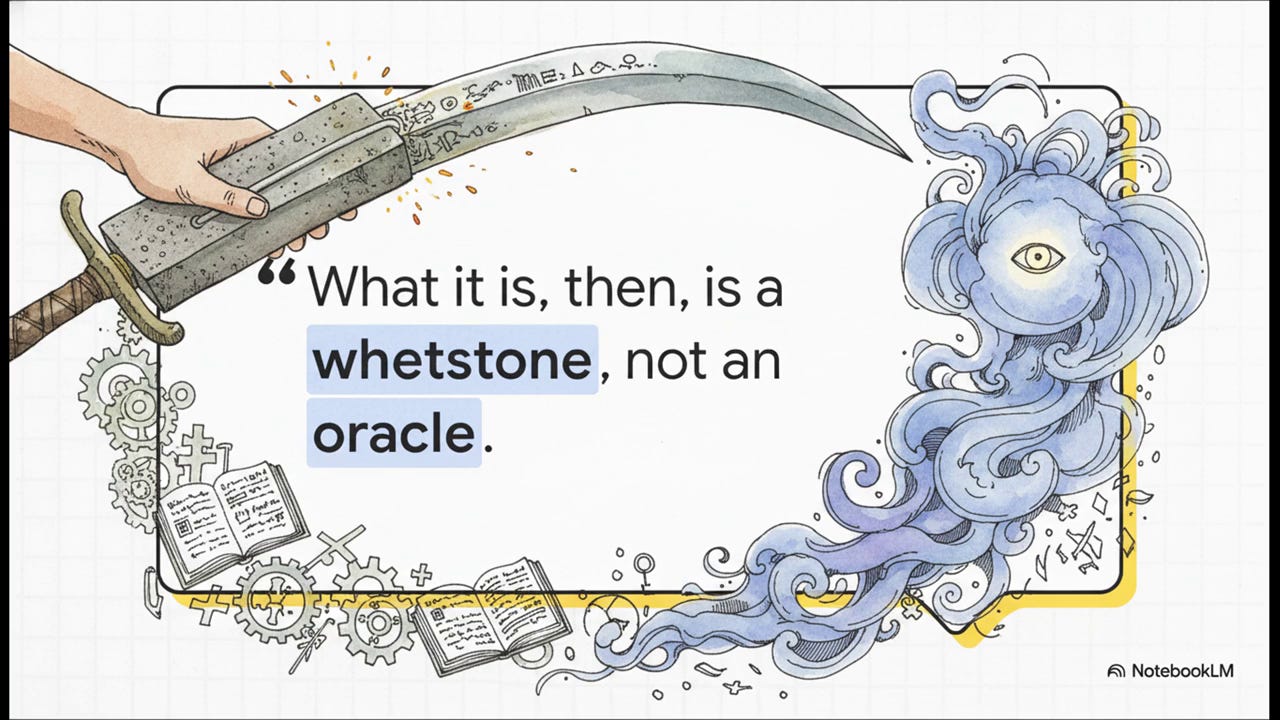
What it is, then, is a whetstone, not an oracle — a tireless, broad, and oddly honest interlocutor that can follow a wandering mind wherever it goes without losing the thread, and hold that mind to a standard it might not hold itself to alone. The irony I want to record is that the rambling was not a defect of the method; it was the method. An unhurried, associative, unembarrassed inquiry, pursued with a partner that neither tires nor flatters nor forgets where you started three hours ago, is precisely the condition under which an unlooked-for thing gets found. The criticism says such tools make us think less. This once, at least, the opposite happened: I was made to think more, and more carefully, than I would have alone — and at the end of it stood an argument I had never seen, resting on sources I had been shown how to check, with its own limits honestly marked.
That is not a defense of the tool against every charge. It is only one true account, set against the tide of grim ones, of what the thing can be when a person brings it the right kind of question and keeps hold of the judging himself.
Sancta Ioanna, ora pro nobis.
—
—
The Royal Channel
An Apologetic that Royal Dignity May Be Validly Transmitted Through the Female Line, Argued from the Divine Maternity of the Blessed Virgin Mary
Scriptural citations follow the Douay–Rheims (Challoner). Patristic and magisterial citations have been verified against the Ante-Nicene Fathers / New Advent texts and a printed Roman Catechism (see the closing Note on Sources). The Summa is given in the English Dominican Province translation.
I. Dedicatory Preface: Why I Bear the Name of Joan
I did not, when I chose her, know what a confirmation saint was. I knew only a little of Joan of Arc, and that little was enough: that she was an ignorant, untrained, unskilled girl who was nonetheless inspired and Holy-guided; that she led armies; that she was the instrument by which a king was crowned, and that she won that king’s trust, his faith, and his support. I knew nothing of the doctrine of patron saints, nor of what the Church intends when a soul takes a saint’s name at Confirmation. I was simply drawn to her, and at my confirmation I took her name — this years before I came to recognize and enter the true traditional Church.
What drew me was not study but the Holy Ghost. After the exorcising of a familial spirit — a family demon of the kind the Church’s angelic theology has long recognized, an evil that fastens upon and descends through a bloodline — I was granted a Holy Clarity, and that clarity moved me to spiritual battle and toward the Faith. At the time I knew only that I had been delivered, and that I had been given a soldier-maid to bear me company in a war I was only beginning to understand.
She drew me, too, by the very virtues I most lacked, and most needed strength to seek. The familial spirit had worked in me chiefly through pride — for God had given me gifts I had not earned: a quickness of mind, creativity, a sensitivity to others, a strong and able body, capacities in which I was, almost always, found above most other men. These were given me as occasions of gratitude, and the spirit turned them into occasions of vanity. And I was weak and ignorant in the matter of chastity — in disordered uses of the body and the appetites that this fallen world both excuses and applauds — a weakness whose most grievous fruit was a daughter, conceived and then aborted by her mother long before I ever knew that she had been. Against my pride stood Joan’s humility, who did all and claimed nothing for herself; against my unchastity stood her virginity, kept whole and unbroken in the midst of an army. And both of these — humility and virginal purity — shine first and most perfectly in the Blessed Virgin herself, to whom Joan, and this whole treatise, finally point. I took the maid’s name as a man takes up a standard he has not yet earned the right to bear, needing the strength of her whose name it was to struggle toward what she already was.
Only afterward did I learn what I had been given. I learned that a confirmation saint is no ornament. Confirmation is the sacrament by which the baptized is sealed with the Holy Ghost and made a soldier of Christ, strengthened to profess and defend the Faith as an adult and to stand in the spiritual combat — the very combat into which I had already been thrust. To take a saint’s name at that sacrament is to bind oneself, for life, to a particular friend in heaven: an intercessor, whose prayers before the throne of God are asked as one asks the prayers of a holy friend on earth — never worshipped, for worship is God’s alone, but invoked; and a model, a concrete pattern of how grace is lived under a particular calling, given to be studied and imitated. The resonance a soul feels toward a saint is itself often a quiet sign of its own vocation. That a warrior-maid, humble and virginal, should have been given to me at the very sacrament of spiritual soldiery — and given before I knew any of this, and before I knew her own virtues answered my own deepest wants — I can only receive as His providence and not my planning.
Consider what she was. A peasant girl of Domrémy, unlettered, untrained in arms, ignorant of statecraft, small and by every worldly measure weak. She could not read. She had no rank, no faction, no claim of her own. And by the guidance of voices she named as Saint Michael the Archangel, Saint Catherine, and Saint Margaret, this girl reached the dispossessed Dauphin, was given a place with his army, stood at the relief of Orléans in 1429 where the trained captains had failed, and pressed on until the Dauphin was crowned Charles VII at Reims, the city of the kings. She led armies. She made a king. And she did none of it as her own: she signed and acted on behalf of the King of Heaven. The leadership and the king-making flowed through an emptied and obedient instrument, not from a capable woman. The martial genius and the holy simplicity were not in tension; the second was the source of the first. Here is the Pauline pattern in the flesh — the weak things of the world hath God chosen, that he may confound the strong (1 Cor. 1:27).
It was only some years after my baptism and confirmation that I came to see that the church I had entered was not the true one. At first this was no more than a sensed wrongness — an underlying falseness in which the reverence owed to the Most Precious Blood and the Sacred Flesh of Our Lord was wanting, as though the very heart of worship had been quietly hollowed out. But the sense hardened into certainty when I understood what had been done in the open: that a new Rite had been suddenly imposed upon all the laity across the whole world, and the Traditional Latin Rite — the Mass of all the ages — cast out of public worship, withheld even from the very old and the lifelong faithful who had been nourished upon it the whole of their days. This was no small adjustment of discipline. It was my first clear sight of the Vatican abusing and wounding the Living Body of Jesus Christ on earth; and it was then that I sought, and by grace found, the True Church in the traditional Catholic faith as it stood before these innovations.
One thing more I learned only later still — after my baptism, my confirmation, and my entrance at last into the traditional Church: that Joan herself had been sold out by a bishop. Pierre Cauchon, Bishop of Beauvais, bound to the English–Burgundian party and angling for the see of Rouen, made of a heresy trial an instrument of faction: she was denied counsel, denied her explicit appeal to the Pope, held in a secular military prison, and condemned. The rehabilitation trial of 1456 annulled it all. That this should have come to my knowledge only after I had chosen her, and after I had myself come out from a counterfeit church at the hands of unfaithful prelates, I take as a further confirmation of the fittingness of the choice: for she is a standing sign of contradiction against churchmen and office-holders who serve their own advancement above faith and duty — those, as Fr. Ripperger has taught, enslaved to status and preferment over the care of souls. And she is, fittingly, patroness of prisoners and of prisoners of war, her own betrayal in captivity making the patronage just. Burned at Rouen on 30 May 1431, beatified in 1909, canonized by Benedict XV in 1920, she was vindicated in law within a generation and raised to the altars only after five centuries.
It is from contemplating her — the woman through whom a higher kingship acted, and to whom a real but wholly derived authority was therefore given — that the argument of this treatise was born. For if God so willed to crown a king through a maid who claimed no crown, it is worth asking what the supreme instance of His own choosing teaches us of how royal dignity may travel: namely, that it may travel through a woman.
II. The Question Stated (status quaestionis)
It is asked whether royal dignity, the title and right of a kingdom, may be validly transmitted through the female line — that is, from a king to the son of his daughter, or carried latent through a daughter to a later son — or whether, as the so-called Salic Law of France asserted, no right to a crown can pass through a woman at all.
I answer that such transmission is licit and not repugnant to nature or to the divine law; and I argue it from the highest royal succession that has ever occurred or ever shall: the descent of the King of Kings, according to His sacred humanity, from David His father — which descent came to Him through a woman, the Blessed Virgin Mary.
A precision must govern the whole. The argument does not assert that a woman may reign in her own person (a distinct question, treated under §VI). It asserts only that royal right may be transmitted through her. The Blessed Virgin reigned over no earthly kingdom; she bore and carried the King. It is transmission, not reign, that the divine maternity establishes.
III. The Necessary Distinctions
First distinction — the twofold kingship of Christ. Our Lord is King in two manners. He is King by His divine nature and by the hypostatic union — Lord of all creation, a kingship eternal, unbegotten in time, conferred by no creature and transmitted by none. Mary did not give Him this; no creature could. He is also King according to His sacred humanity, as the promised heir of David’s throne — a real, earthly, dynastic royalty foretold by the prophets. It is this second, human and Davidic royalty, and this alone, that is transmitted to Him; and the question is, through whom.
This distinction is the gate of the whole argument, and the careless are wrecked at it. To say loosely that “Mary transmitted Christ’s kingship” invites the just retort that no creature confers divine lordship. We say precisely: Mary transmitted to the Incarnate God His true human royal lineage, His descent according to the flesh from David. That claim is unassailable.
Second distinction — the twofold royal inheritance: blood and title. The kingdom promised to David’s seed involves two distinct things: the flesh and blood of David (descent of the body) and the juridical throne-title (the dynastic right). Under the law these were ordinarily united but were not the same, for legal paternity sufficed to convey title (membership, inheritance, dynastic right) independently of biology. We shall find that in Christ these two were providentially divided: the title supplied by Joseph, the blood by Mary. This division is not an embarrassment to the argument but, rightly read, its confirmation (§V, Obj. 2).
Third distinction — the mode of the a fortiori. The inference must not be run on the bare word “kingship” — if divine kingship passes through a woman, then surely civil kingship may — for that equivocates: divine and civil royalty are not one genus differing in degree but belong to different orders, the one supernatural and unique, the other natural and general. The argument is run instead on the mode of transmission — a royal lineage conveyed through a woman who does not herself reign — which structure is univocally the same in the sacred case and in any civil case. This is the hinge on which a manualist objection turns or fails.
IV. The Argument from the Divine Maternity
The argument proper proceeds thus.
It is of divine and Catholic faith that Christ is truly descended from David according to the flesh. Saint Paul: “Concerning his Son, who was made to him of the seed of David, according to the flesh” (Rom. 1:3); and again, “Be mindful that the Lord Jesus Christ is risen again from the dead, of the seed of David, according to my gospel” (2 Tim. 2:8).
But Christ received His flesh from one human source only — the Blessed Virgin — for He was conceived of her by the Holy Ghost without a human father. There was no paternal seed.
Therefore the Davidic descent according to the flesh must have come to Him through Mary; for there is no other channel of flesh. Whence it follows necessarily that Mary herself was of the house and lineage of David — a conclusion the Fathers drew from the second century (§VII), precisely to secure the reality of the prophecies in Christ’s body and not merely in a legal fiction.
Thus, in the supreme royal succession — the descent of the Messianic King to whom the throne of David was promised “for ever” — the royal lineage was transmitted through a woman, and this by the express ordination of God, who arranged the manner of His own Son’s coming.
But God cannot ordain, as the very means of fulfilling His sworn covenant, a thing intrinsically disordered, against nature, or against the divine law; for the Author of nature does not contradict nature, nor the Lawgiver His own law.
Therefore transmission of royal dignity through the female line is not intrinsically disordered, nor against nature, nor against the divine law. What God honored in the highest case cannot be base in the lower.
Corollary. The Salic principle — that no royal right may pass through a woman — cannot therefore be what its apologists claimed it to be: a fundamental law rooted in nature or in the sacral order of kingship. At most it is positive human convention, which a realm may adopt to order its own succession, but which possesses no force of nature or of divine law and binds no realm that has not enacted it.
This is the whole of the affirmative case. Note its modesty and its strength together: it does not decree that every kingdom must admit female-line succession (positive law may order the matter within its competence); it establishes the sharper negative that does all the work against the Salic pretension — that such transmission is not against nature, and the Salic exclusion is therefore mere convention masquerading as fundamental law.
V. Objections and Replies
Objection 1 (the sui generis objection). Christ is unique and unrepeatable; one may not argue from the mystery of the Incarnation to the constitution of a temporal realm. To do so is to reason from the supernatural and singular to the natural and general — an analogy without force.
Reply. The objection would stand if the argument ran on the supernatural mode (the virginal conception, the hypostatic union). It does not. It runs on the natural fact embedded within the mystery: that a real, earthly, dynastic royal descent — David’s throne and seed, a thing wholly of the natural and covenantal order — was in fact carried through a woman. That natural fact is fully generalizable. And the a fortiori is not “the supernatural permits the natural” but “what the divine wisdom positively ordained, in ordering the supreme case, cannot be repugnant to the nature He authored.” God did not merely permit but chose female-line transmission as the vehicle of His covenant. The singular instance proves the general possibility, as one true instance always disproves a claim of impossibility.
Objection 2 (the Salic objection: the exception that seems to confirm the rule). Even granting that the blood ran through Mary, the throne-title of David ran through Joseph, the legal father, in whom Saint Matthew traces the royal Solomonic line (Matt. 1:6–16). Title male, blood female. This is precisely the Salic intuition — that the right descends through men. The Christ case thus confirms the rule rather than breaking it.
Reply. Concede the fact, and watch it invert. Why did the title have to be supplied by Joseph? Solely because the virginal conception left no human father to supply the legal line in the ordinary way; espousal and legal paternity were summoned to fill a gap peculiar to the virgin birth. This is an artifact of a fatherless generation, not a law of generation as such. In ordinary generation there is no such gap: there a father exists, and the descent the woman carries brings its title with it, for title follows descent unless a contrived exclusion severs them. Therefore Joseph’s supplying of the title is the exception that proves the rule: the legal line had to be furnished by a man only because nature’s ordinary channel — a father — was miraculously absent. Where nature operates normally, no such substitution is needed, and the line a woman carries conveys its right. Pressed hard, the objection establishes our thesis.
Objection 3 (the objection from the required male line). Yet Scripture and the messianic prophecies did require the legal descent through the male, through Joseph the son of David. Does this not show that royal title is, by a higher law, masculine?
Reply. Distinguish the positive from the natural. The requirement of the legal Davidic line through Joseph was a matter of the positive law of the messianic economy — a feature of God’s particular covenant with Israel and the specific credentials by which the Messiah was to be known — not a dictate of the natural law binding all polities. Only the natural fact within the mystery (royal descent really passing through Mary) is generalizable to civil succession; the positive messianic requirement is not. One may not inflate “the Messiah’s legal title ran through Joseph” into “all royal title must run male,” for the first is special positive law and the second a claim about nature.
Objection 4 (the objection that it proves too much). If royal dignity may pass through a woman, then a woman may reign; but female sovereignty is contrary to the natural order of headship. Therefore the argument proves too much, and so proves nothing.
Reply. It proves exactly what is claimed and no more. The Blessed Virgin did not reign; she bore and carried the King without herself wielding a kingdom. The argument therefore licenses transmission through a woman — to her son, or carried latent through a daughter to a later son — and is silent on whether a woman may reign in her own person, which is a distinct question requiring distinct arguments (the precedents of Debbora and the daughters of Salphaad, the natural capacity of the rational soul, the licit practice of the Church in crowning queens regnant). The two claims must be kept apart, lest the adversary collapse them and accuse us of deriving female sovereignty from a Mother who governed no kingdom. We assert the transmission and reserve the reign.
VI. The Boundary Affirmed, and the Highest Instance of the Third Mode
To make the boundary explicit: what the divine maternity establishes is transmission, not reign. And of the modes of transmission, the strongest and most certain is the third — the dignity carried latent through a woman who does not exercise it, surfacing in her son or a later son. For this is the very thing the Blessed Virgin did. She did not reign; she carried the King and His royal descent through herself without herself wielding it, and the dignity surfaced in her Son. The Incarnation is therefore not merely consistent with dormant female-line transmission — it is its highest and most perfect instance. A daughter carrying a crown to a later son does in the natural order what the Mother of God did in the order of grace.
VII. Confirmation from the Fathers and from the Davidic Polity
The patristic witness to Mary’s Davidic descent. The Church held from the sub-apostolic age that the Blessed Virgin was herself of David’s line — the necessary consequence of Romans 1:3.
Saint Ignatius of Antioch (c. A.D. 107), Epistle to the Ephesians 18:2: “For our God, Jesus Christ, was, according to the appointment of God, conceived in the womb by Mary, of the seed of David, but by the Holy Ghost.” He grounds the Davidic descent in the mother. See likewise Epistle to the Smyrnaeans 1:1, professing Christ “truly of the seed of David according to the flesh… truly born of a virgin.”
Saint Justin Martyr (c. A.D. 155), Dialogue with Trypho 120: speaking of the promise to Isaac and Jacob, he says it was made “only to those of whom the Christ should arise, according to the dispensation, through the Virgin Mary… For the seed is divided from Jacob, and comes down through Judah, and Phares, and Jesse, and David.” Here the Davidic descent runs through the Virgin Mary, naming her as the channel of the royal line. (Cf. also Dial. 43 and 45, where Christ is born “of a virgin sprung from the stock of Abraham.”)
Saint Irenaeus, Adversus Haereses III.22.1 (ANF / New Advent division; the passage falls within the matter some editions number at III.21): having quoted Romans 1:3 — “who was made of the seed of David according to the flesh” — he reasons that Christ took real flesh from His mother: “Superfluous, too, in that case is His descent into Mary; for why did He come down into her if He were to take nothing of her?” The Davidic seed according to the flesh is thus shown to be taken from Mary herself.
The Roman Catechism (Catechism of the Council of Trent), Article III, Born of the Virgin Mary — the magisterial-traditional anchor, now confirmed verbatim: “for Mary, whom we truly proclaim and venerate as Mother of God, because she brought forth Him who is at once God and man, was descended from King David.”
The covenant texts that demand both throne and seed. The prophecies require both a juridical throne and a fleshly seed — Joseph answering the first, Mary the second:
Nathan’s oracle, 2 Kings [2 Sam.] 7:12–13, 16: “And when thy days shall be fulfilled, and thou shalt sleep with thy fathers, I will raise up thy seed after thee, which shall proceed out of thy bowels, and I will establish his kingdom. He shall build a house to my name, and I will establish the throne of his kingdom for ever… And thy house shall be faithful, and thy kingdom for ever before thy face, and thy throne shall be firm for ever.”
Psalm 131:11: “The Lord hath sworn truth to David, and he will not make it void: of the fruit of thy womb I will set upon thy throne.” — Note the fruit of thy womb: a fleshly, generative image, not a merely legal one.
Isaias 11:1: “And there shall come forth a rod out of the root of Jesse, and a flower shall rise up out of his root.” And 9:6–7: “For a CHILD IS BORN to us… He shall sit upon the throne of David.”
Jeremias 23:5: “Behold the days come, saith the Lord, and I will raise up to David a just branch.”
Saint Gabriel to Mary, Luke 1:32: “The Lord God shall give unto him the throne of David his father.”
The Queen Mother (gebirah) — female dignity within the Davidic succession. That David’s own polity accorded the king’s mother a recognized and honored station — not reigning, yet officially dignified and bound to the king’s person — is shown when Solomon receives Bethsabee: “and the king arose to meet her, and bowed to her… and a throne was set for the king’s mother, and she sat on his right hand” (3 Kings [1 Kings] 2:19). The Davidic kingdom thus had a real female office woven into its royal order. Mariology takes this up directly: Mary as Queen Mother of the Davidic King. The woman through whom the king comes is, even within David’s house, no cipher but a station — which is the very intuition this treatise presses, embedded in the institution itself.
VIII. Historical Corollary: The Salic Law as Manufactured Convention
The affirmative case having shown that female-line transmission is not against nature, history confirms that the contrary French doctrine was not ancient natural law but a late and deliberate construction.
The Lex Salica of the Salian Franks (c. A.D. 507–511) was a code concerning land, theft, and assault; its chapter De allodio assigned a father’s landed inheritance (the terra salica) to sons and gave daughters only personal property. It said nothing of crowns. Only centuries later, to bar the claim of Edward III of England (who claimed the French crown through his mother Isabella), did royal publicists repurpose it. The pivotal moment came around 1413, when Jean de Montreuil, notaire et secrétaire of the Crown, added a note to his polemical treatise À toute la chevalerie de France citing the De allodio clause and inserting words to make a rule about private land speak in regno — of the kingdom — so that it might exclude women from the throne. Montreuil and Jean Juvénal des Ursins championed this reading for over eighty years, and a chain of later jurists (Seyssel, Grassaille, Du Moulin, and others) built upon it the printed myth of La Loy Salique, première loy des François, the alleged “first law of the Franks,” elevated by the sixteenth century into a “fundamental law of the kingdom” and a cornerstone of the constitution. (Source: Craig Taylor, French History 15:4 [2001], 358–377.)
Two points follow for the apologist. First, against the broad European background the French doctrine was the outlier: cognatic and “quasi-Salic” succession — by which a woman does not herself reign but her son inherits — was widely practiced (a grandfather succeeded by the son of his daughter, and the like). The principle this treatise defends was thus the ordinary assumption; the absolute Salic exclusion was the novelty that had to be manufactured. Second, where deeper justification was sought beyond raw custom, jurists invoked “the priestly character of kingship” to exclude women — the anointed king as a quasi-sacerdotal figure, and women being incapable of priesthood. But this argument rests on sacramental signification, not on civil right: the impediment of sex (defectus sexus, Suppl. q. 39, a. 1) concerns the recipient’s capacity to signify Christ the Head in Holy Orders, a matter of divine sacramental institution. It cannot be stretched to govern the transmission of a civil title, which is not a sacrament and signifies nothing of the priesthood. The sacral-kingship argument, pressed into the service of Salic exclusion, exceeds its proper object.
IX. Conclusion
The supreme royal succession in the history of the world was arranged by God Himself, and in it He transmitted the Davidic royalty of His Son through a woman — through the Immaculate Virgin, who reigned over no kingdom yet carried the King and His lineage in her flesh. From this it follows that the transmission of royal dignity through the female line is not against nature, nor against the divine law, but was honored in the highest instance by the Author of nature and Law. The Salic pretension to the contrary stands convicted as human convention dressed in the borrowed authority of nature — valid, if a realm enacts it, only as positive law, and binding no realm and no truth beyond its own enactment.
And it is fitting that this should be argued under the patronage of Saint Joan of Arc, who is its living emblem: the maid who claimed no crown and yet bore a king to his, exercising a real authority that was wholly derived — under God, for the lawful sovereign, in the end vindicated by the Church. The same shape runs from the Mother who bore the King without reigning to the maid who crowned a king without ascending a throne. Through the weak things, the strong are confounded; and through a woman, a kingdom may lawfully pass.
Sancta Ioanna, ora pro nobis.
Note on Sources
All citations in this treatise have now been verified against primary or scholarly editions:
Scripture — Douay–Rheims (Challoner) throughout, as preferred.
Ignatius, Eph. 18:2; Justin, Dialogue with Trypho 120; Irenaeus, Adv. Haer. III.22.1 (ANF / New Advent division; some older editions place the surrounding matter at III.21) — confirmed against the Ante-Nicene Fathers texts.
Roman Catechism (Council of Trent), Article III, Born of the Virgin Mary — confirmed verbatim.
St. Thomas, Summa Theologiae I, q. 92, a. 1, ad 2, and Supplement q. 39, a. 1 — confirmed verbatim against the English Dominican Province translation. (Note: q. 92, a. 1, obj. 1 contains the mas occasionatus / “misbegotten male” borrowing from Aristotle, De Gener. Animal., flagged in §IV as the flawed empirical premise to be avoided; and Suppl. q. 39, a. 1 grounds the exclusion from Orders explicitly in sacramental signification — “since a sacrament is a sign… it is not possible in the female sex to signify eminence of degree” — confirming the point made in §VIII.)
Salic Law — Craig Taylor, “The Salic Law and the Valois Succession to the French Crown,” French History 15:4 (2001), 358–377 (DOI 10.1093/fh/15.4.358), confirms the attribution of the in regno insertion to Jean de Montreuil (c. 1413, in À toute la chevalerie de France), drawing on the Lex Salica chapter De allodio, and the later elevation of the doctrine into a “fundamental law.”
—
—
—
Gratuitous Technical White-Paper
—
Audio overview of this White Paper:
YouTube Mirror: https://www.youtube.com/watch?v=UU15Xj3eIvQ
Self-Repairing Legged Robots
A Self-Model, Neuroevolution, and Distributed-Simulation Architecture for Autonomous Fault Recovery in Ant-Form Swarms
White Paper
Abstract
This paper describes an architecture for autonomous fault recovery in legged robots intended to operate where no human can intervene — undersea, underground, or on asteroids. The design is biologically motivated: an animal that loses the use of a limb does not halt and wait for repair; it discovers, within seconds, a degraded but workable way to keep moving. The system reproduces that capacity through several cooperating mechanisms. An internal self-model (a mechanical “avatar” of the robot) has detected damage or load imbalance injected into it, so that recovery can be searched in simulation before it is risked in the body. Candidate controllers are produced inside that self-model by neuroevolution (NEAT), which evolves both the wiring and the weights of the control networks. A hierarchical controller makes each degree of freedom independently reprogrammable, so adaptation is attempted at the smallest affected motion primitive before escalating to whole compound actions. A physical verification step — informally, the ant dance — tests a candidate repair on the real machine and treats the gap between predicted and observed motion as new diagnostic information. And a swarm layer lets neighboring units supply an external view of the injured robot’s body and lend their processors as a distributed simulation cluster. The paper presents each mechanism, the diagnostic reasoning that ties them together, the handling of two notoriously hard cases — lying sensors and intermittent faults — and an honest account of the open problems that remain.
1. Motivation and Design Philosophy
The architecture began with an observation about animals as control systems. A cane toad striking a mealworm performs, on minimal hardware, a complete sensorimotor act: target acquisition, range estimation, timing, the ballistic commit of the tongue, and recovery — reliably, and with graceful tolerance for disturbance. The intelligence is in the mechanism, not in a central deliberation. The instinct behind this work was that the same property should be engineered rather than merely admired: build the body and its reflexes so that competence and resilience are distributed into the structure, and a damaged machine can re-derive how to move the way an injured animal does.
This yields a design principle that runs through every section below: resilience should live in the body and its local controllers, not in a perfect central plan. A centralized plan is brittle precisely where deployment is harshest — far from operators, with long communication lag and no possibility of physical repair. The relevant failure modes are concrete and ordinary: a servo fails, a leg is physically broken, a joint stiffens, or the robot must carry an off-center load it was not designed for. In each case the goal is not to restore the original behavior but to find the nearest workable substitute fast enough to continue the mission.
The design also reflects a control-engineering sensibility carried over from real-time scientific instrumentation — systems in which a control loop must close within a deterministic deadline or the measurement is lost.1 That discipline matters here because the per-joint controllers and the verification step are real-time obligations: a recovery that cannot be computed and committed inside the available time window is not a recovery.
2. System Overview
The robot is an ant- or hexapod-form walker. Its control and recovery stack has the following elements, each developed in the sections that follow:
Per-DOF control subsystems. Every degree of freedom has its own reprogrammable control subsystem — a small control network — that can be rewritten in the field and committed to nonvolatile per-DOF controller storage.
A hierarchical motion vocabulary. Low-level motion primitives compose into compound actions, which compose into gaits.
A self-model (“avatar”). A detailed mechanical simulation of the robot’s own body, kept in correspondence with the real machine and editable to reflect damage or added load.
A neuroevolution engine. NEAT generates and refines candidate control networks entirely inside the avatar.
A simulation environment. The avatar is exercised against a model of the local terrain so candidate motions can be evaluated before being tried physically.
Proprioceptive and contact sensing. Joint state, ground-contact pads, and inertial sensing report what the body is actually doing.
A swarm communication layer. Peers within range can observe the injured unit externally and contribute computation.
3. The Self-Model (“Avatar”)
When a problem is detected, the system first loads a detailed mechanical avatar of itself. If the fault is structural — a broken servo or limb — the avatar is damaged in the same way. If the problem is an off-balance load, the avatar is given an offset load as close as possible to the real one. The avatar is then simulated against the environment model so that candidate recoveries can be evaluated against predicted physics rather than discovered by trial on the real machine. This self-model-and-recover loop is the architecture’s foundation, and it has a direct precedent in the resilient-machines work of Bongard, Zykov, and Lipson.2
4. Hierarchical Motion Representation
Motion is represented at three levels, and this layering is what keeps the recovery search tractable:
Primitives. Atomic, parameterized joint motions — for example lift-up (0–n), push-down (0–n), shift-right-absolute (0–x), shift-right-reverse (0–k). Each maps onto a reprogrammable per-DOF control subsystem.
Compound actions. A functional action such as step-forward (0–r) is assembled from a sequence of primitives.
Gaits. Compound actions are coordinated across the legs into whole-body locomotion.
The key consequence: when something fails, adaptation is attempted first at the lowest affected primitive, and escalated to the compound action only if the primitive cannot be locally rescued. If “lift-up” no longer works, the system searches for a substitute that reproduces its effect — for instance, having a different servo rotate to near 90 degrees and later rotate back to stand in for the missing lift. Only if no local substitute is found does the search escalate to re-synthesizing the whole step. Searching locally before searching globally keeps the cheap, likely fix cheap, and reserves expensive whole-action search for when it is actually needed.
5. Controller Synthesis: NEAT Inside the Avatar
The preceding sections describe where adaptation happens and that candidate controllers are searched in the avatar; this section specifies the search engine. The architecture uses NeuroEvolution of Augmenting Topologies (NEAT), introduced by Kenneth O. Stanley and Risto Miikkulainen at the University of Texas at Austin.3 NEAT evolves both the weights and the topology of neural networks, and it runs entirely inside the self-model: across a single recovery episode, tens of thousands of candidate control networks can be generated and evaluated against the damaged or loaded avatar before any one of them is risked on the physical machine.
5.1 Encoding and historical markings
NEAT represents each candidate controller as a linear genome of connection genes — each naming an input node, an output node, a weight, an enable bit, and an innovation number — over a set of node genes. The innovation number is a historical marking: a global counter stamped on each new gene as it first arises. Because two genes that share an origin share a number, networks of different shapes and sizes can be lined up gene-by-gene and recombined sensibly without expensive topological analysis. This resolves the “competing conventions” problem — the same function encoded in different orders — that otherwise wrecks crossover between dissimilar networks.
5.2 Protecting innovation; the variation operators
A newly added node or connection usually lowers fitness before its weights are tuned, so NEAT speciates the population — grouping similar genomes by their historical markings — so that a young structural change can mature in its own niche instead of being eliminated immediately by the broader population. The variation operators are weight perturbation; add-connection; add-node (splitting an existing connection and inserting the new node with weights chosen to minimize initial disruption); and, in this design, recombination of sub-networks drawn from the more successful candidates together with the addition, replacement, or disabling of individual links. Tens of thousands of such variants are bred and scored against the damaged avatar over the course of a recovery.
5.3 Warm-starting from hard-coded “linked pairs”
For compound (non-primitive) actions, the search is not started cold. Certain higher-function actions are determined, by off-unit testing at the factory, to be near-mirror images of one another and are hard-encoded as linked pairs — for example (step-forward rate x / step-back rate x) or (pivot-rear-clockwise n / pivot-rear-counter-clockwise n). When one member of a pair must be synthesized or repaired, NEAT warm-starts from the top-performing controllers of its partner and translates one into the other: stripping and rebuilding a known-good network for the similar action rather than evolving a controller from scratch.
5.4 The deconstruction-biased repair heuristic
Because the warm-start network was evolved for a related but different action, it typically carries structure the target does not need. To prune toward the nearest working simplification, the search applies a deconstruction bias — but only to these hard-coded compound pairs, and only while translating one member into the other; never to primitives. The mechanism is as follows:
Deconstruction-favoring mutations make up a fraction 1/k of all alterations, with k stepping 3, 4, 5, … over successive cycles, so the simplifying pressure starts moderate and weakens with time.
The bias continues until either (a) positive progress toward a solution is measured, or (b) the network shrinks to 1/n of its starting size, where n = (starting nodes + links) / 40 — the constant 40 being provisional, to be fixed by experiment. Whichever condition is met first releases the bias, after which ordinary NEAT proceeds.
The two stopping conditions are an OR, and their interaction deserves a note. For a large starting network, n exceeds 1 and the target 1/n is a genuine size floor. For a small starting network, n falls below 1, the “1/n of starting size” target becomes larger than the network itself, and the size condition never triggers — leaving only the progress-based stop active. This is acceptable rather than erroneous: small controllers should not be forced to deconstruct. It is flagged only so the behavior is not mistaken for a bug.
This heuristic is a deliberate inversion of canonical NEAT. Standard NEAT starts minimal and complexifies, adding structure only when justified, and its efficiency argument rests on never carrying structure that has not earned its place. The repair mode here does the reverse: it starts from a rich, already-evolved relative and prunes toward the smallest edit that restores function under the new constraints. The inversion is appropriate for warm-started repair, where the task is not open-ended exploration but finding the nearest working controller to a known-good one. It is presented here as an adaptation of NEAT for repair, not as NEAT’s standard operation.
5.5 NEAT at both levels of the hierarchy
NEAT is the synthesis engine at both levels of the motion hierarchy. At the primitive level it re-derives a single degree-of-freedom controller. When a primitive cannot be locally rescued and the search escalates, NEAT re-synthesizes the whole compound action over the already-programmed primitives. In either case the accepted controller is then committed to nonvolatile per-DOF controller storage.
5.6 A NEAT-optimized processor
Breeding and scoring tens of thousands of networks under a recovery time budget motivates dedicated hardware. The design anticipates a layered dataflow (systolic) accelerator in which the processing “layers” are the network’s connections — input-to-node, node-to-node, and node-to-output links — rather than fixed neuron layers. Node state propagates one hop per hardware “click”; on each click the states of downstream nodes along the link paths are folded in. A single node may lie on many paths at once, so its state — the pointer to that node’s value — may be updated by one, two, or more inputs within a single click. With on the order of 5 to 20 such connection-layers operating in parallel, large subsections of a network are advanced per clock cycle.
This is, in effect, a spatial dataflow accelerator specialized not for the fixed dense layers most neural accelerators target, but for the sparse, irregular, and continually changing topologies NEAT produces — which means the fabric must be reconfigurable per genome, the central hardware challenge. The expectation that such hardware will be built is offered as a reasoned projection from the rising scale and volume of these and similar workloads, not as a certainty.
6. “The Ant Dance”: Physical Verification
Once NEAT yields a candidate adaptation, the new pattern is burned into the affected reprogrammable subsystems — and then, critically, the robot physically tests it on itself. This is necessary because no self-simulation is perfect; the discrepancy between the avatar’s prediction and the real outcome — the reality gap — is exactly what physical testing measures and corrects. The test reads, from the outside, as a dance: small shifts back and forth, a step forward and back, the body probing whether the substitute motion actually holds against real gravity, friction, and footing. The same behavior appears in the field in the damage-recovery work of Cully and colleagues, where a damaged hexapod trials a handful of candidate gaits on the physical machine and keeps what works.4
7. Diagnosis as Inference: When the Dance Fails
If the dance fails — the substitute motion does not hold — the system does not simply try another motion against the same model. It assumes its initial understanding of the fault was wrong or incomplete, and feeds the failure back to correct the self-model itself. This is the difference between a robot that merely adapts and one that learns what it has become. The commanded-versus-observed discrepancy is itself the richest diagnostic signal available: if a joint rotated through its commanded arc but the foot’s contact pad kept reading ground contact throughout the rotation, the leg did not actually lift — which localizes the fault to a broken linkage or a decoupled servo rather than to the control logic.
7.1 Ruling out the environment before rewriting the self
The deepest trap in self-modeling is to attribute an external disturbance to internal damage — a robot on the bed of a moving truck, on a slope, or on yielding sand sees its predictions fail and “repairs” a body that was never broken, crippling itself adapting to a problem that is not its own. Before any rewrite, the system therefore asks whether the environment changed: is the ground level? Is there ground motion? The principled discriminator is persistence and correlation. An internal fault travels with the body and recurs consistently across different motions and orientations; an environmental disturbance is transient, or correlates with an external signal such as an inertial reading of vehicle motion or a tilt that matches a slope. If the error stays with the robot when it changes what it is doing, the fault is internal; if it comes and goes with the world, it is environmental.
8. Sensor Integrity: the Self-versus-Self Problem
A subtler failure is a sensor that lies — a contact pad reading contact when there is none. A naive system would ship its peers a confident but false account of its own body and waste their computation optimizing a recovery for a fault that does not exist, or “repair” a healthy leg on the strength of a lying instrument. The architecture addresses this without a separate subsystem: the distributed fault search evaluates which states of the body — including its instruments — would jointly explain everything being read at once. A dead contact pad and a dead linkage may look identical on a single channel, but they produce different total signatures across the servo current draw, the inertial sensors, and a neighbor’s external view. One channel can lie; the conjunction of all channels is much harder to fake. The external observer is especially powerful here, because it can detect faults that proprioception is structurally blind to — a leg whose motion checks out internally but whose geometry is bent is visible only from outside.
9. Distributed Recovery: Swarm Sensing and Computation
When more than one unit is within communication range, two distinct forms of help become available, and the design assigns each to the party that can best provide it.
9.1 Shared sensing
Each unit knows what the others are supposed to look like and their normal ranges of motion. A peer that can approach the injured unit inspects it and reports back whatever appears unnatural. The injured unit compares this external view against its last known-good state (in case this is not its first fault) and against its internal belief about how it should look; a discrepancy localizes the likely cause of the failed adaptation. Shared sensing breaks the fundamental limit of self-modeling — a robot can sense itself only from the inside — by supplying an outside observer the way an animal cannot obtain one.
9.2 The injured unit as server
Leadership of the recovery rests with the injured unit, because it holds the data no peer has: the record of what actually happened in the real application, the last known-good state, and the failed adaptation attempt. It therefore acts as the server and directs the search, while healthy peers act as compute nodes — a swarm-scale repurposing of the Beowulf-cluster idea.5 The allocation is deliberately asymmetric: a damaged unit is exactly the one with the least time, energy, and perhaps capacity to think, so the swarm spends its collective computation defending its weakest current member. The injured unit can in effect say, “I am hurt and have a narrow window; run my recovery search on your processors and send me back a working gait.”
9.3 The distributed diagnostic protocol
The recovery proceeds as follows:
The injured unit broadcasts its last known-good state — the physical model together with the control networks that were working (or acceptably adjusted) before the fault.
It sends what it believes are the failed parts, the candidate re-wired control networks it has tried, and — most important — what actually happened in the real application.
Each peer is assigned a search range and back-simulates what else could be failing to produce the observed real-world result, initially under the assumption of a single additional fault.
If the full single-fault search space is exhausted with no acceptable solution, the search escalates to two simultaneous faults — but it is seeded with the closest near-miss from the single-fault pass as a starting point, rather than restarted cold.
The whole effort runs under a failure-to-fix budget set by the task and the estimated maximum allowable task time. If the budget is exhausted, the injured unit is left to continue simulating on its own and emits a status flag at regular intervals.
Failing a full recovery, the unit falls back to a reduced but reliable function — moving without the affected leg, parking it in a neutral position, and switching to a pre-set degraded mode (e.g., “appendage 4 non-functional,” turning a six-legged gait into a five-legged limp).
10. Graceful Degradation
The fallback in step 6 above is not an afterthought; it is the maturity of the design. The system does not insist on restoring lost function at any cost. Foreseeable damage — the loss of a given limb — has its recovery pre-compiled and cached rather than searched from scratch under a deadline, because the five-legged gait should be on the shelf before it is needed. This mirrors biology: a dog drops almost instantly to a three-legged trot because that gait is effectively pre-wired, not reasoned out in the moment. The principle is to search only for the unforeseen, and to cache the foreseen.
11. The Hardest Case: Intermittent Faults
Intermittent faults defeat the verification step on which the whole architecture rests, because that step assumes reproducibility. If a fault comes and goes — a connection that opens only when hot, a power rail that sags only under load — the dance can pass cleanly while the fault happens to be absent, the system declares itself healed, and the failure returns minutes later under the conditions that trigger it. The intermittent attacks the confirmation, not merely the function.
This is a familiar adversary in hardware practice. A six-degree-of-freedom pulse-DC magnetic tracker returned from a customer as faulty will often test perfectly on the bench, because the triggering condition — a thermally cycling solder joint that opens when hot, or a marginal supply sagging under field conditions — went home with the customer. “No fault found” rarely means “no fault”; it means “fault not present here, now.” The correct response is not to demand reproduction, which is precisely what cannot be guaranteed, but to act on the signature and the probability.
The architecture adopts the same posture in two moves, both extensions of mechanisms already present:
Carry suspicion forward. A single passing dance does not fully clear a fault. The suspected channel is kept under lightweight watch, so a recurrence is recognized as “the known intermittent, again” rather than diagnosed from zero each time.
Reclassify and route around. If a fault recurs despite passing confirmations, the system stops trying to repair it and reclassifies the component as unreliable, routing around it permanently. A leg that works only sometimes is more dangerous than one that is reliably dead, because a reliably dead leg can be planned around, whereas an intermittent one betrays the gait under exactly the load or heat that triggers it.
12. Relationship to Prior and Contemporary Work
The architecture converges, from independent reasoning, on directions the robotics and machine-learning fields have also pursued, which is some evidence that the instincts are sound. The self-model-and-recover loop is the core idea of Bongard, Zykov, and Lipson’s resilient machines.6 The in-avatar controller search is NEAT, the topology-and-weight neuroevolution method of Stanley and Miikkulainen;7 using NEAT in a warm-started, deconstruction-biased repair mode (Section 5.4) is a deliberate departure from its canonical minimal-start, complexifying operation. The physical trial-and-keep verification — “the dance” — corresponds closely to Cully and colleagues’ damage-recovery hexapod, which finds a working gait in about two minutes by testing a few candidates on the real machine.8 The philosophy of locating resilience in the body rather than a central plan is the spirit of morphological computation.9 And the swarm layer sits within the broad field of decentralized multi-robot coordination.
Several features of this design are comparatively distinctive. The first is the strict local-before-global adaptation hierarchy — rescuing the smallest affected primitive before re-synthesizing whole actions — which directly bounds the search. The second is the warm-started repair via factory-determined linked pairs, which translates a known-good controller for one action into its mirror by stripping and rebuilding rather than evolving from scratch. The third is the injured-unit-as-server protocol, which places control of the recovery with the unit that owns the irreplaceable real-world data while offloading computation to healthier peers. The fourth is the explicit coupling of shared sensing to distributed simulation: the external observers are what make the distributed search trustworthy, because they correct the injured unit’s self-model before peers spend computation optimizing against it.
13. Open Problems and Limitations
For balance, the design’s genuine difficulties should be stated plainly. None is fatal; each is where the engineering work actually lies.
The reality gap. Every recovery is only as good as the fidelity of the avatar and the terrain model. The physical dance mitigates this but cannot eliminate it, and a large gap can make simulated recoveries fail repeatedly in the body.
Cost of the search under a real-time budget. A NEAT recovery may breed and score tens of thousands of candidate networks. On a damaged unit’s own processor — without the proposed accelerator or peers to offload to — that search may not finish inside the task’s recovery budget. This is precisely the pressure the distributed-simulation layer and the NEAT-optimized processor are meant to relieve, and a unit isolated from both is the worst case.
Bootstrapping an accurate self-model. When peers simulate the injured unit’s recovery, whose model do they run? The injured unit’s problem is precisely that it may not yet know its own damage correctly. The architecture’s answer — external observers correct the avatar first — depends on a peer being in range and able to inspect, which is not guaranteed.
Warm-start lock-in. Seeding repair from a related controller and biasing toward deconstruction speeds the search, but it can also trap it near the relative’s structure when the true best repair lies in a different region of topology space. The progress-based release mitigates this but does not remove it.
Combinatorial explosion. Escalating from single- to two-fault search controls cost only partially; three or more simultaneous faults, or a fault plus an environmental change, can blow up the search beyond any reasonable time budget.
Trust among peers. Shared sensing assumes honest neighbors. A peer that is itself subtly faulty — reporting a bad external reading — can mislead the recovery. A mature system needs a way to weigh or cross-check the observers themselves, a Byzantine-fault problem the present design does not fully solve.
Communication and energy constraints. The undersea, subterranean, and asteroid settings that motivate the work are exactly those with poor, intermittent, or high-latency communication and tight energy budgets — stressing the swarm layer where it is most needed.
Nonvolatile-storage wear. Repeatedly committing re-synthesized controllers to per-DOF storage in the field implies many rewrite cycles; the storage technology must tolerate that endurance, or repair frequency becomes bounded by the hardware rather than by the search.
Safety during the dance. Physical self-testing is, by definition, executing motions of uncertain safety on possibly-damaged hardware in an uncontrolled setting. The test itself can worsen damage or destabilize the robot, and bounding that risk is non-trivial.
14. Provenance and Design Lineage
The architecture originates not from a robotics laboratory but from a research-programming and instrumentation background — control software for scientific experiments, including hard-real-time control of an optical-trapping (“light-tweezers”) system in which a laser was steered through an acousto-optic modulator and bead displacement was read out by a quadrant photodetector, with the control loop running beneath the operating system on real-time Linux. That work instills a specific sensibility visible throughout this design: a control loop is only as good as its timing guarantees; a measurement that misses its deadline is lost; and the diagnostic art lies in knowing when a clean test is itself lying. The same instrumentation discipline appears in the treatment of the verification step as a real-time obligation and in the insistence that a single clean confirmation is not proof.
The biological framing is equally part of the lineage. The design’s seed was the observation of real animals as solved control problems — the toad’s ballistic strike as a complete sensorimotor act on minimal hardware — and the conviction that such competence can be re-derived by building it. The recurring instinct of the designer — to understand a working physical system by reconstructing it, and to distrust the instrument as readily as the mechanism — is the throughline connecting the optical trap, the returned magnetic tracker, and the self-repairing ant.
—
This document compiles and organizes a conceptual architecture and is intended as a design synthesis, not a report of a built or benchmarked system. The contemporary references (Bongard et al.; Cully et al.; Stanley and Miikkulainen; morphological computation) are offered to locate the design within the published literature; the central architecture — the avatar, the NEAT-based controller synthesis with warm-started, deconstruction-biased repair over factory-determined linked pairs, the motion hierarchy, the dance, the injured-unit-as-server swarm protocol, the handling of lying and intermittent faults, and the proposed NEAT-optimized processor — is the author’s own.
—
—
1 “Morphological computation” — the idea that a well-designed body offloads control work onto its own physics — is associated with R. Pfeifer and collaborators. It is the theoretical backdrop for designs that locate resilience in the body and its reflexes rather than in a central plan.
2 J. Bongard, V. Zykov, and H. Lipson, “Resilient Machines Through Continuous Self-Modeling,” Science, vol. 314 (2006). A four-limbed robot builds an internal model of its own body, uses it to generate locomotion, and — after damage — revises the self-model and synthesizes a new gait. The closest published precedent for the self-model-and-recover loop described here.
3 K. O. Stanley and R. Miikkulainen, “Evolving Neural Networks through Augmenting Topologies,” University of Texas at Austin, Technical Report TR-AI-01-290 (2001); journal version in Evolutionary Computation 10(2), 2002. NEAT evolves connection weights and network topology together, uses historical “innovation” markings so that dissimilar networks can be aligned and recombined without topological analysis, speciates the population to protect new structure while it matures, and (canonically) starts from minimal structure and complexifies only as justified.
4 A. Cully, J. Clune, D. Tarapore, and J.-B. Mouret, “Robots that can adapt like animals,” Nature, vol. 521 (2015). A six-legged robot recovers from leg damage in roughly two minutes by trialing a small set of candidate behaviors on the physical machine and keeping what works — a direct real-world instance of what this paper calls “the ant dance.”
5 A Beowulf cluster lashes commodity computers into a parallel compute fabric over a network. The architecture here repurposes the idea: healthy swarm members act as compute nodes for an injured member that lacks the time or capacity to run its own recovery search.
6 J. Bongard, V. Zykov, and H. Lipson, “Resilient Machines Through Continuous Self-Modeling,” Science, vol. 314 (2006). A four-limbed robot builds an internal model of its own body, uses it to generate locomotion, and — after damage — revises the self-model and synthesizes a new gait. The closest published precedent for the self-model-and-recover loop described here.
7 K. O. Stanley and R. Miikkulainen, “Evolving Neural Networks through Augmenting Topologies,” University of Texas at Austin, Technical Report TR-AI-01-290 (2001); journal version in Evolutionary Computation 10(2), 2002. NEAT evolves connection weights and network topology together, uses historical “innovation” markings so that dissimilar networks can be aligned and recombined without topological analysis, speciates the population to protect new structure while it matures, and (canonically) starts from minimal structure and complexifies only as justified.
8 A. Cully, J. Clune, D. Tarapore, and J.-B. Mouret, “Robots that can adapt like animals,” Nature, vol. 521 (2015). A six-legged robot recovers from leg damage in roughly two minutes by trialing a small set of candidate behaviors on the physical machine and keeping what works — a direct real-world instance of what this paper calls “the ant dance.”
9 “Morphological computation” — the idea that a well-designed body offloads control work onto its own physics — is associated with R. Pfeifer and collaborators. It is the theoretical backdrop for designs that locate resilience in the body and its reflexes rather than in a central plan.