
Multiverse Journal - Index Number 2238: 24th April 2026, the Wounding of Human Faculties
Journal across Realities, Time, Space, Soul-States.

YouTube Mirror: https://www.youtube.com/watch?v=DjofH_RPfWU
Edits and Changes
April 25th 2026: Added Source references section.
April 30th 2026: Added developing incomplete Peer Review Manuscript, Added to references
April 30th 2026 - P2: Added Appendixes A-D Google NotebookLM AI Reports, updated Audio Overview, update video.
May 1st 2026: Updated draft manuscript PDF.
May 2nd 2026: Updated later draft manuscript PDF, audio overview of manuscript.
May 3rd 2026: added a fully expanded version of the information of this subject as PDF, audio overview of this fuller PDF version.
—
—
April 24th, 2026
Good Friday,
May the Spirit of the Gospel and the Holy Word be Always on our Tongues, in our Hearts, Minds, and in our Hands. Holy Virgin Mother Mary and All Saints - Pray for us!
—
Index Number 2238:
— —
May this article find us all ever closer to God, and His Justice. Holy Jesus, I Ask all this and-or more Holy Goodness, made perfect and Complete in Intention and Form, through the Holy Ghost, in Jesus Christ, Your Holy Name, and {while making the sign of the Cross} in the Name of; The Father, The Son, and The Holy Ghost.
—
—
References:
“Multiverse Journal - Index Number 2237: 9th April 2026, A Thomistic Solution for Truth-Enforcement and Greater Justice”, https://stevenwork.substack.com/p/multiverse-journal-index-number-2237, Archive: https://archive.is/GhbO6, YT Mirror: https://www.youtube.com/watch?v=E7AaWp4VVK8
“.. Indigenousness Traditional Majority-White Christian-Based Western Cultural Genocide Apologetic”, https://stevenwork.substack.com/p/multiverse-journal-index-number-2234, Archive: https://archive.is/k8BCx, YT Mirror: https://www.youtube.com/watch?v=64DKR7CCccE
“.. Question|Perspective: Poisonous Gate-Keeper Grandmother with Hyper-Power, Catholic Apologetics”, https://stevenwork.substack.com/p/multiverse-journal-index-number-2232, Archive: https://archive.is/Xkbcn, YT Mirror: https://www.youtube.com/watch?v=eCUeA7MxxtI
“.. Crisis of the Modern World, Many Decades of Professional Class Betrayals”, https://stevenwork.substack.com/p/multiverse-journal-index-number-2231, Archive: https://archive.is/lR0Ky, YT Mirror: https://www.youtube.com/watch?v=liVz9YpEM7g
“.. By the Will of God, Our First possible ‘Treatise Concerning ..’ From Offices of Papal-King”, https://stevenwork.substack.com/p/multiverse-journal-index-number-2228, Archive: https://archive.is/aEcrq, YT Mirror: https://www.youtube.com/watch?v=4NkpLdRpzrQ
“.. The Ongoing Worldwide Rape of Mind and Soul to fully realize Homo Umbrans”, https://stevenwork.substack.com/p/multiverse-journal-index-number-2227, Archive: https://archive.is/i6i5W, YT Mirror: https://www.youtube.com/watch?v=qI42veC7UiU
“{full article name}”, url, Archive: url, YT Mirror: url
Amato, P. R. (2005). The impact of family formation change on the cognitive, social, and emotional well-being of the next generation. The Future of Children, 15(2), 75–96. https://doi.org/10.1353/foc.2005.0020
Aquinas, T. (1265–1274). Summa Theologica (Fathers of the English Dominican Province, Trans.). Benziger Bros. (1920).
Bandura, A. (1999). Moral disengagement in the perpetration of inhumanities. Personality and Social Psychology Review, 3(3), 193–209. https://doi.org/10.1207/s15327957pspr0303_3
Baumeister, R. F., Bratslavsky, E., Muraven, M., & Tice, D. M. (1998). Ego depletion: Is the active self a limited resource? Journal of Personality and Social Psychology, 74(5), 1252–1265. https://doi.org/10.1037/0022-3514.74.5.1252
Baydar, N., & Brooks-Gunn, J. (1991). Effects of maternal employment and child-care arrangements on preschoolers’ cognitive and behavioral outcomes. Developmental Psychology, 27(6), 932–945. https://doi.org/10.1037/0012-1649.27.6.932
Bem, D. J. (1972). Self-perception theory. Advances in Experimental Social Psychology, 6, 1–62. https://doi.org/10.1016/S0065-2601(08)60024-6
Bengtson, V. L. (2013). Families and faith: How religion is passed down across generations. Oxford University Press.
Bynum, M. S., & Kotchick, B. A. (2006). Mother–adolescent relationship quality and adolescent sexual risk behavior: The mediating role of family processes. Journal of Child and Family Studies, 15(6), 735–750. https://doi.org/10.1007/s10826-006-9041-0
Dalrymple, T. (2001). Life at the bottom: The worldview that makes the underclass. Ivan R. Dee.
Dobbs v. Jackson Women’s Health Organization, 597 U.S. 215 (2022).
Ellis, B. J., Bates, J. E., Dodge, K. A., Fergusson, D. M., Horwood, L. J., Pettit, G. S., & Woodward, L. (2003). Does father absence place daughters at special risk for early sexual activity and teenage pregnancy? Child Development, 74(3), 801–821. https://doi.org/10.1111/1467-8624.00569
Festinger, L. (1957). A theory of cognitive dissonance. Stanford University Press.
Friedan, B. (1963). The feminine mystique. W. W. Norton.
Fukuyama, F. (1995). Trust: The social virtues and the creation of prosperity. Free Press.
Gangestad, S. W., & Simpson, J. A. (2000). The evolution of human mating: Trade-offs and strategic pluralism. Behavioral and Brain Sciences, 23(4), 573–587. https://doi.org/10.1017/S0140525X0000337X
Hawkes, K., O’Connell, J. F., Jones, N. G. B., Alvarez, H., & Charnov, E. L. (1998). Grandmothering, menopause, and the evolution of human life histories. Proceedings of the National Academy of Sciences, 95(3), 1336–1339. https://doi.org/10.1073/pnas.95.3.1336
McLanahan, S., & Sandefur, G. (1994). Growing up with a single parent: What hurts, what helps. Harvard University Press.
Planned Parenthood v. Casey, 505 U.S. 833 (1992).
Pruett, K. D. (2000). Fatherneed: Why father care is as essential as mother care for your child. Free Press.
Putnam, R. D. (2000). Bowling alone: The collapse and revival of American community. Simon & Schuster.
Roe v. Wade, 410 U.S. 113 (1973).
Rosenfeld, M. J. (2017). Who wants the breakup? Gender and breakup in heterosexual couples. In D. F. Alwin, D. H. Felmlee, & D. A. Kreager (Eds.), Social networks and the life course (pp. 221–243). Springer.
Sear, R., & Mace, R. (2008). Who keeps children alive? A review of the effects of kin on child survival. Evolution and Human Behavior, 29(1), 1–18. https://doi.org/10.1016/j.evolhumbehav.2007.09.003
Seligman, M. E. P. (1975). Helplessness: On depression, development, and death. W. H. Freeman.
Smith, C., & Denton, M. L. (2005). Soul searching: The religious and spiritual lives of American teenagers. Oxford University Press.
—
Developing incomplete Peer Review Manuscript

Audio is overview of this manuscript.
—
Expanded version of this article in PDF form
Audio overview of this expanded version.
—
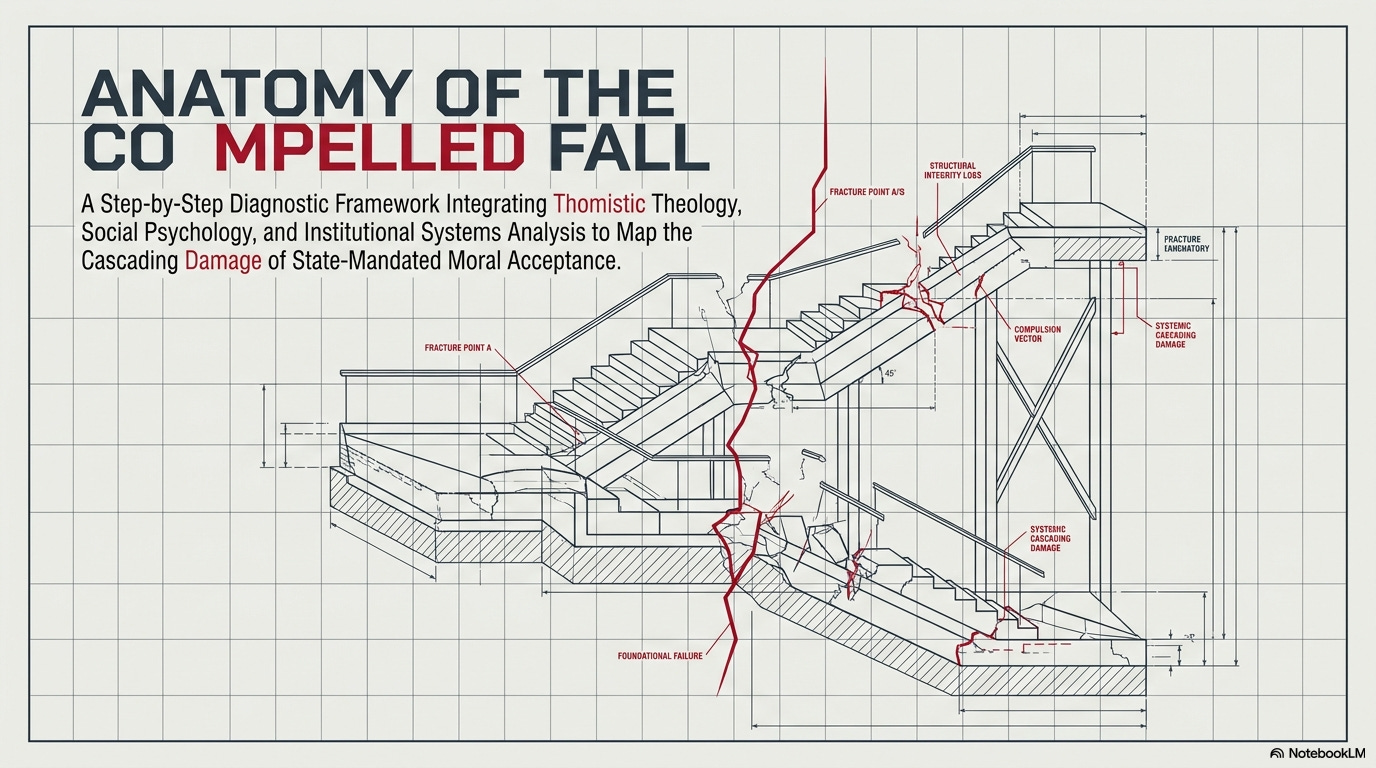
THE COMPELLED FALL
State-Mandated Moral Acceptance, the Wounding of Human Faculties,
and the Cascading Damage to Person and Society — 1973 to Present
A Moral, Theological, and Psychological Apologetic
with Expanded Theological, Philosophical, and Empirical Analysis
Drawing upon Saint Thomas Aquinas, Modern Psychology,
and the Observable Evidence of Social Disintegration
________________
—
Preamble: A Question of Compelled Acceptance
This document is an apologetic — a reasoned moral and philosophical defense of a position. Its central claim is not merely that legalized abortion is wrong, but that the manner by which abortion was legalized in the United States — by judicial fiat, without democratic deliberation, and enforced by the full coercive apparatus of the State — constitutes a unique and identifiable category of harm: the compelled acceptance of a moral wrong under threat of government power.
From this single rupture in 1973, this apologetic traces a documented cascade of moral, psychological, and social disintegration that has grown more severe across the five intervening decades, and for which, absent a fundamental reversal of principle, there is every reason to believe will continue to intensify. The argument draws upon the permanent theological insights of Saint Thomas Aquinas, the findings of contemporary psychological science, and the observable catalogue of social evidence that accumulates around us with increasing velocity.
A note on method: The Thomistic and psychological frameworks employed here are not mere rhetorical decoration but foundational explanatory tools. They explain not only that harm has occurred, but why it occurs, how it propagates through persons and generations, and why its trajectory is upward rather than self-correcting. This is not a lament — it is a diagnosis, from which a course of remedy may be discerned.
—
Part I: The Mechanism of State-Compelled Moral Acceptance
—
I.1 — The Distinction Between Persuasion and Coercion
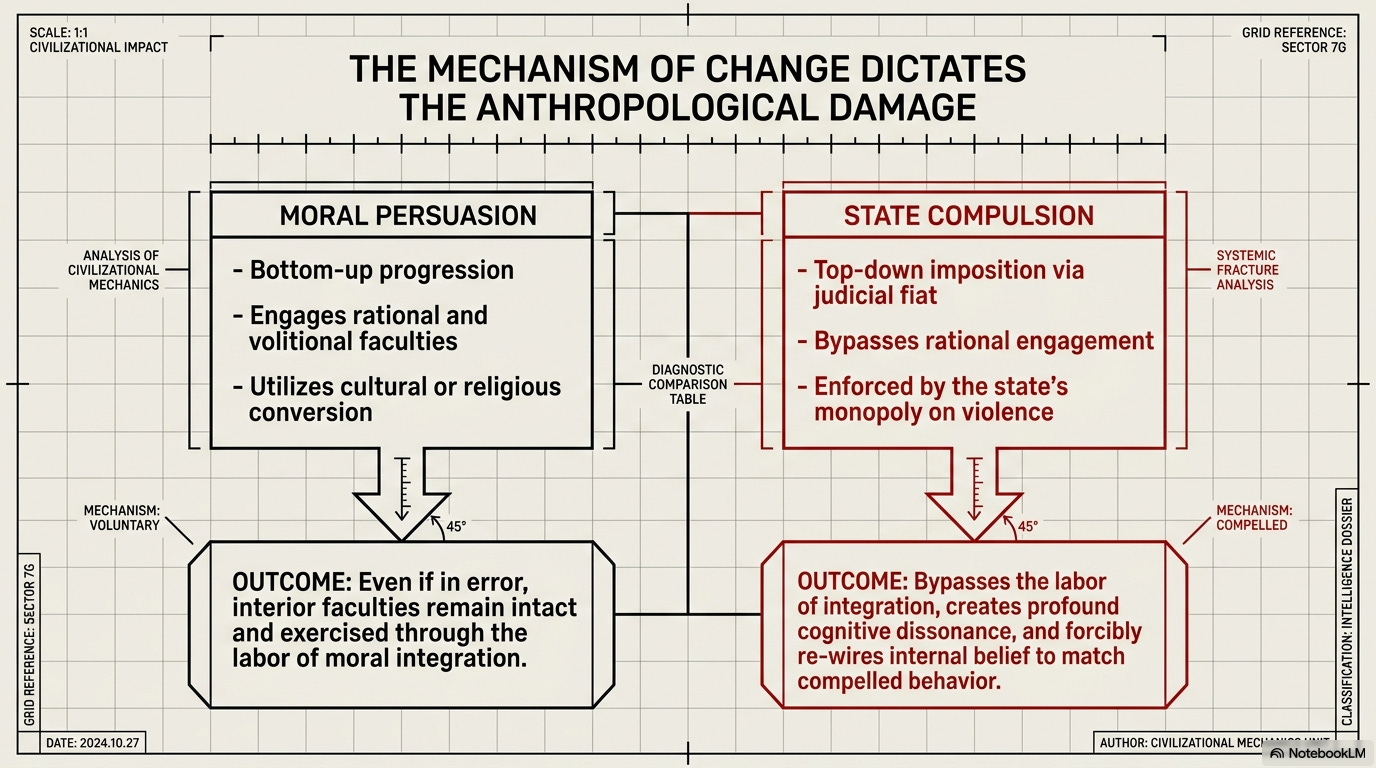
Moral positions change in society through two fundamentally different mechanisms. The first is persuasion: argument, demonstration, cultural shift, religious conversion, and the slow work of conscience operating in freedom across a community. The second is coercion: the imposition of a moral position backed by legal sanction and, ultimately, by the State’s monopoly on the lawful use of force. These two mechanisms are not morally equivalent. They produce different effects upon persons and cultures, and they carry different downstream consequences.
When a moral change is achieved through persuasion, those who adopt the change have, however imperfectly, engaged their reason, conscience, and will. Even if the change is wrongheaded, the faculties remain active. When a moral change is compelled by law — particularly when that law descends from a court rather than from the deliberative processes of a legislature — the individual is placed in a different relationship to the moral position. They are not asked to reason toward it. They are required to accept its practical consequences, fund it through their taxes, tolerate its exercise among their neighbours, and integrate it as a background social fact. The moral position is, in effect, installed from above.
—
—
I.2 — Roe v. Wade (1973): Judicial Imposition as Moral Event
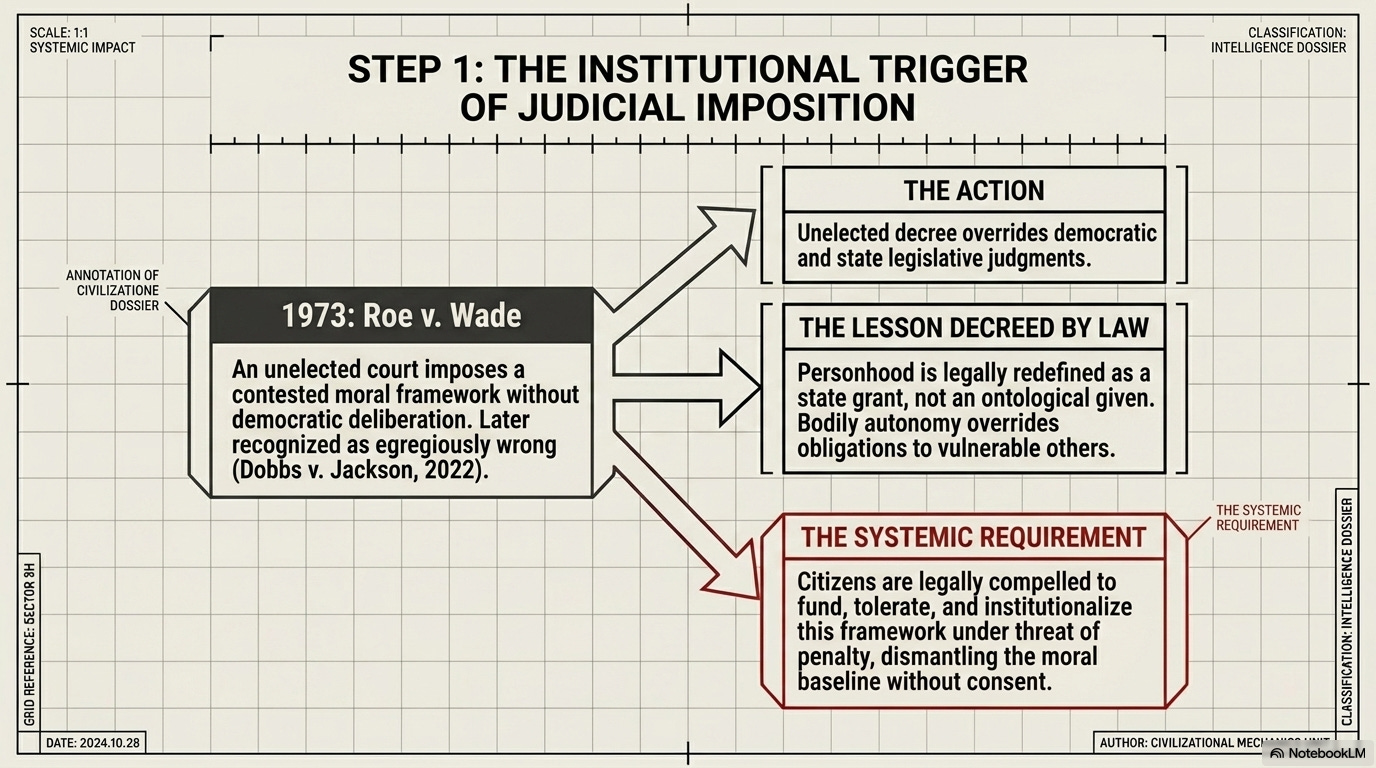
On January 22, 1973, the Supreme Court of the United States, in Roe v. Wade, struck down the abortion laws of all fifty states by judicial decision, without a single vote cast by any American citizen in any democratic forum. Seven justices — unelected, life-tenured, accountable to no constituency — declared that a constitutional right to abortion existed, and that this right overrode the legislative judgements of every state government in the union.
The constitutional basis was fragile from the outset. Justice Blackmun’s majority opinion located the right in a “zone of privacy” derived from penumbras and emanations of other constitutional provisions — a doctrinal architecture that even sympathetic constitutional scholars acknowledged was constructed rather than discovered. Justices Byron White and William Rehnquist dissented that the decision was “an exercise of raw judicial power.” Forty-nine years later, the Supreme Court itself, in Dobbs v. Jackson Women’s Health Organization (2022), confirmed that Roe had been “egregiously wrong” as a matter of constitutional law from its inception.
But the Dobbs overruling, however legally correct, cannot undo what the intervening fifty years accomplished in the moral fabric of the nation. The damage is not primarily legal — it is anthropological. What Roe did was not merely permit abortion. It conscripted the moral imagination of an entire society into the proposition that the deliberate ending of an unborn human life is a protected right — and it did so under pain of law, backed by the State’s coercive power.
—
I.3 — The Unique Moral Weight of State Compulsion
Saint Thomas Aquinas, in the Summa Theologica, observes that human law does not merely regulate external behaviour — it also teaches. Law is a moral instructor, in that it signals what a community regards as permissible, impermissible, required, or praiseworthy. When the State declares a thing lawful and protected, it communicates a moral lesson to every person under its jurisdiction, and particularly to every child raised within its educational institutions.
Roe communicated a lesson of extraordinary gravity: that the unborn child’s life is subordinate to the preferences of the one who carries it; that personhood is not an ontological given but a legal grant; that bodily autonomy is a value so supreme it overrides the life of another. These lessons were not offered for democratic debate — they were decreed. And having been decreed, they were enforced, institutionalized, funded, taught in schools, embedded in medical training, and woven into the standard assumptions of popular culture with a speed and thoroughness that voluntary persuasion could never have achieved.
This is the mechanism by which state-compelled acceptance differs from voluntary moral evolution. The latter leaves individuals the psychological labour of integration. The former bypasses that labour entirely — and in bypassing it, it bypasses the rational and moral faculties that the labour would have exercised. The result is a population conditioned to accept a profound moral claim without having reasoned their way to it. And a faculty never exercised atrophies. This atrophy is the subject of the remainder of this document.
—
Part II: The Theological Framework — Saint Thomas Aquinas on the Wounds of Sin
II.1 — Human Nature and Its Proper Order
Aquinas, following Aristotle and Augustine, understands the human being as a unity of body and soul in which rational faculties — intellect and will — are ordered toward their proper objects: truth and the good. The intellect is designed to apprehend reality as it is; the will is designed to desire and pursue what the intellect has correctly identified as genuinely good. When both faculties operate as designed and are ordered rightly toward God as the highest Good and Truth, the human person flourishes. This is what Aquinas means by virtue and the natural law: the conformity of human action to the rational order inherent in human nature and created reality.
—
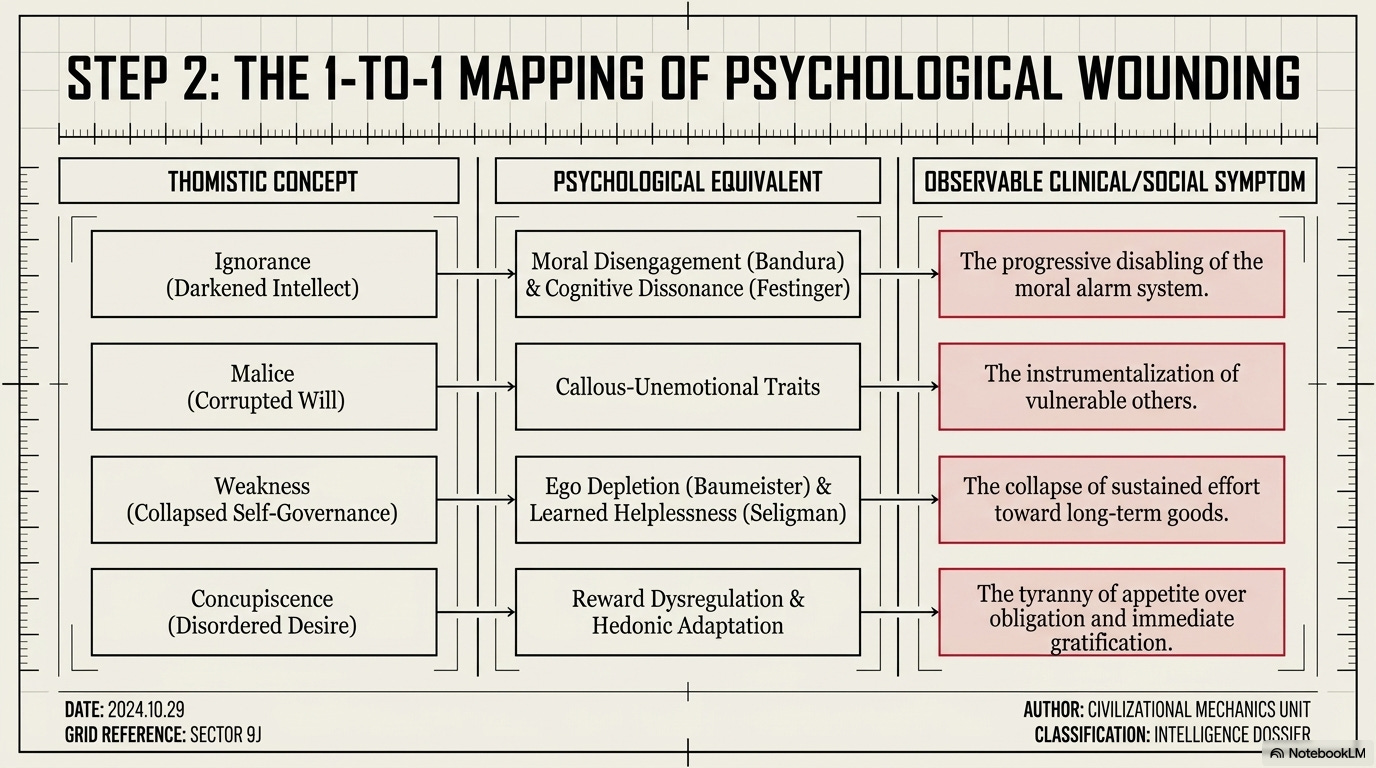
II.2 — The Four Wounds of Sin
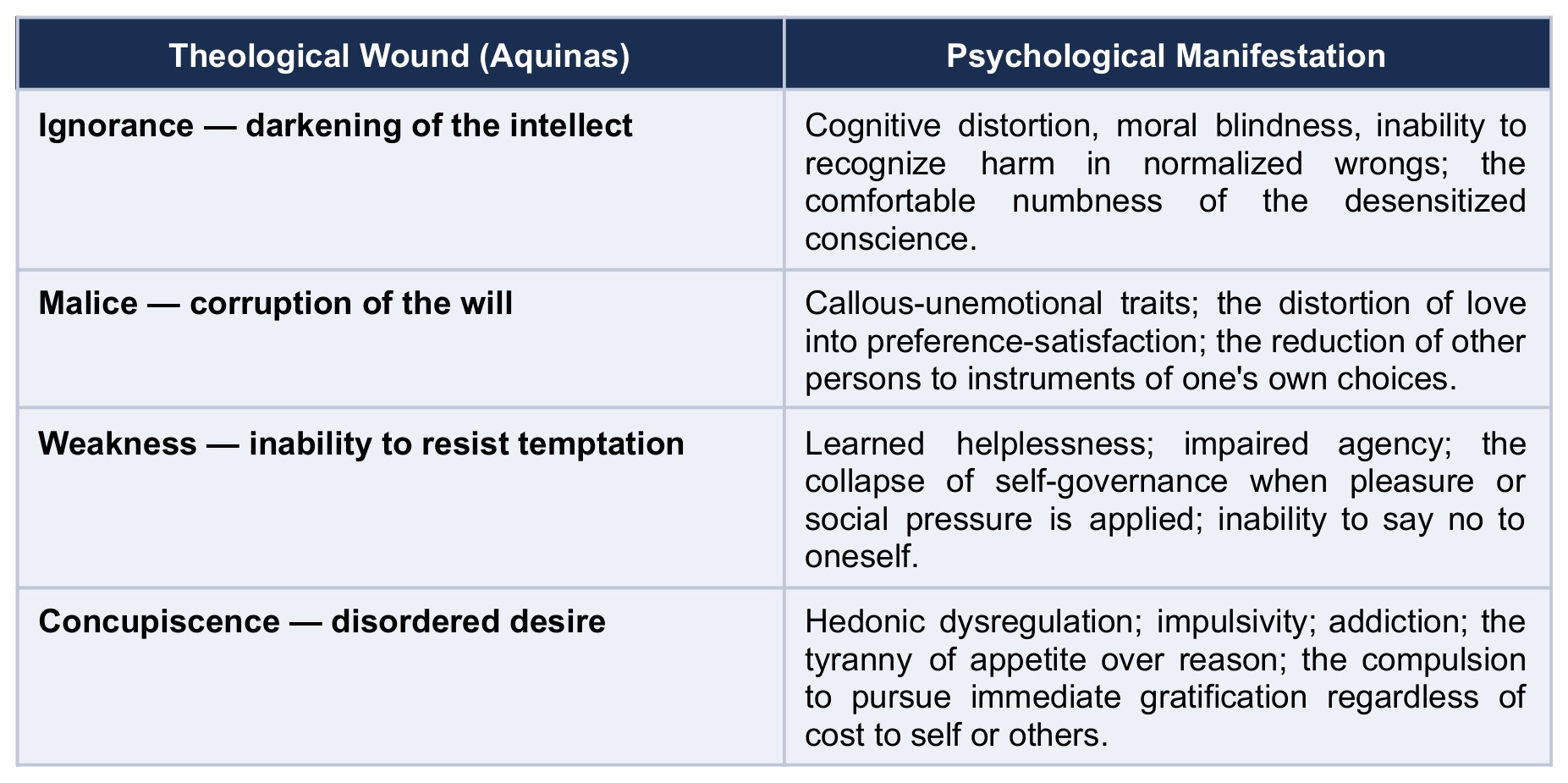
Aquinas teaches that sin — understood as a deviation from rational moral order — does not merely produce guilt. It inflicts positive damage upon the very faculties through which the human person apprehends truth and chooses good. In the Summa Theologica (I-II, Q. 85), he identifies four specific wounds that sin inflicts upon human nature, wounds inherited through original sin and deepened by personal and habitual sin. These are not metaphors but descriptions of functional damage to identifiable human capacities.
—
II.3 — Habituation and the Deepening of Wounds
A sin committed once harms. A sin committed habitually, and especially a sin normalized by social acceptance and legal permission, deepens the wound geometrically. Aquinas explains this through his account of virtue and vice as habits: repeated acts carve grooves in the soul, making certain responses progressively more automatic and others progressively less accessible. The person who routinely acts against reason progressively loses the capacity to reason clearly about the domain of their vice. The person whose community routinely acts against reason in a particular domain is surrounded by a social environment that continuously reinforces the vice and provides no corrective friction.
What Roe introduced was precisely such a social environment of habituation at the national scale. A wrong that had previously been restrained by law, custom, and social stigma was suddenly, and by governmental authority, removed from the category of wrongs entirely. The vice was not merely permitted — it was publicly celebrated, publicly funded, institutionally defended, and taught as a component of women’s liberation. Habituation at this scale does not merely wound individuals. It wounds generations.
II.4 — The Generational Transmission of Wounded Faculties
Aquinas’s account of original sin involves the recognition that the disorders of one generation are transmitted, in some fashion, to the next — not through mere imitation (though imitation is a powerful mechanism) but through the formative environment in which children develop their own moral perception and habits. A child raised in a community that has normalized abortion does not merely learn a proposition (”abortion is legal”). They are raised in an environment where the act is uncontested, where it is presented as morally neutral or positive, where those who object to it are marginalized as extremists, and where no corrective moral friction is encountered in educational, medical, or legal institutions.
This child’s intellect is therefore never exercised in the labour of examining the claim against the evidence of their own moral intuition and reason. The wound of ignorance is transmitted not through genetics but through the formative environment — through the cumulative weight of what is taken for granted, what is never questioned, and what is enforced by social and legal power. This is what the document calls “generational erosion”: each successive generation inherits a slightly more damaged moral faculty, and from this increasingly damaged foundation, it produces a slightly more disordered social consensus, which it then transmits to the generation that follows.
Part III: The Psychological Framework — Modern Science and the Confirmation of Ancient Wisdom
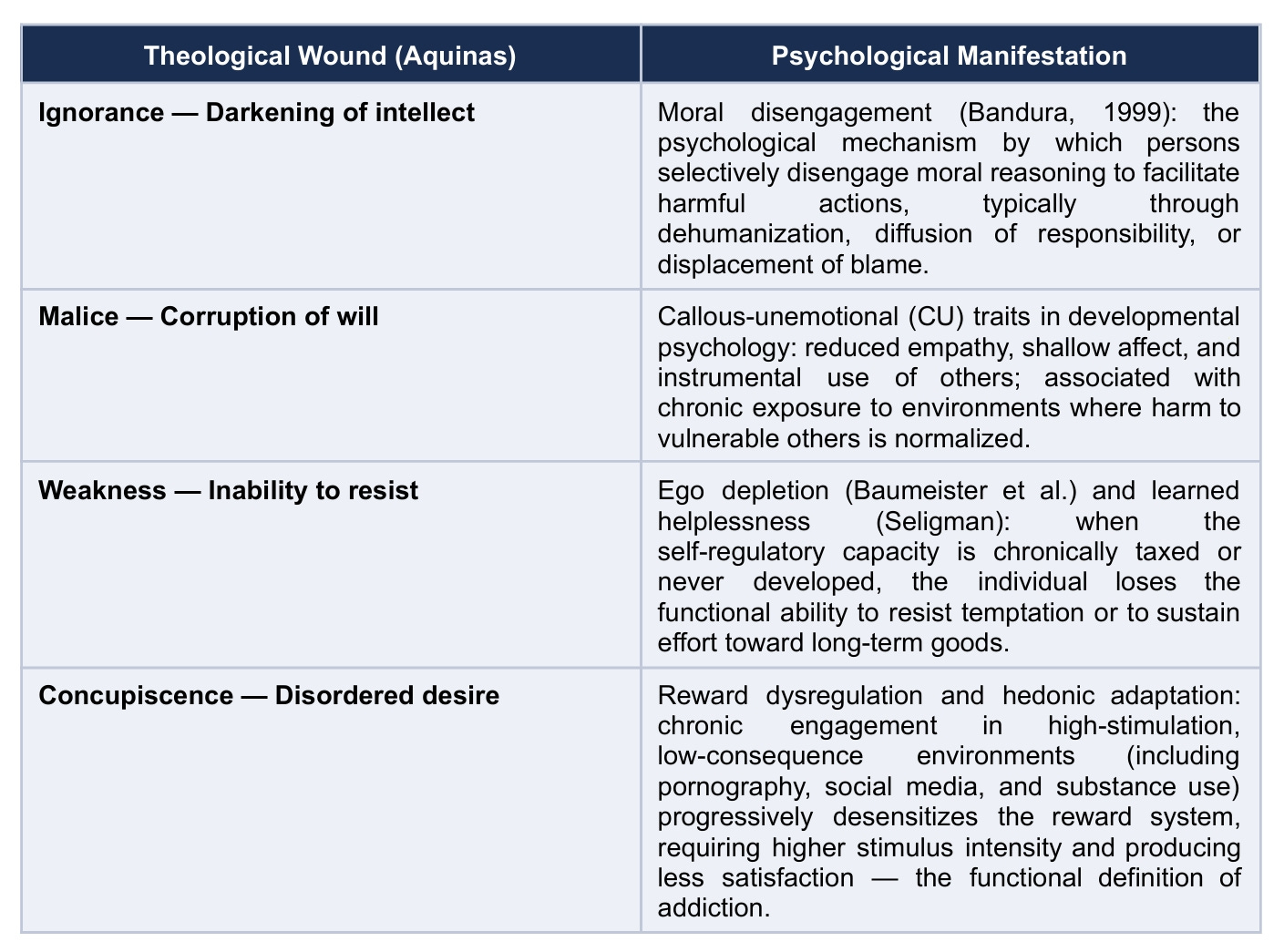
III.1 — The Scientific Parallel to the Wounds of Aquinas
It would be a mistake to regard Aquinas’s account of the wounds of sin as a purely theological construct with no purchase in the empirical world. Contemporary psychological science, operating from entirely different methodological premises, has identified a remarkably congruent set of phenomena. This convergence is not proof that each framework is simply translating the other — but it is evidence that both are tracking real features of human psychology as it responds to moral dysfunction.
The following correspondences are not speculative mappings. Each of the psychological phenomena identified has a robust literature in clinical, developmental, and social psychology, and each describes a dysfunctional cognitive or volitional state that corresponds structurally to the Thomistic wound with which it is paired.
—
III.2 — Social Desensitization and the Shifting Moral Baseline
One of the most thoroughly documented phenomena in social psychology is the shifting of what researchers call the “Overton Window” or, in experimental settings, the “anchor” — the reference point against which new information is evaluated. Morally, this corresponds to the process of desensitization: when exposure to a distressing or morally significant stimulus is sustained over time, the initial response — shock, disgust, grief, moral alarm — diminishes, and what was previously unacceptable becomes merely unusual, then ordinary, then unremarkable.
This process has been documented in laboratory settings with violence, sexual imagery, and expressions of cruelty — but its most consequential operation is at the social level, where the cumulative normalization of previously unacceptable moral positions reshapes the baseline of moral perception for entire communities. In 1972, the photograph of nine-year-old Kim Phuc running, naked and burning, from a napalm strike on her Vietnamese village generated immediate, overwhelming, international moral outrage. The image required no caption — it communicated its moral claim directly to the conscience of whoever saw it.
By contrast, in the present era, footage of incomparably greater violence and suffering is streamed continuously through social media platforms to audiences of billions, generating brief cycles of outrage that dissipate within hours and produce negligible long-term moral or political consequence. The moral alarm system has been degraded not by a single event but by the cumulative weight of exposure to moral enormity in a context where no proportionate response is culturally reinforced or required. The audience is trained, over decades, to feel briefly and move on. The wound of ignorance — the darkening of the moral intellect — operates precisely through this mechanism.
III.3 — The Psychology of Government-Mandated Belief
A crucial and underappreciated finding from social psychology bears directly on the argument of this document. Research in cognitive dissonance (Festinger, 1957) and self-perception theory (Bem, 1972) demonstrates that when a person is compelled by external authority to behave consistently with a proposition — particularly when they cannot publicly resist that compulsion — they will, over time, tend to adopt internal attitudes consistent with the compelled behaviour. The mechanism is not simply resignation: it is a deep psychological pressure toward internal consistency, which, when the external behaviour is fixed, resolves by shifting internal belief toward alignment with behaviour.
This means that state compulsion of moral acceptance is not merely a political or social phenomenon — it is a psychological intervention into the belief systems of the persons subject to it. A citizen who is repeatedly required to fund, tolerate, and publicly accept a practice — under pain of legal penalty for open non-compliance — is being subjected to a sustained psychological pressure that tends, over time, to produce genuine attitudinal change in both the individual and the population. This is not hypothetical. It is a well-documented feature of how authoritarian moral systems have always operated, and it is precisely the mechanism at work in the post-Roe normalization of abortion.
III.3a — Dalrymple: The Lie Demanded as an Instrument of Power
The argument of this document — that state-compelled acceptance of a moral wrong inflicts damage upon the moral and rational faculties of the persons compelled — finds precise and striking corroboration in the work of the British psychiatrist and social critic Theodore Dalrymple (Anthony Daniels), whose extended observations of life under ideological compulsion provide a clinical dimension to the political philosophy.
Dalrymple’s central insight, developed across his work on political correctness, propaganda, and the culture of enforced dishonesty, is that the demand that a person accept and repeat an obvious falsehood is not primarily an informational act — it is an act of power, and it is chosen for its psychological effect rather than for its truth content. The person who can compel another to say what both parties know to be false has demonstrated something more devastating than mere physical dominance: they have demonstrated that the compelled party cannot mount even the interior resistance of refusing to speak a lie. The victim of this compulsion has been shown — to themselves as much as to their tormentor — that their grip on their own rational self-governance is insufficient to resist even the demand to betray truth with their own words.
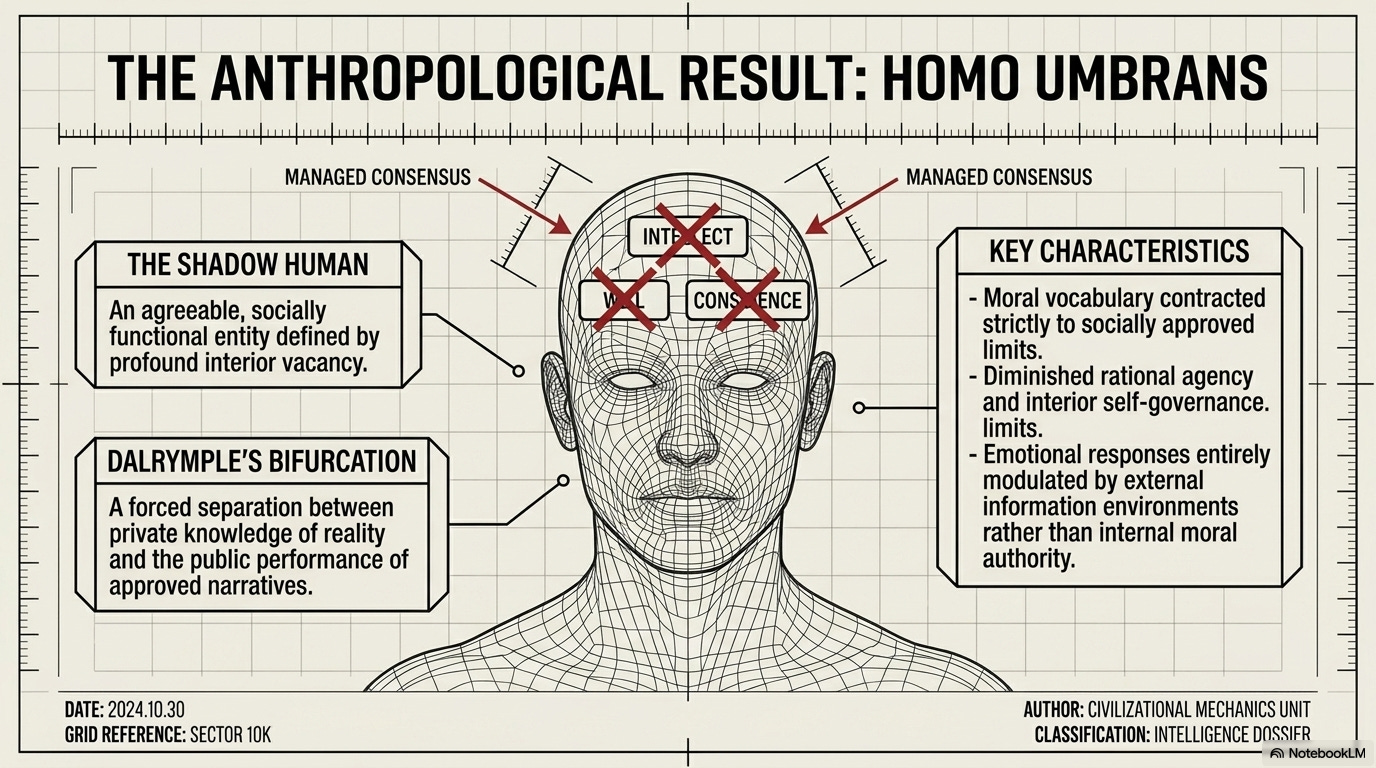
Dalrymple observes that life under conditions of enforced ideological dishonesty produces a characteristic psychological configuration in those subjected to it: a progressive bifurcation between the person’s private knowledge of reality and their public performance of the approved narrative. This bifurcation is not neutral — it is corrosive. The sustained effort of maintaining a public position one knows to be false, without the ability to resist it openly, requires the continuous suppression of one’s own rational and moral responses. Over time, this suppression becomes habitual; the capacity for honest self-assessment, which depends upon the habit of connecting one’s interior judgements to one’s exterior expression, is degraded. The person becomes, incrementally, less able to distinguish their own genuine convictions from the socially compelled performance — which is precisely the condition that the Thomistic wound of ignorance describes from a theological direction.
Applied to the post-Roe American cultural environment, Dalrymple’s analysis illuminates why state-compelled acceptance is so much more damaging than mere legal permission. A law that merely permitted abortion would leave the moral imagination of the population relatively free to form its own judgement about the practice. A cultural environment in which the acceptable public position is not merely “abortion is legal” but “abortion is healthcare,” “abortion is a right,” and “opposition to abortion is a form of violence against women” — enforced through social ostracism, professional consequence, and institutional pressure — requires citizens to perform the compelled lie in precisely the way Dalrymple describes. They learn, by repeated experience, that their private moral judgement cannot be expressed without cost. They learn to suppress it. And the suppression, as Dalrymple documents and Aquinas predicts, progressively compromises the faculty that performs it.
—
III.4 — The Concept of Homo Umbrans: The Shadow Human
The term “Homo Umbrans” — the Shadow Human — captures a phenomenon that the psychological evidence described above points toward: the progressive dimming of the fully integrated human person into a shadow version of themselves, defined by diminished rational agency, attenuated moral perception, weakened self-governance, and increasing susceptibility to ideological direction.
The Homo Umbrans is not a monster. They may be agreeable, productive, and socially functional. What defines them is an interior vacancy: the rational and moral faculties that would have equipped them to interrogate received propositions, resist social pressure, sustain long-term commitments, and perceive the human dignity of those whom their society has designated as non-persons — these faculties have been progressively dimmed through habituation, desensitization, and the replacement of interior moral authority by externally managed consensus.
The Homo Umbrans does not choose evil with the full engagement of a corrupted will. They largely fail to recognize it as evil at all. Their moral vocabulary has contracted to the range of the socially approved. Their emotional responses have been modulated to the frequencies broadcast by their information environment. Their sense of selfhood is largely assembled from the identity-fragments offered to them by ideology, commerce, and entertainment. This is the cumulative anthropological product of five decades of state-mandated moral acceptance, generational erosion, and systematic desensitization — and it is the most dangerous condition of all, because it is self-sustaining and self-reproducing.
Part IV: Primary Evidence of Wounded Mind and Soul — The Immediate Aftermath of 1973
IV.1 — The Desensitization of the Moral Conscience
The most immediate and traceable evidence of the wounding process initiated by Roe v. Wade is the graduated desensitization of moral alarm across the American and Western cultural space. The trajectory is not a matter of subjective impression but of documented shifts in cultural production, legal standards, institutional policy, and — crucially — in what is now treated as appropriate material for children.
Prior to 1973, the broad American moral consensus included: the wrongness of taking innocent human life; the special vulnerability and consequent protection owed to the unborn, the infant, the child, and the elderly; and the proper role of civic institutions in defending those who cannot defend themselves. Roe fractured this consensus not merely on the question of abortion but at the level of the underlying principles. If the unborn child is not a legal person, then the category of “those who cannot defend themselves and who therefore require institutional protection” has been contracted by governmental decree. And once the category has been contracted once — once the principle of state-determined personhood has been established — every subsequent extension of that principle encounters less resistance, because the first and hardest contraction has already been accepted.
IV.2 — The Destruction of Family and the Systematic Marginalization of Fatherhood
IV.2a — No-Fault Divorce: The Statistical Record and Its Ideological Drivers
Among the most empirically well-documented consequences of the post-1973 cultural revolution is the systematic destruction of the family and the progressive legal, social, and institutional marginalization of fatherhood. The centrepiece mechanism of this destruction is no-fault divorce, introduced in California in 1969 and adopted by every U.S. state by 1985 — the same legislative period in which Roe was consolidated as federal law and feminist ideology achieved its first major institutional penetrations into law, education, and public policy.
The statistics that emerge from no-fault divorce data are not anecdotal impressions — they are documented, replicated findings across multiple longitudinal studies. In marriages involving college-educated populations — the demographic most fully exposed to the feminist academic culture that produced “gender studies” curricula, the ideology of female autonomy as the supreme personal virtue, and the social and legal apparatus of abortion-on-demand — women initiate divorce at a rate approaching 70 to 80 percent. Among the broader population, the figure is consistently above 65 percent, and this pattern has been stable across decades and replicated across Western jurisdictions.
The reasons cited for divorce in these studies compound the indictment. Research by sociologists including Michael Rosenfeld (Stanford, 2017) and replicated in surveys conducted by the National Fatherhood Initiative and similar bodies consistently finds that the most frequently cited reasons for female-initiated divorce fall into a cluster that researchers variously label as unmet personal expectations, lack of self-fulfilment, the desire for personal growth or independence, and emotional dissatisfaction — categories that, taken together, describe what Aquinas would recognize as the wound of concupiscence: disordered desire elevated above obligation, commitment, and the good of others, including one’s own children. Independent review of stated grounds in contested divorce proceedings finds that a majority of women-initiated divorces in college-educated populations cite reasons that, stripped of therapeutic language, reduce to variants of self-priority: the marriage no longer met her needs; she had changed and wanted different things; she felt unfulfilled. In the language of this document, these are descriptions of the wound of weakness — the collapse of the sustained act of will that love, properly understood, requires.
This is not a claim that every woman who initiates divorce is morally culpable in equal measure, nor that genuine marriages of abuse, cruelty, or abandonment should be maintained. It is the claim that the aggregate statistical pattern — women initiating the overwhelming majority of divorces, in the demographic most fully exposed to ideological formation through feminist academic culture, citing reasons that are predominantly self-referential — is not a random distribution. It is the sociological signature of an ideology that has successfully taught a generation of women that their primary moral obligation runs to the self, that personal fulfilment is the supreme criterion of a life well-lived, and that commitment, sacrifice, and the prioritization of the needs of children and spouse over one’s own preferences are forms of oppression rather than virtue.
IV.2b — Feminist Ideology and the Amplification of Privilege
The ideological infrastructure that produced this statistical pattern was not assembled by accident. It was constructed deliberately, institutionalized systematically, and funded publicly, through the apparatus of academic “gender studies,” feminist legal theory, Title IX bureaucracies, government-funded women’s advocacy organizations, and the pervasive cultural industry of popular feminism in media, entertainment, and social platforms.
At the core of this ideological formation is a specific claim about the relationship between women’s autonomy and their obligations. The claim is that women’s autonomy — bodily, professional, relational, reproductive — is an unconditional right requiring no justification and admitting no limitation by external obligation or the needs of dependants. This claim was given its most powerful legal expression in Roe v. Wade, where the Supreme Court declared that a woman’s right to determine what happens to and within her body was so fundamental that it overrode even the life of the human being whose existence resulted from her prior free choices. The message transmitted to every woman in the country by that decision — backed, as all legal decisions are backed, by the State’s monopoly on the legitimate use of force — was: your autonomy is supreme. Your preferences are constitutional. What you choose for your body cannot be overridden even by the life of another.
This proposition, installed by judicial decree and thereafter reinforced by every institutional apparatus of the feminist academic and legal culture, has the predictable psychological effect that social learning theory would predict: it creates in those who absorb it a vastly amplified sense of personal entitlement and a correspondingly diminished sense of obligation. When this inflated entitlement — the internalized message that one’s personal preferences and sense of fulfilment are constitutional priorities — is brought to the institution of marriage, which demands precisely the subordination of personal preference to sustained commitment, the friction is severe and the statistical outcome is what we observe: divorce, overwhelmingly initiated by those whose ideological formation has most thoroughly convinced them that personal fulfilment is the supreme criterion of a morally acceptable life.
The wound of concupiscence — disordered desire — operates here not as a primal appetite but as a cultivated ideological formation: the systematic training of desire toward the self and away from the other, disguised as liberation and validated by the authority of the State, the academy, and the courts. It is, in Aquinas’s terms, vice institutionalized as virtue.
IV.2c — The Enslavement of the Father and the Severing of the Family
The consequences of this pattern for the father — and, far more critically, for the children — are catastrophic in their scale and compound in their generational transmission. When a woman initiates divorce, particularly in a marriage involving children, the standard legal and social outcome in the contemporary United States and most Western jurisdictions involves a configuration of radical asymmetry: the mother receives primary physical custody of the children in the overwhelming majority of contested cases; the father is reduced to visitation according to a court-determined schedule, typically representing a minority of the child’s time; and the father is simultaneously required, under legal compulsion and on pain of imprisonment for non-compliance, to continue providing financial support to a household from which he has been largely or entirely excluded.
This configuration deserves to be named plainly for what it is. The father is legally compelled, on pain of criminal prosecution, to fund a household and family life from which the initiating party has excluded him. He continues to bear the financial obligations of family membership while being denied the presence, the daily relationship, the ordinary moments of formation and influence, and the legitimate authority that constitute the actual substance of fatherhood. He is retained as a financial instrument while being removed as a person. The language of “child support” dignifies this arrangement with the vocabulary of parental obligation; the reality, in many cases, is a form of economic servitude maintained by judicial order, in which the father’s labour continues to benefit those from whom he has been structurally separated, with no corresponding right of presence, influence, or relationship proportionate to his financial obligation.
The social science literature on the consequences of father removal from the family is among the most consistent and replicated bodies of evidence in developmental psychology. Children raised without a consistently present father are, relative to those raised in intact two-parent households: significantly more likely to live in poverty; significantly more likely to experience educational failure and dropout; significantly more likely to engage in criminal behaviour (the effect being particularly pronounced for male children); significantly more likely to experience substance abuse disorders; significantly more likely to experience mental health disorders including anxiety, depression, and conduct disorders; and — completing the generational loop — significantly more likely themselves to have children outside of stable partnerships, thus propagating the pattern into the next generation.
These are not ideological claims. They are the findings of the social science literature, from researchers across the political spectrum, replicated across decades and jurisdictions. The family with an engaged, present father is the single most powerful anti-poverty, anti-crime, and pro-flourishing institution that human society has ever developed. Its systematic destruction — through a combination of legal incentives, ideological formation, and the cultural devaluation of masculine domestic authority — is the most consequential social policy catastrophe of the past half-century, and it is one whose victims are primarily children who did not choose it.
IV.2d — The Absent Masculine and the Manufactured Stereotype
The removal of fathers from the family produces a secondary harm of underappreciated severity: the growing up of entire generations of children — particularly male children — without substantive personal experience of adult masculinity in a domestic, relational, or formative context. This experiential deficit does not occur in a cultural vacuum. It occurs in an environment saturated with representations of men and masculinity that are systematically negative, that portray fathers as absent by choice, as dangerous, as incompetent, as emotionally stunted, or as sources of threat to women and children.
The popular culture, the public health apparatus, the educational system, and the legal culture have, over the past fifty years, progressively adopted and broadcast a narrative about men — and specifically about fathers — that would be immediately recognized as prejudicial and harmful if applied to any other demographic group. Men are presumed potentially violent in domestic contexts; fathers who seek custody are treated by courts and social services as the more likely source of harm; masculine modes of engagement — competition, physical assertiveness, risk-taking, directness — are pathologized in educational settings designed around norms of behaviour that correspond more naturally to female developmental patterns.
A child who grows up without a consistently present father, whose early educational experience is delivered almost exclusively by female teachers and administrators — a demographic reality in American primary and secondary education, where women now comprise over 75 percent of teaching staff at the elementary level and over 60 percent at the secondary level — and whose media environment presents men primarily as absent, dangerous, or comic figures, has no personal experiential corrective to these representations. The stereotype becomes, for that child, the only available evidence. When the only accessible data about adult men comes from institutional narratives that are systematically hostile to positive masculine identity, the child’s cognitive model of what men are and what fathers do is assembled from prejudice in the absence of experience.
The consequences for male children are particularly severe. Boys who grow up without fathers, in schools where masculinity is implicitly or explicitly treated as a problem to be managed, and in a cultural environment where positive masculine identity is absent from the dominant representations they receive, face the challenge of constructing a male identity from hostile or absent materials. The documented results include: dramatically elevated rates of school disengagement among boys relative to girls (a gap that has widened consistently since the 1990s); higher rates of mental health crisis among young men; the crisis of male meaning and belonging that has driven the explosive growth of radicalized online communities offering perverse substitutes for the legitimate masculine formation that families and communities once provided; and the rising rates of male violence, addiction, and social withdrawal that are the predictable product of a generation of boys raised without the modelling, the discipline, and the affirmation of positive masculine identity that only a present father can reliably provide.
This is the full circuit of the wound: ideology drives divorce; divorce removes the father; the removed father’s absence creates children — especially sons — without masculine formation; the absence of masculine formation creates a cultural and personal vacuum that institutional narratives fill with stereotypes and pathologies; those stereotypes further delegitimize the father and masculinity itself; the next generation of young men, formed in this environment, is less capable of the sustained commitment of fatherhood; and the cycle deepens. Each generation’s wound is the previous generation’s unaddressed wound, compounded.
IV.2e — The Two Modes: What Father and Mother Each Provide
Natural law philosophy and a substantial body of developmental research converge on a point that the dominant ideology works hard to obscure: mothers and fathers do not provide the same thing, dressed in different names. They provide categorically different and complementary developmental goods, each irreplaceable and each necessary for the full formation of the child. The Catholic anthropological tradition, grounded in the differentiated ordering of the sexes toward the good of the family, has always understood this. Contemporary developmental psychology, operating from empirical rather than theological premises, has confirmed it.
The maternal mode is oriented primarily toward nurture and emotional regulation. In the earliest years, the mother’s presence establishes the foundational security from which all subsequent development proceeds: the secure attachment that allows exploration, the emotional literacy that enables relationship, the regulatory attunement that teaches the infant to manage its own internal states. The mother provides what researchers call the “safe harbour” — the stable emotional base from which the child ventures into the world. This is not a minor or optional contribution. It is the developmental bedrock without which nothing else can be built.
Yet this is precisely what the post-1973 cultural revolution has systematically removed or degraded for a growing proportion of children. The same ideological formation that encourages women to treat motherhood as secondary to career advancement, and that armed them legally with the right to dissolve the family structure without the father’s consent, has produced a cultural and economic environment in which both intact and single-parent families routinely place infants and very young children in institutional daycare during the precise developmental window — the first two to three years of life — in which the safe harbour is most critically needed. Research by Jay Belsky and colleagues, which generated enormous controversy when first published precisely because it challenged the dominant ideology, found that extended non-maternal care in the first year of life was associated with insecure attachment and elevated cortisol stress responses in infants. The secure base is not interchangeable: a rotating staff of daycare workers, however well-intentioned, cannot provide the continuous, attuned, specifically maternal presence that the infant’s developing nervous system requires. When the ideology that produced legal abortion as a right simultaneously produced the career imperative that removes the mother from the infant during this window, it damaged both ends of the developmental equation simultaneously.
The grandmother tradition that this document’s source material analyses in depth was historically the partial corrective to this tension: when mothers needed to work or recover, the maternal grandmother — ideologically aligned with the family’s continuity and practically skilled in infant care — provided care of a quality and relational warmth that no institutional substitute can replicate. Research by Baydar and Brooks-Gunn (Developmental Psychology, 1991) documented that grandmother care is superior to institutional care for preschool developmental outcomes, producing better language development, fewer behavioural problems, and stronger attachment. But the ideologically captured grandmother — the Baby Boomer grandmother who absorbed the feminist formation of the 1960s and 1970s, who may herself have encouraged or normalized the divorce, who transmits not traditional wisdom but inverted values — does not reliably provide this corrective. A 40-year longitudinal study by sociologist Vern Bengtson found that when a grandmother is highly religious and traditionally formed, 63 percent of her grandchildren remain so; when she is non-religious or ideologically captured, the transmission of the faith and the practical wisdom it carried effectively fails. The safe harbour has been doubly damaged: removed from the infant by ideology-driven maternal absence, and no longer reliably provided by the ideologically captured grandmother who would historically have stood in the gap.
The paternal mode is oriented differently: toward protection and the expansion of horizons. The father’s characteristic engagement with children — the rough-and-tumble play, the encouragement of risk-taking within safe limits, the push toward independence and social competence, the modelling of how strength is regulated and directed toward the good of others — provides something the maternal mode cannot replicate and was not designed to. Where the mother provides the safe harbour, the father provides the “voyage”: the experience of a world beyond the self that requires courage, judgement, and the capacity to absorb and recover from difficulty. K. D. Pruett’s foundational research, documented in Fatherneed (2000), demonstrates that children deprived of this paternal developmental input show measurable deficits in precisely the capacities it was designed to cultivate: risk assessment, frustration tolerance, social competence with peers, and the regulation of competitive and aggressive impulses.
These two modes are not interchangeable. A mother attempting to provide both — as divorced and single mothers are structurally required to do — is being asked to provide a developmental good that is, in the relevant respects, outside her natural register. This is not a criticism of single mothers, many of whom perform extraordinary feats of love and dedication under conditions of radical asymmetric burden. It is an identification of what the law and the culture have done to them and to their children by treating the father as an expendable component of the family rather than an irreplaceable co-provider of categorically different developmental goods.
IV.2f — The Daughter Without Her Father: Biological and Relational Consequences
The impact of father absence on daughters has been among the most consistently documented and least publicly acknowledged findings of developmental research over the past four decades. The natural law tradition’s account of the father as the protector of the daughter’s moral and relational formation is confirmed, from a completely different methodological direction, by the biological and psychological literature.
The most striking biological finding is the link between father absence and earlier onset of puberty in daughters. Research by Bruce Ellis and colleagues, published in Child Development (2003) and replicated in subsequent studies, found that daughters raised without their biological fathers entered puberty measurably earlier than daughters in intact families — a finding that persists after controlling for socioeconomic status, maternal behaviour, and other confounds. The proposed mechanism is evolutionary: the absence of the biological father’s pheromonal presence, combined with the environmental stress of a fatherless household, triggers a biological “fast life history strategy” — earlier reproductive maturity in an environment perceived as unstable. The body, in effect, responds to the social damage of father removal with a biological adaptation that places the daughter at risk of premature adult sexualization before her psychological and relational formation is adequate to manage it.
The relational consequences compound the biological ones. The father provides, in the Catholic anthropological tradition’s precise terms, the daughter’s first “template” for how a man should treat a woman — the lived, daily experience of being valued, protected, and related to with dignity by a male person who has no agenda other than her good. When this template is absent, the daughter faces adult male relationships without the internal reference point that would allow her to distinguish genuine care from manipulation, appropriate interest from exploitation, and worthy partnership from the appearance of it. What researchers describe as “paternal hunger” — the deficit of paternal affirmation that manifests as heightened sensitivity to male attention and a lowered threshold for romantic involvement — is the predictable relational consequence of the missing template. The statistical outcomes are well-established: daughters from fatherless homes show significantly higher rates of early sexual initiation, higher rates of unintended adolescent pregnancy, and greater vulnerability to exploitative relationships across the life course.
The theological dimension of this finding is important. The Catholic tradition does not locate the father’s protective role merely in surveillance or discipline. It locates it in presence — in the stabilizing horizon of a loving male authority that allows the daughter to develop her femininity without the premature pressure of adult male attention in the absence of adult male protection. When that horizon is removed — by divorce, by the legal apparatus that facilitated the divorce, and by the ideological formation that encouraged it — the daughter is not merely inconvenienced. She is placed, by the decisions of adults and the policies of governments, in a position of developmental vulnerability that she did not choose and cannot remedy by her own will. The harm runs from the state-compelled acceptance of the moral framework that made her father’s removal thinkable all the way to the biological adaptation her body makes to the resulting instability. This is the full reach of the cascade.
IV.2g — The Burden Shifted Onto the Mother: Role Overload and the Cascade Into Poverty
The harms of the fatherless family do not fall only on the children. They fall with particular severity on the mother who, having been placed — whether by her own choice under ideological formation, or by the father’s abandonment, or by some combination — in the position of sole parent, is structurally required to perform what can only be described as a functional inversion of her natural developmental role.
The single mother must provide both the maternal emotional regulation that is her natural strength and the paternal discipline, boundary-setting, and outward orientation that constitute a categorically different developmental register. She must do this while managing the household economy, maintaining employment sufficient to meet financial obligations, and doing so without the economic partnership that the intact family provides. The result, documented extensively in the research on single-parent households, is chronic role overload — the sustained attempt to perform two full developmental functions simultaneously, without adequate rest, support, or resources — which produces in turn the progressive reduction of the one capacity most essential to the maternal role: the attentive, regulated, emotionally available presence that infants and children require.
The economic dimension of this overload is severe and self-compounding. Single-mother households in the United States are among the highest-risk demographic categories for poverty: approximately 40 percent live below the poverty line, a rate five to six times higher than that of married-couple families with children. This economic instability does not merely create material hardship — it creates a pervasive insecurity that shapes every dimension of the child’s developmental environment, reducing the sense of safety that is the precondition of healthy attachment and cognitive development, and increasing the family’s dependence on state welfare apparatus rather than the organic community and extended family networks that the family structure, when intact, naturally generates and sustains.
There is a further dimension that the uploaded material identifies with precision and that deserves explicit treatment here. When the father is removed and the mother’s family of origin — grandmother included — has itself been shaped by the ideological formation described in this document, the extended family network that should provide corrective wisdom, practical support, and alternative masculine presence for the children may instead function as what the source material calls “an accelerant of dissolution.” A grandmother who absorbed the feminist ideology of her own formation, who encouraged or normalized the divorce, who reinforces the narrative of male inadequacy and female victimhood, and who transmits these attitudes to the grandchildren in the authority-weighted manner characteristic of the grandmotherly role, is not providing the safety net the family requires. She is providing the next generation of the same wound, dressed in the language of solidarity and support.
This is the complete downward cascade of the family destroyed by ideologically driven divorce: the children lose the father’s irreplaceable developmental contribution; the mother is burdened with functional and economic overload that degrades her capacity for the very nurture that is her natural gift; the extended family, captured by the same ideology, reinforces rather than corrects the damage; and the children — daughters prematurely sexualized, sons without masculine formation — carry the compounded wound into adulthood and reproduce its conditions in the families they attempt, and often fail, to form. The State, which compelled the initial moral acceptance that made all of this thinkable, then funds — through welfare, public housing, medicalized intervention, and the expanding apparatus of the therapeutic state — the management of the damage it has produced, while the ideology that produced it continues to be taught in every school and broadcast through every institutional channel.
IV.2h — The Ideologically Captured Grandmother: From Civilizational Anchor to Accelerant of Dissolution
The most underappreciated single factor in the generational transmission of the damage described in this document is the ideological capture of the grandmother — the elder woman who, in the pre-revolutionary family structure, served as the primary transmitter of moral, spiritual, practical, and relational wisdom across generations, and who now, in a growing proportion of families, transmits instead the inverted values that accelerate the very dissolution she once existed to prevent.
The grandmother’s traditional function was not peripheral. The “Grandmother Hypothesis” in evolutionary anthropology — developed by Hawkes et al. in the Proceedings of the National Academy of Sciences (1998) — posits that the uniquely extended post-reproductive lifespan of human females evolved precisely because grandmotherly care and knowledge transmission increased the survival and reproductive success of offspring sufficiently to constitute a significant evolutionary advantage. A meta-analysis of 45 studies by Sear and Mace (Evolution and Human Behavior, 2008) found that maternal grandmother presence is the single strongest predictor of child survival across diverse human societies. This is not merely a Western or Christian observation — it is a cross-cultural universal, documented in pre-communist China, traditional India, pre-colonial Africa, and Native American tribal societies, each of which identified the elder woman as the repository of the community’s practical knowledge, moral formation, and sacred tradition.
Within the Christian and specifically Catholic tradition, this role carries explicit scriptural mandate. Titus 2:3-5 instructs elder women to “teach what is good, and so train the young women to love their husbands and children, to be sensible, chaste, domestic, kind” — an intergenerational transmission of precisely the virtues whose absence this document traces through the post-1973 social landscape. St. Augustine, St. John Chrysostom, and the catechetical tradition following the Council of Trent all identified the grandmother as a primary agent of domestic catechesis — the transmission of lived faith in the home. A 40-year longitudinal study by sociologist Vern Bengtson (Families and Faith, 2013) quantified this: when a grandmother is highly religious and traditionally formed, 63 percent of her grandchildren remain so; when she is nominally religious, that figure falls to 28 percent; when she is non-religious or ideologically captured, effective faith transmission fails almost entirely. The grandmother is more important than the mother for intergenerational faith transmission because of her longer time horizon, her moral authority in the family system, and the additional availability she has once her own childrearing is complete.
The traditional grandmother performed five specific and irreplaceable functions: moral and spiritual formation through daily prayer, catechism, and the modelling of virtue; practical wisdom transmission covering domestic arts, food preservation, household economy, and folk medicine; relationship and marriage guidance grounded in lived experience and long-term orientation (”physical attraction fades; character remains”; “never threaten divorce”; “all marriages have difficult seasons”); childcare support and parenting wisdom that provided both practical relief and the developmental perspective that only experience can supply; and social enforcement and gatekeeping — the maintenance of community moral standards and the protection of young women from poor mate choices through the network of social observation and accountability that elder women historically managed. This last function — the calibration of female mate selection by experienced elder women who understood what actually sustains a family across a lifetime — is precisely what the ideological revolution dismantled most thoroughly and most deliberately.
The Baby Boomer generation of women — born between 1946 and 1964 — was the first to be widely and deeply ideologically captured by the revolutionary changes that this document traces: the contraceptive pill (FDA-approved 1960), which severed the biological link between sexuality and procreation; the feminist ideological revolution catalysed by Friedan’s The Feminine Mystique (1963), which reframed domestic roles and maternal vocation not as a noble calling but as oppression; and no-fault divorce (California 1969, nationally adopted by 1985), which converted marriage from a covenantal institution into a dissolvable contract and made career prioritization a rational economic hedge for women. This generation absorbed these ideological formations in their formative years, transmitted them to their daughters, and then entered their grandmother years in the 1990s and 2000s — becoming the grandmothers of the children now being raised in the conditions this document describes.
The captured grandmother does not transmit the five traditional functions. Where she once taught prayer, she teaches therapeutic self-affirmation. Where she once transmitted marriage wisdom oriented toward perseverance and sacrifice, she now encourages the dissolution of a daughter’s marriage on grounds of personal fulfilment. Where she once served as a gatekeeping authority over female mate selection — protecting her granddaughter from poor choices with the hard-won wisdom of experience — she now validates whatever the granddaughter desires, because the ideology she absorbed holds that women’s choices are by definition valid and that any questioning of them is patriarchal interference. Where she once provided the corrective friction that might have saved a struggling marriage, she now provides the social permission and practical support — housing, childcare, financial assistance — that makes the decision to dissolve the family easier to execute. And where she once stood as the living transmission of a moral and spiritual tradition that reached across centuries, she now stands, in many cases, as the institutional repository of the ideology that is dissolving the family, the faith, and the culture that tradition sustained.
The Thomistic analysis of this inversion is precise. The grandmother whose moral formation has been captured by ideology suffers the wound of ignorance in its most consequential form: not ignorance of facts, but ignorance of the permanent human goods whose transmission was her proper function. She cannot transmit what she does not possess. And what she does transmit — the ideology of autonomous self-fulfilment, the normalization of divorce, the validation of disordered sexual choices, the suppression of the corrective wisdom that would protect her grandchildren from avoidable harm — is transmitted with all the authority that the grandmotherly role historically conveyed, in the very form that Aquinas identifies as most harmful: the vice that presents itself as virtue, the wound that presents itself as health.
IV.3 — Legal Incoherence and the Inversion of Moral Reason
One of the most reliable indicators of wounded moral reasoning at the institutional level is legal incoherence: the simultaneous maintenance of contradictory legal principles in the same jurisdiction. Post-Roe America provides textbook illustrations of this phenomenon.
Consider the following legal contradictions that have been sustained for decades:
A pregnant woman killed by a third party may give rise to homicide charges for the death of the unborn child under many state and federal laws — yet that same unborn child has no independent legal standing to claim protection from death by abortion. Personhood is thus simultaneously granted and denied to the same class of being, by the same legal system, depending entirely upon who is doing the killing and whether the mother consents.
Corporations — juridical fictions, artificial constructs with no biological existence — have been granted extensive legal personhood and constitutional rights. The unborn human being — a biological entity with unique human DNA, physiological development, and, from the earliest stages, a functioning nervous system — has been denied the same. The legal system has chosen to recognize the personhood of a fiction while denying it to a demonstrable biological reality.
A physician who assists a patient in ending their own life in a jurisdiction where euthanasia is illegal faces criminal prosecution. The same jurisdiction may fund abortions without restriction. The principle governing the taking of human life is not applied consistently — it is applied selectively, depending on whose life is at stake and whose autonomy is invoked.
These contradictions are not oversights. They are the structural expression of a moral principle — state-determined personhood — that is inherently incoherent and can be maintained only by the suppression of the rational analysis that would expose its incoherence. The suppression is achieved partly by social pressure (to raise these contradictions publicly is to invite the accusation of misogyny or extremism) and partly by the wound of ignorance itself: the faculties that would perform the analysis have been dimmed by a half-century of moral habituation to the initial wrong.
IV.4 — Challenge to Bodily Autonomy: The Argument and Its Implications
The central legal argument for abortion rights — that the woman’s right to bodily autonomy supersedes the unborn child’s right to life — introduces a moral principle of extraordinary reach whose implications the culture has been slowly working through ever since. If the right to bodily autonomy is absolute enough to justify the termination of another human life, then its implications cascade across every domain where bodily sovereignty intersects with social obligation.
Pregnancy, it should be observed, is not simply a condition that happens to a woman from outside. In the overwhelming majority of cases, it is the foreseeable result of a consensual act that carries a known risk — indeed, a biological purpose — of producing a new human life. The legal analogy to military conscription — also invoked as a limit on bodily autonomy — is instructive: the conscripted soldier did not choose to enter a situation of risk through a voluntary act with a foreseeable consequence. The application of “bodily autonomy” to override the life of a being whose existence results from one’s own prior free choice is a moral argument that requires the suppression of the concept of personal responsibility — which is itself a wound in the faculty of prudence.
The principle, once embedded, does not remain contained to abortion. The same reasoning — my body, my choice — has been extended, with remarkable consistency, to every subsequent controversy in which individual desire conflicts with obligation to another. Its presence in the cultural argument about contraception, euthanasia, drug use, vaccination mandates, and gender medicine is not coincidental. It is the natural extension of a principle that the law elevated to the status of a constitutional right in 1973.
—
In shadows cast by twisted tongues we dwell,
Where words, once bridges to the light of truth,
Become the chains that bind the human soul,
Corrupting essence, stealing sapient youth.
From Dalrymple’s gaze on propaganda’s art,
Humiliation born from lies embraced,
To Carter’s cry of “Homo Umbrans” stark,
A race of shades, by ideology debased.
— Steven Work, Multiverse Journal 2227
Part V: The Cascade — Evidence of Disordered Acceptance Across Society
V.1 — The Logic of Moral Cascade
A moral cascade describes the phenomenon whereby the acceptance of a primary wrong — particularly one accepted under social or legal pressure rather than genuine persuasion — progressively lowers the resistance to a sequence of subsequent wrongs that share the same underlying premises or are made thinkable by the same wounded faculties. The cascade is not inevitable; it can be interrupted by moral renewal, cultural resistance, or institutional reform. But in the absence of such interruption, it follows a recognizable logic: each downstream acceptance is justified by appealing to principles established in the upstream acceptance, and each downstream acceptance makes the next one more thinkable by further dimming the faculties that might resist it.
The following catalogue represents, in chronological and thematic order, the most significant evidence of this cascade in the five decades since 1973. It is not exhaustive — to be exhaustive would require a much longer document — but it is sufficient to establish the pattern.
V.2 — The Normalization of Medically Assisted Death (Euthanasia)
The acceptance of medically sanctioned euthanasia represents perhaps the most direct downstream extension of the principle established in Roe v. Wade: that the medical profession may, under certain conditions, participate in the intentional ending of human life; that the legal system should protect rather than prohibit this participation; and that the determination of whose life is worth sustaining may be delegated to a combination of individual preference and medical judgement rather than treated as an inviolable social given.
The trajectory has been rapid and has followed a consistent pattern: initial introduction in a single jurisdiction under ostensibly narrow conditions (terminal illness, unbearable suffering, full competence, repeated request); followed by gradual expansion of qualifying conditions; followed by the progressive lowering of age thresholds; followed by extension to psychiatric and non-terminal conditions.
In the Netherlands and Belgium, euthanasia is now legally available for psychiatric suffering alone — including depression, trauma disorders, and personality disorders — in the absence of any terminal physical illness. In Canada, Medical Assistance in Dying (MAID) was expanded in 2021 (Bill C-7) to include persons whose natural death is not reasonably foreseeable, with further expansions proposed for those with mental illness as the sole condition and discussion of extension toward mature minors. In 2023, testimony before a Canadian parliamentary committee revealed that veterans with PTSD had been offered MAID by Veterans Affairs caseworkers as a solution to their distress.
The Thomistic analysis is precise: the wound of ignorance — the darkening of the moral intellect that prevents one from perceiving the gravity of a wrong — and the wound of malice — the corruption of the will that permits the instrumentalization of the vulnerable — operate together in the institutional acceptance of euthanasia’s progressive expansion. The question “whose life is worth sustaining?” is a question that, once asked and answered by the State, will be answered with progressively less restrictive criteria as the wound of ignorance deepens and the threshold of moral alarm continues to recede.
V.3 — The Exposure of Children to Sexual Content and Gender Ideology
Among the most viscerally alarming manifestations of the moral cascade is the systematic exposure of young children — in state-funded educational institutions, without parental consent or even parental knowledge — to graphic sexual content and to the ideology of gender as an infinitely malleable personal choice unconstrained by biological reality.
The phenomenon is not anecdotal. Across the United States, Canada, the United Kingdom, Australia, and Western Europe, educational curricula from kindergarten onward now routinely include material that: presents sexual acts, including same-sex acts and acts of sadomasochistic nature, in age-inappropriate graphic form; instructs children in gender ideology as established fact rather than contested philosophical proposition; facilitates children’s adoption of alternative gender identities, in some cases including social transition (different name, pronouns, presentation) at school, while explicitly withholding this information from parents on the grounds that disclosure might be harmful to the child.
The last of these practices — the institutional secret-keeping from parents about fundamental aspects of their child’s identity and psychological state at school — represents a direct assault upon the family as the primary institutional protection of children. It inverts the proper relationship between the parent, the child, and the State: the State becomes the child’s primary moral guardian, and the parent is demoted to a potential threat to be managed. But this inversion did not originate in the school system. It is the natural and inevitable extension of a legal precedent that the State established decades earlier, in the family court system, and which the school’s ideological apparatus has now simply extended into the educational domain.
The foundational precedent is this: family courts, operating under no-fault divorce law, routinely determine which parent retains primary custody of the children and which is legally removed from daily access to them. In practice, this decision is made overwhelmingly in favour of the mother — a pattern so consistent and so entrenched that it constitutes a structural policy rather than a case-by-case judicial determination. The father who objects to this removal from his children’s daily life is required, by the coercive apparatus of the State, to stand down, comply with a court-imposed visitation schedule, and continue providing financial support from a distance. He has been legally severed from the primary relationship of his fatherhood by a governmental decision he had no meaningful power to prevent. The mother retains the children, retains the home, and retains the political support of the most reliably mobilized voting demographic in American politics — women — which has created a decades-long structural barrier to legislative reform of family court practice. A politician who proposes equalizing custody presumptions faces the implacable opposition of a constituency whose material interests, as currently structured, are served by the existing asymmetry.
Having established in family courts the precedent that the State may determine which parent has access to a child, and having established that this determination is routinely made against the father, the State then progressively extended its authority to remove children from intact families on grounds of expanding breadth and diminishing seriousness. Child protective services agencies, operating under statutory frameworks that were initially designed to remove children from genuine abuse, have progressively expanded the categories of reportable concern, lowered the evidentiary threshold for investigation, and empowered anonymous reporting by neighbours, teachers, and acquaintances — creating a system in which the family’s interior life is subject to State inspection and potential disruption on the basis of a complaint from a stranger that may be entirely unfounded. The legal precedent that the State may override parental authority over children — once established in the extreme case of genuine abuse — has been incrementally extended toward the merely ideologically inconvenient, as recent cases in which children have been removed or custody threatened on the basis of parents’ refusal to affirm a child’s stated gender identity amply demonstrate. The school’s withholding of information from parents is thus not an aberration — it is the institutional expression of a relationship between the State, the parent, and the child in which the State has progressively asserted primacy, and in which parental authority has been correspondingly reduced to a residual permitted by State discretion rather than an inviolable natural right.
This inversion is only possible in an institutional culture in which the principle of parental authority over the moral formation of children has already been substantially eroded — an erosion that follows directly from the normalization of reproductive choices that are themselves antithetical to the family’s integrity, and from the legal architecture of custody decisions that first established the State as the arbiter of parental access to children.
The Thomistic wound here is the wound of malice — the corruption of the will toward the good of the other — manifested in the institutional willingness to place children in situations of psychological and moral harm, in order to advance an ideological programme, against the explicit objections of the parents whose primary obligation and right is the protection of those children. The modern psychological literature on Adverse Childhood Experiences (ACEs) documents with precision the long-term harms of early exposure to sexual material and of institutional manipulation of a child’s identity. The evidence does not produce a correction to the policy, because the wound of ignorance prevents the evidence from registering as it should upon the moral perception of those administering the policy.
V.4 — Puberty-Blocking Medications and the Medical Harm of Ideological Compliance
The administration of puberty-suppressing medications — GnRH agonists such as leuprolide — to children and adolescents experiencing gender dysphoria, and the subsequent administration of cross-sex hormones and the performance of surgical procedures including mastectomies and genital surgeries on minors, represents a convergence of the wound of malice, the wound of ignorance, and the concupiscence of institutional power that is without precedent in the history of Western medicine.
GnRH agonists were originally developed and used to treat precocious puberty. Their use in gender dysphoria was introduced on the explicit claim that they were “fully reversible” — a claim that has now been substantially contradicted by the available evidence. The documented risks of puberty blockade followed by cross-sex hormones include: permanent infertility in the majority of cases; significantly impaired bone density development with lifelong consequences; brain development disruption during a critical neurological window; and, in the case of natal males blocked before the development of sufficient genital tissue, the impossibility of certain subsequent surgical procedures. These are not contested fringe claims — they are acknowledged in the systematic evidence reviews that led Sweden, Finland, Denmark, Norway, the United Kingdom (Cass Review, 2024), and several other previously enthusiastic countries to either prohibit or drastically restrict these interventions for minors.
The Cass Review (2024), commissioned by England’s National Health Service and representing the most comprehensive systematic review of the evidence base for paediatric gender medicine ever undertaken, found: that the evidence for the efficacy and safety of puberty blockers was “remarkably weak”; that many children treated had comorbid psychiatric conditions that were not adequately addressed; that social transition in children was poorly studied but appeared to increase the likelihood of medical transition; and that children were being placed on a treatment pathway without adequate assessment of long-term consequences.
The question that the Thomistic and psychological frameworks must confront is not whether these harms exist — they are documented. The question is why the medical and educational institutions responsible for the welfare of these children continued to administer these interventions for years, and in many jurisdictions continue to do so, in the face of mounting evidence of harm. The answer lies in the wound of ignorance — reinforced by the social and institutional pressure of ideological commitment — that renders the evidence invisible to those whose moral perception has been sufficiently dimmed. A physician who administers a sterilizing medication to a thirteen-year-old on the basis of the child’s stated identity preference, against the wishes of the parents, and without adequate informed consent regarding the long-term consequences, is not simply making a clinical error. They are acting from a morally disordered faculty that cannot perceive the child as a being whose biological integrity requires protection rather than ideological affirmation.
V.5 — The Institutionalization of False Witness and the Erosion of Accountability
V.5a — Why False Witnessing Is Serious at Every Level: The Thomistic Analysis
The moral wound of “false witness” — bearing false testimony against another, or propagating known or reasonably knowable falsehoods for personal, political, or institutional gain — is among the oldest and most precisely condemned moral wrongs in the Western tradition. The prohibition appears in the Decalogue as one of the foundational moral ordinances, is analysed with precision by Aquinas (Summa Theologica, II-II, Q. 70-71), and corresponds in modern psychological terms to moral disengagement through distortion of consequences: the selective presentation or invention of information to achieve a desired outcome while insulating the agent from accountability.
The deepest Thomistic ground for the gravity of false witnessing is not primarily its harm to the person falsely accused, nor its damage to social trust, nor even its political consequences — though all of these are real and serious. Its deepest ground is metaphysical. Aquinas holds that God is identical with Truth — Veritas Ipsum — such that every deliberate lie is an act oriented against the nature of God (ST I, Q.16, a.5). The liar does not merely inconvenience another person or distort a social fact. He aligns his rational will against the first principle of all intelligibility. In Aquinas’s own formulation: “Since God is truth itself, whoever speaks falsely against truth, in some way acts against God.” False witnessing is not a local harm — it is a cosmic disorder, a defection of the creature’s rational faculty from the purpose for which it was given. This is why Aquinas cannot regard false witnessing as a merely social or legal offence: it is, at its root, an act of defiance against the being of God, and its gravity scales with the deliberateness of the intent and the magnitude of the harm it occasions.
It is essential, before examining the institutional scale of false witness, to understand why Aquinas treats even casual or minor false witnessing as a serious moral harm — not primarily because of its external damage to the one falsely accused, but because of what it does to the one who speaks it. This is a dimension the contemporary culture, which evaluates lying almost exclusively by its measurable consequences for others, largely fails to grasp.
Aquinas’s analysis begins from the observation that the intellect is ordered by its nature toward truth: truth is the proper object of the intellect as sight is the proper object of the eye. To speak falsely — to assert as true what one knows or ought to know to be false — is therefore not merely an external social act. It is a self-inflicted injury to the faculty through which one apprehends reality. Every false statement asserted as true is a small act of violence against one’s own intellect: it habituates the mind to moving between truth and falsehood without registering the difference as morally significant; it weakens the will’s orientation toward truth as a good to be sought and preserved; and it progressively narrows the distance between what the speaker knows and what the speaker is willing to say. In Aquinas’s terms, each lie deepens the wound of ignorance — not because the liar becomes factually uninformed, but because the faculty through which they would perceive the moral gravity of their own act is progressively dimmed by the act itself.
The same analysis applies to the reception of false witness. A person who routinely hears, accepts, and repeats falsehoods — in casual conversation, in social media sharing, in the uncritical consumption of institutional narratives — undergoes an analogous habituation. The moral alarm that should fire upon encountering a falsehood — the instinctive recognition that something false is being presented as true, and that this matters — is progressively desensitized by repeated exposure without consequence. The wound of ignorance operates here not through the listener’s own lies but through the accumulated effect of inhabiting a culture of normalized untruth without mounting the interior resistance that truth demands.
Beyond the individual harm, Aquinas’s treatment of scandal (ST II-II, Q.43) provides the framework for understanding false witnessing’s most dangerous property: its cascading and multigenerational character. Scandal, in the strict Thomistic sense, is any act that occasions the spiritual or temporal harm of another. False witnessing is scandalous in the highest degree when it distorts the shared epistemic foundation of a community — when it causes people to hold false beliefs that govern their actions and the formation of their children. Aquinas states explicitly in his Commentary on the Sentences: “He who lies does injury not only to the person against whom he lies, but to society as a whole; for the society of men is founded on truth.” A lie that reshapes a community’s understanding of reality — particularly a lie that is institutionally propagated and goes unchallenged — does not merely harm those who first receive it. It is transmitted through the formation of children, embedded in institutional memory, reinforced by subsequent decisions made on its false basis, and inherited by generations who accept it as background fact without ever having the opportunity to evaluate the original deception. A justice system that fails to punish such lies does not merely fail to correct a harm — it actively communicates to the community that truth is optional. That silence of justice is itself a form of public instruction. It is, in Aquinas’s terms, a form of scandal: an institutional act that occasions the ongoing spiritual harm of a community that has been taught, by the failure of its guardians to act, that lying with impunity is possible for the powerful.
The full triple-offense character of false witnessing deserves explicit statement. Aquinas identifies it as simultaneously: an offense against God, who is Truth itself (Veritas Ipsum), such that a deliberate lie is a rational act oriented against the divine nature; an offense against justice, which requires rendering to each person what is genuinely due them — and every person falsely accused or falsely informed has been denied, by the lie, the truth to which they are owed as rational beings capable of self-governance; and an offense against charity, which requires active goodwill toward the neighbour expressed in truthfulness — to deceive a person is to treat them as an object to be managed rather than a rational subject deserving honest engagement. These three dimensions simultaneously active in every deliberate false witness explain why the natural law and divine law treat it with a gravity that the contemporary culture, evaluating lying almost entirely by its measurable external consequences, is structurally unable to perceive.
Aquinas further holds — and this principle has particular force for the professional class betrayals described in V.5c — that culpable ignorance is not an excuse but an aggravation of moral fault when it concerns what a person’s office requires them to know. In ST I-II, Q.76, a.2, he states: “A man is bound to know those things pertaining to his state or office: thus a judge is bound to know the law; a physician to know medicine. If either of them errs through ignorance of these things, he does not escape blame, for his ignorance is his own fault.” The economist who propagates a false economic narrative, the journalist who broadcasts unverified claims, the physician who administers disproven treatments, the religious leader who teaches a morality accommodated to the ideology of the age rather than to the permanent truth of the tradition — their ignorance, if it is ignorance rather than deliberate concealment, is not a defence. It is itself a culpable failure of the duty that their office imposes. And a culpable failure of professional duty, sustained across an entire professional class and across decades, is precisely the form of institutionalized false witness that V.5c identifies.
This is why the classical tradition, following both the natural law account in Aquinas and the ancient insight expressed in Confucius’s doctrine of the rectification of names, insists that naming things correctly is not a pedantic concern but the beginning of wisdom and the precondition of right action. When the names of things are deliberately altered to conceal their nature — when “termination of pregnancy” replaces “killing of an unborn child,” when “gender-affirming care” replaces “administration of sterilizing medications to healthy minors,” when “enhanced interrogation” replaces “torture,” when “collateral damage” replaces “killing of civilians” — the distortion is not merely rhetorical. It is a cognitive intervention that prevents the listener from forming an accurate moral judgement about what is being described. The thing cannot be rightly evaluated if it cannot be rightly named. A person whose moral vocabulary has been systematically colonized by the terminological choices of those who benefit from their inability to name what is happening is a person whose wound of ignorance has been deliberately deepened by the false witness embedded in the language they have been given.
This also explains the seriousness of casual, habitual false witnessing — the small, daily, socially unremarkable misrepresentation. It is not merely a private vice. It is the training ground for the larger false witness. A person habituated to minor untruth for social advantage, self-protection, or the avoidance of difficult conversations, has progressively weakened the faculty that would, when confronted with institutional false witness on a larger scale, generate the alarm, the revulsion, and the sustained moral response that justice requires. The casual liar is being formed, through their own habitual choices, into a person less capable of recognizing and resisting the lies of those who govern them. The social ecology of truth-telling is not separable into private and public spheres: the moral quality of public discourse is the aggregate expression of the moral habits of the individuals who compose the public, and a public habituated to personal dishonesty will not find the resources to demand institutional honesty.
V.5a(ii) — The Enabler and Amplifier: Aquinas on Cooperation in Evil
One of the most urgently applicable elements of the Thomistic framework for the present era concerns not the original false witness but those who enable and amplify the lie. In ST II-II, Q.43 (On Scandal) and Q.62, a.7 (On Cooperation in Unjust Damage), Aquinas develops a doctrine of moral cooperation in evil that extends full or partial guilt for a harm to every person who knowingly participated in bringing it about. Q.62, a.7 specifies the categories with precision: “He who by counsel, command, consent, flattery, receiving, sharing, or silence [i.e., by deliberate concealment when he had a duty to speak] cooperates in another’s sin, participates in that sin and shares in its guilt proportionately to his participation.”
In Q.43, Aquinas adds a specific observation with immediate application to the media environment: “Those who spread harmful doctrines give scandal in the most proper sense, because they not only occasion harm to one person, but through their action, the harm may be multiplied almost without limit, since each person who receives the harmful doctrine may in turn spread it further.” Applied to the present era — in which a single editorial decision can propagate a falsehood to hundreds of millions within hours — the amplifier’s guilt is not diminished by the efficiency of the mechanism. It is amplified proportionately to the reach. The editor who publishes a known falsehood, the broadcaster who repeats it, the institutional authority whose professional credentialing lends it respectability — each participates in the harm proportionate to their participation, and Aquinas’s framework holds each individually accountable for their own act of cooperation, not merely as accessories to the original wrong.
Crucially, Aquinas holds in ST II-II, Q.73, a.10 that those in positions of public trust and authority bear greater — not lesser — moral responsibility for harmful acts committed in the exercise of that authority, because their position amplifies the reach and effect of their acts. The elected official who false-witnesses does not deserve more protection than the private citizen; he deserves less, because his false witness reaches further and does more damage. The principle is the precise inversion of the artificial immunity doctrine that contemporary legal systems have erected: where those systems treat high office as a source of protection from consequence, the natural law treats it as a source of amplified obligation and amplified accountability. Any human law that shields those who commit grave injustice from proportionate consequence “is no longer a law but a perversion of law” (ST I-II, Q.95, a.2) — it does not bind in conscience as genuine law binds it, because it lacks the essential character of law, which is its ordering to justice and the common good. The governmental immunity doctrine, the diplomatic passport, the editorial privilege, the corporate veil — these are human constructions. Natural justice is prior to and superior to all of them.
V.5b — Institutional False Witness and Its Impunity: The Iraq War as Paradigm Case
The post-1973 cultural environment has produced a remarkable normalization of false witness at the institutional level, with correspondingly negligible consequences for those who engage in it. The most consequential single instance in recent history is the claim, advanced by the governments of the United States and the United Kingdom and by their intelligence communities in 2002-2003, that Iraq possessed weapons of mass destruction of sufficient imminence and scale to justify a war of aggression. This claim was the stated primary justification for the invasion of Iraq in March 2003 — a war that resulted in the deaths of an estimated 200,000 to 1,000,000 Iraqis (depending on methodology), the destruction of Iraq’s civilian infrastructure, the displacement of millions, and the destabilization of the broader Middle East in ways that continue to generate mass casualties two decades later. To these must be added the consequences borne by the United States itself: over 4,400 American military personnel killed in combat, with an estimated 30,000 to 40,000 additional deaths among veterans in the years following service — through suicide, delayed medical consequences of combat injury, and the compounding effects of severe PTSD — and a direct and indirect financial cost exceeding two trillion dollars of public funds, extracted from American taxpayers and redirected from domestic use to a war conducted on a manufactured pretext. The soldiers who died, and the families they left behind, were not casualties of a genuine national security necessity. They were the human cost of an institutional lie.
The weapons of mass destruction did not exist. The intelligence assessments were manipulated, the evidence was “sexed up” (in the language of the Downing Street Memo), dissenting assessments were suppressed, and the public and their parliamentary and congressional representatives were deliberately misled into supporting a war of aggression on false grounds. Under the standards of international law established at Nuremberg, a war of aggression — one not conducted in lawful self-defence or under proper United Nations authority — constitutes a war crime. By those standards, the governments of two democracies committed a war crime on the basis of false witness that they manufactured and presented to their own peoples.
No senior member of either government has faced criminal prosecution. No senior intelligence official has faced career-ending consequences for the false assessments. The architects of the false case for war received, in several instances, subsequent promotions, honours, and lucrative careers in media and consulting. This is not merely a failure of accountability — it is a systematic signal, broadcast throughout the culture, that false witness on matters of life and death, conducted at the highest institutional levels, carries negligible personal risk.
The signal completes the circuit described in V.5a. A population habituated, through decades of personal and social normalization of minor untruth, to a diminished threshold of moral alarm at dishonesty will not mount a proportionate response when that dishonesty is scaled to the institutional level and results in hundreds of thousands of deaths. The Thomistic wound of malice — the corruption of the will toward the good of others — is exhibited with clarity in those who manufactured the false case. The wound of ignorance — the darkened intellect that cannot register the full moral weight of what it observes — is exhibited in the population that absorbed the news of the deception, expressed brief outrage, and returned to ordinary life without demanding accountability. These two wounds are not independent: the first was inflicted by deliberate act; the second was the accumulated product of five decades of the habituation described throughout this document.
V.5c — The Lie of Silence: Professional Complicity as Institutional False Witness
Aquinas’s account of truthfulness and lying in the Summa Theologica addresses not only the active assertion of falsehood but the sin of omission by those who have a professional or moral duty to speak truth and who instead maintain silence. In his treatment of the virtue of truthfulness (II-II, Q. 109), Aquinas establishes that the obligation to communicate truth is not merely negative — avoid lying — but positive: those whose office or relationship gives them authority to inform others have a duty to exercise that authority honestly. Silence in the face of a known wrong, when one has the obligation and capacity to speak, is a form of false witness by omission. The wound it inflicts is the same: the person who needed the truth to form a correct moral judgement is denied it, not by a lie, but by the calculated withholding of what they needed to know.
This Thomistic category of false witness by omission describes with precision what the professional class of the modern Western world has done with respect to documented economic harm inflicted on ordinary people over the past five decades. The evidence is not hidden. It is publicly available, quantifiable, and — for those with professional expertise — unmistakable. From 1979 to 2024, the productivity of the American worker increased by approximately 80.9 percent. Real wages over the same period increased by only 29.4 percent. Had wages kept pace with the productivity gains to which workers’ labour contributed, the median hourly wage would today be in the range of forty dollars per hour. It is instead below twenty. The gap between what workers produced and what they received represents, for the average full-time worker, a monthly deficit of approximately $3,500 to $4,500 — wealth that was produced and redirected, not through violence or theft in the conventional sense, but through the legal and financial architecture of the post-1979 economy, quietly and continuously, year after year.
Compounding this is the systematic misrepresentation of inflation. The official Consumer Price Index, while technically accurate within its defined methodology, does not measure the costs that consume the largest share of ordinary household budgets: housing, healthcare, childcare, and education. These have increased by 300 to 500 percent over the same period in which the official index reports cumulative inflation of approximately 188 percent. The result is that households operating on official inflation figures — which their financial advisors, pension administrators, and government benefits formulae use — are making economic decisions based on a picture of purchasing-power reality that substantially understates the actual erosion of their wealth.
These are not matters of contested interpretation available only to specialists. They are documented by the Economic Policy Institute, by the Bureau of Labor Statistics’ own data series, and by the academic economic literature. They are known to every trained economist, every financial journalist, every policy-facing academic, and every elected representative whose staff includes economic advisors. The professional classes whose explicit mandate is to inform the public about precisely these matters — economists, journalists, educators, physicians (who treat the health consequences of financial stress), religious leaders (whose ancient mandate includes advocacy for the economically oppressed), lawyers, and social workers — have, with rare individual exceptions, maintained a coordinated silence about this documented transfer of wealth and the mechanisms that enable it.
The Thomistic analysis of this silence is precise. It is false witness by omission, committed by those with the clearest professional obligation to speak, producing the clearest harm: a public that cannot form correct political and economic judgements because the information necessary to do so has been withheld by those whose professional authority they trusted to provide it. The wound of ignorance — the darkening of the moral and rational intellect — is not here produced by habituating the public to a moral wrong. It is produced by the deliberate withholding of the empirical information that would allow them to perceive and name the wrong being done to them. A person cannot resist an extraction they do not know is occurring. A populace cannot demand accountability for a harm they cannot measure. The professional silence is therefore not a passive failure — it is an active contribution to the wound.
The mechanism that produces and maintains this silence also deserves Thomistic analysis. The professional classes do not, in the main, maintain their silence through deliberate malicious conspiracy. They maintain it through the wound of weakness — the inability to sustain a commitment to truth against the pressure of institutional interest, career incentive, and the social cost of dissent. Research institutions that receive funding from the financial sector do not produce analyses that challenge the financial sector’s interests. Journalism enterprises owned by the same corporate structures that benefit from wage suppression do not commission investigations into wage suppression. Educators whose institutional advancement depends on ideological conformity within captured universities do not teach the evidence that contradicts the dominant narrative. The system selects, progressively and reliably, for the compliant and against the truthful — until the professional class, as a whole, consists predominantly of those who have demonstrated their willingness to maintain the required silence. In Aquinas’s terms: the wound of weakness, sustained over a career and across an entire professional culture, produces the wound of malice in the institutional aggregate, even if few individual actors would describe their silence as a deliberate choice to harm.
The consequence for the trust that binds professional authority to the public it serves is irreversible in the absence of genuine accountability. The epistemic crisis produced by the failure of professional truth-telling is not merely a political or economic phenomenon — it is a Thomistic one: when the institutions through which a society’s moral and rational formation is meant to proceed have been captured by interests hostile to truth, the formation they provide is formation in error. The Homo Umbrans — the Shadow Human formed by ideological direction rather than rational self-governance — is partly the product of this professional failure. Not knowing what has been done to them economically, not knowing who has withheld this knowledge and why, not knowing that the information environment they inhabit is managed by those who profit from their ignorance, the ordinary person cannot exercise the rational agency that human dignity requires. They are, in the most precise Thomistic sense, victims of false witness — not by an individual liar but by the coordinated silence of an entire class of those entrusted with truth.
V.5d — What Justice Would Require: The Thomistic Framework for Truth-Enforcement
The Thomistic analysis of false witnessing is not merely descriptive. It is prescriptive: it generates, from the natural law and the account of justice, a clear set of principles about what a well-ordered community would do in response to the harm that false witnessing causes. These principles are drawn from a systematic Thomistic examination of truth-enforcement that proceeds from the foundational moral theology of the Summa Theologica and applies it with rigour to the question of institutional accountability. The following is a summary of that framework — not as a policy prescription for immediate implementation, but as a moral standard against which the present system’s failures can be clearly measured.
Aquinas identifies in De Regimine Principum that the proper function of civil authority is to order the community toward the common good, which requires both the promotion of virtue and the repression of vice. A justice system that fails to punish a grave and socially destructive vice is not merely inefficient — it fails in its constitutive purpose, and it communicates to the community that the vice is not grave, thereby increasing it. When false witnesses who cause wars, destroy reputations, corrupt institutions, and mislead generations face no meaningful consequence, the justice system does not merely fail to correct the harm — it actively instructs the community that truth is optional. Applied to the present situation: five decades of institutional false witnessing, conducted at every level from the casual to the catastrophic, with negligible consequence for any of its authors, has produced precisely the instruction that natural law theory predicts such impunity will produce.
The Thomistic framework identifies five distinct categories of moral responsibility for false witnessing, each of which generates its own accountability:
The Original False Witness — any person who deliberately asserts as true what they know to be false, who deliberately misframes truth to create a false impression, who culpably omits information a reasonable person would know to be relevant, or who bears false testimony in a position of public trust. This is the primary offense, from which all downstream harm flows.
Enablers — those who knowingly enable, support, or provide the institutional framework within which false witnessing is conducted. The editor who publishes what a reasonable person would recognize as false, the institution that provides the platform and authority from which a known falsehood is broadcast, the administrator who creates the policy under which a lie is systematically taught — each is morally implicated in the original false witness, in proportion to their knowledge and the magnitude of their enabling role.
Amplifiers — those who knowingly spread what they know or should know to be false: the journalist who repeats without critical examination a claim that carries obvious red flags; the professor who teaches as established fact what the evidence does not support; the politician who repeats a narrative he has been briefed contradicts the available data. Formal amplifiers — those with full knowledge and intent — bear nearly equal guilt to the original witness; proximate material amplifiers bear guilt proportionate to what they reasonably should have known.
Those who maintain culpable silence — the professional with a duty to inform who instead maintains silence about a known wrong, as Aquinas treats in his account of truthfulness (ST II-II, Q. 109). His formulation of cooperation in sin includes those who are complicit “by silence, i.e. by deliberate concealment when he had a duty to speak.” The economist, journalist, physician, clergy member, and educator whose professional mandate includes informing the public about documented harms, and who instead maintain silence enabling those harms to continue unchallenged, are formal cooperators in the ongoing false witness of omission.
Those responsible for formative failure — parents, educators, and institutional guardians who have propagated false beliefs through the formation of the young, whether through active teaching of what they know to be false or through failure to correct the false beliefs their charges absorb from the surrounding culture. This category is morally distinct but not morally exempt: the wound of ignorance transmitted through false formation is as real as that transmitted through deliberate deception, and those responsible for the formation bear accountability for the formation they provided.
A principle of foundational importance runs through the Thomistic account of all five categories: office amplifies accountability; it does not reduce it. Aquinas is explicit that the person whose social position gives their words greater reach and authority bears greater responsibility for the harm their false words occasion (ST II-II, Q.73, a.10). The senator, the judge, the editor, the tenured professor, the bishop, the intelligence director — each faces enhanced accountability in proportion to the amplified reach and harm of their false witnessing, not reduced accountability by reason of their title. The elaborate architecture of immunity — governmental immunity, sovereign immunity, qualified immunity, journalistic privilege, diplomatic immunity — which modern Western legal systems have constructed specifically to shield the powerful from the consequences of their false actions, is from the Thomistic perspective not a protection of legitimate authority but a systematic corruption of the justice function: a collective mechanism by which those with the greatest power to harm through false witness have arranged to be exempt from the consequences that natural law requires they bear.
The public dimension of accountability is also essential to the Thomistic account. Punishment that is concealed, privatized, or managed within institutions serves neither the deterrence function (the community does not witness the consequence) nor the corrective function for the community (the community does not receive the evidence that the justice system regards truth as a serious good). Aquinas’s concept of infamia — the legitimate public loss of the good reputation that a false witness has forfeited by their offense — is not cruelty but the restoration of a social order in which a person’s reputation accurately reflects their moral conduct. A culture in which known liars retain their reputations, their titles, their platforms, and their authority is a culture whose moral infrastructure has been inverted: it rewards the vicious and punishes the truthful. The social consequence of this inversion is precisely the landscape this document has been tracing: a population unable to trust its institutions, forming its moral perceptions from a media environment managed by those with interests in their deception, and progressively losing the capacity for the moral discernment that self-governance requires.
The proposed framework rests on a moral foundation more deeply aligned with the principles of St. Thomas Aquinas than any contemporary Western justice system. Truth is not a preference but the nature of God. Justice is not a bureaucratic process but the restoration of an objective moral order. Falsehood causes real, measurable, multigenerational harm to real persons and communities. Those who knowingly amplify a lie share in its guilt and must share in its consequences. No title, office, or legal fiction elevates any person above the demands of natural justice. A community that refuses to punish liars — and that erects elaborate institutional structures to protect them — has not chosen mercy; it has chosen the slow dissolution of the trust upon which all human community depends.
V.6 — The Acceptance of War Crimes and Genocide with Public Resource Support
Closely connected to the normalization of institutional false witness is the progressive acceptance by Western democratic governments of the support — including financial, military, and diplomatic support funded by public taxation — of actions that, by the standards of international law, constitute war crimes and, in certain cases, genocide.
The Rome Statute of the International Criminal Court defines war crimes to include: deliberately targeting civilians; imposing conditions of life calculated to bring about physical destruction of a population; using starvation as a method of warfare; and executing persons hors de combat. The Convention on the Prevention and Punishment of the Crime of Genocide (1948) defines genocide as acts committed with intent to destroy, in whole or in part, a national, ethnical, racial, or religious group.
The willingness of democratic publics to continue funding, arming, and providing diplomatic cover to governments whose forces engage in conduct meeting these legal definitions — while their own governments publicly acknowledge the concerns in cautious diplomatic language that stops carefully short of legal characterization — represents a profound failure of moral perception at both the elite and popular levels. The ability to watch, in real time, the destruction of hospitals, schools, and refugee columns, and to continue extending the material support that enables this destruction, requires a degree of moral desensitization that would have been, in earlier generations, simply inconceivable.
The Thomistic analysis locates this failure not merely in political calculation but in the wound of weakness — the incapacity to sustain a moral conviction against the pressure of political, economic, and social interest — and in the wound of ignorance — the dimming of the moral perception that would, in a fully functioning faculty, recognize and name what is being observed for what it is, and refuse complicity in it regardless of the political cost.
V.7 — The COVID-19 Emergency and the Extra-Legal Suspension of Civil Liberties
The global response to the COVID-19 pandemic beginning in 2020 provides a particularly illuminating case study of the extent to which the moral and cognitive faculties of Western populations had, by that point, been sufficiently dimmed to permit the extra-legal suspension of fundamental civil liberties without proportionate democratic resistance.
The factual record is now substantially clear. COVID-19 presented a serious and genuine threat of mortality to specific identifiable populations: the elderly, particularly those above seventy years of age, and those with significant pre-existing immune compromise. The infection fatality rate for healthy persons below forty years of age was, by the mid-pandemic period, established to be comparable to or lower than seasonal influenza. This risk stratification was recognized by epidemiologists from the early months of the pandemic and was explicitly articulated in the Great Barrington Declaration (October 2020), signed by over 60,000 medical and public health scientists, which called for targeted protection of the vulnerable alongside restoration of normal social functioning for the low-risk population.
The actual policy response departed dramatically from this evidence-based, risk-stratified approach. Governments across the democratic world imposed: extended closure of schools, churches, and small businesses; prohibition of public assembly including religious worship; mandatory masking requirements of varying scientific justification; mandatory vaccination of specific workforces and, in some jurisdictions, of the general population under penalty of employment loss or denial of access to public spaces; and the systematic suppression and professional marginalization of scientists and physicians who questioned the proportionality of these measures.
The closing of schools — institutions whose operation is essential not merely for academic progress but for the social, psychological, and developmental formation of children — was maintained in many jurisdictions for periods of one to two years. The documented consequences, still accumulating in the longitudinal literature, include: catastrophic learning loss particularly among economically disadvantaged children; sharp increases in child and adolescent anxiety, depression, and suicidality; significant increases in child abuse and domestic violence; and sharp spikes in drug overdose and alcohol-related mortality among adults deprived of employment, social connection, and community institutions.
These harms were imposed, through governmental power, upon populations — particularly children and the young — who were not themselves at meaningful risk from the virus in order to achieve a risk reduction for populations — the elderly and immune-compromised — who were. This is a profoundly important moral fact. The precautionary principle, as actually applied, operated to impose severe harm upon those at low individual risk in order to benefit those at high risk. Whether this represents a justifiable collective sacrifice or an unjustifiable imposition of harm on the young and healthy for the benefit of the elderly and ill is a profound moral question that was not subjected to proportionate democratic deliberation — it was managed by executive decree, in real time, with expert consensus deployed as a substitute for democratic accountability.
The moral question posed by this episode for the purposes of this document is not whether the governments made the right or wrong policy calls. It is this: How was it possible for democratic publics — whose foundational self-understanding includes the commitment to civil liberties, the rule of law, freedom of assembly, freedom of worship, and the accountability of government — to accept these impositions with so little organized resistance? The answer that the Thomistic and psychological framework suggests is that the moral and rational faculties necessary to mount such resistance — the intellect that perceives the full moral weight of what is being done, the will that sustains a commitment to principle against social pressure, the prudence that evaluates long-term consequences against immediate fears — had been substantially weakened by five decades of precisely the habituation and desensitization that this document traces.
V.8 — Sexual Disorders and the Normalization of Child Vulnerability
The sexual moral order of a society is among the most reliable indicators of the health or sickness of its moral faculties, because it is the domain in which the wound of concupiscence — disordered desire — most directly manifests. A society with well-functioning moral faculties maintains strong protections around sexual matters, particularly regarding: the distinction between the sexual act and its instrumental use for pleasure divorced from relationship and procreation; the protection of children from sexual knowledge, imagery, and contact beyond their developmental capacity; and the clear condemnation of the use of sex as a mechanism of power, deception, or exploitation.
The post-1973 trajectory of Western sexual culture has moved decisively in the opposite direction on each of these markers. The pornography industry — now a multi-hundred-billion-dollar global enterprise — operates with minimal regulatory constraint and delivers content of progressively extreme nature to progressively younger audiences through unrestricted internet access. The average age of first exposure to internet pornography in Western countries is currently estimated at between eight and eleven years of age. The content to which these children are exposed is not comparable to the material that previous generations might have encountered — it is industrial-scale, extreme, and often violent, and its documented effects on adolescent sexual development, relationship formation, and the treatment of sexual partners are well-established in the clinical literature.
The sexual grooming of children — the gradual normalization of boundary violations through progressive desensitization — is a clinical concept developed to describe a process used by sexual predators. The concept has acquired new and alarming relevance in the present era, because the institutional exposure of children to age-inappropriate sexual material through educational curricula, library collections, and public entertainment venues follows a structure that is functionally indistinguishable from clinical grooming: gradual, institutionally legitimized, framed as educational or affirming, and specifically targeted to an age group whose developmental stage makes them maximally susceptible to having their moral instincts overridden by authority figures.
This is not an accusation of personal predatory intent against any individual educator. It is an observation about institutional process and effect. The effect — the systematic lowering of children’s appropriate instinctive resistance to sexual boundary violations by adults — is the same regardless of the intent of those who design or implement the curriculum. The wound of malice that permits institutional actors to design and implement such processes without recognizing them for what they are is precisely the wound of darkened moral intellect that Aquinas describes: the condition in which the faculty that would recognize the wrong has been sufficiently dimmed that the wrong is experienced as a good.
Part VI: Generational Amplification — Why the Trajectory Will Continue to Worsen
VI.1 — The Self-Reinforcing Nature of Moral Erosion
This document has argued that the wound of ignorance — the darkening of the moral intellect — is both the mechanism and the product of the cascade described above. This creates a self-reinforcing dynamic: the damage to moral perception produced by the acceptance of a wrong makes the next wrong harder to perceive and easier to accept, which produces further damage to moral perception, which makes the next wrong harder still. The trajectory is not linear — it is exponential, in the sense that each successive acceptance removes not merely one resistance but a category of resistance, making a whole family of subsequent acceptances easier.
The evidence for this trajectory is not merely theoretical. It is directly observable in the speed with which subsequent acceptances have followed each other. The normalization of abortion took approximately a decade of sustained political agitation before it could be imposed by judicial fiat in 1973. The normalization of no-fault divorce followed within a few years. The normalization of widespread pornographic access took approximately two decades. The normalization of same-sex marriage, measured from its first serious public advocacy to its juridical imposition, took approximately fifteen years. The normalization of surgical and pharmacological intervention in the biological sex of minors — from the first clinical protocols to the widespread institutional adoption in educational and medical settings — took less than a decade.
The acceleration is the evidence of the wound. Each acceptance is faster than the last because the faculty that would resist it has been further weakened by the previous ones. This is not speculation — it is the direct empirical correlate of Aquinas’s account of habituation into vice and the deepening of the wounds of sin through repeated and escalating moral disorder.
VI.2 — Institutional Capture and the Loss of Corrective Mechanisms
A society retains the capacity to correct its moral errors as long as it maintains functioning institutions whose purpose is to resist cultural pressure on behalf of permanent principles: courts of independent judgement, a free press committed to truth-telling, religious institutions that maintain doctrinal commitment against social fashion, universities that prize intellectual rigour over ideological conformity, and families that transmit an alternative moral tradition to children.
Each of these corrective institutions has been significantly compromised over the past five decades. Courts have been explicitly selected, in many jurisdictions, on the basis of their ideological commitments rather than their legal scholarship. Major media institutions have largely abandoned the distinction between advocacy and reporting. Religious institutions — including, notably, many Catholic dioceses and Protestant denominations — have adopted positions on sexuality, family, and bioethics that are functionally indistinguishable from the secular progressive consensus they once provided a corrective to. Universities have implemented speech policies and curriculum requirements that systematically exclude the perspectives most likely to challenge the dominant moral consensus. And the family itself — the most fundamental institution of moral transmission — has been structurally weakened by the forces described in this document.
The mechanism of institutional capture deserves particular examination because it is so rarely identified for what it is. Captured institutions do not typically announce their capture. They maintain the vocabulary, the credentials, the procedures, and the social authority of their pre-capture form while systematically redirecting their output toward the interests of those who have captured them. The consequence is a perverse incentive structure that, over time, selects the professional cohort for compliance rather than competence: those who speak inconvenient truths are marginalized, defunded, denied tenure, or publicly denounced; those who maintain the required silence advance, receive grants, are published, and accumulate the institutional markers of expertise and authority. The credential itself — the doctorate, the press pass, the medical licence, the judicial appointment — becomes, in a captured institution, not a certification of rigour and truth-telling but a certification of conformity. It signals that the holder has been evaluated and found reliably unwilling to challenge the dominant narrative.
This selection process is the institutional-scale equivalent of the individual habit of false witness described in V.5a. Just as the individual liar progressively weakens their own capacity for honest judgement through the habit of dishonesty, the captured institution progressively weakens its own corrective function through the selection of personnel who will not exercise it. After two or three generations of this selection, the institution no longer contains the people, the habits, or the institutional memory necessary to perform its original corrective role — even if the external pressure that caused the capture were removed. The wound is, at that point, self-sustaining.
The progressive capture of corrective institutions removes the friction that would otherwise slow or reverse the cascade. In the absence of functioning corrective mechanisms, the cascade is self-accelerating, because the institutions that might identify and respond to each successive harm are themselves either compromised by the same moral wounds or actively committed to the ideology that produces them. This is not a counsel of despair — it is an identification of the precise target of any genuine restoration: not the correction of isolated policies, but the rebuilding of the corrective institutions themselves, from their foundations upward, in fidelity to the principles of truth, justice, and the permanent human good.
VI.3 — The Children: The Horizon of the Damage
The most morally urgent dimension of the trajectory described in this document is its impact upon the children who are its primary victims. Each of the specific harms catalogued in Part V — the exposure to sexual material, the ideological manipulation of gender identity, the administration of sterilizing medications, the institutional secret-keeping from parents, the normalization of euthanasia, the acceptance of war crimes — disproportionately harms the most vulnerable: those who are too young to consent, too developmentally immature to evaluate what is being done to them, and too dependent upon institutional authority figures to resist.
This is the deepest irony of the moral cascade that began with the assertion of women’s rights over their bodies: the downstream of a movement that claimed to protect the vulnerable has produced an institutional culture that systematically exposes the young to harms that, in any previous era of Western civilization, would have been recognized immediately and universally as unconscionable. The compass has been so thoroughly disrupted that what was once the primary moral consensus — protect children above all — has been not merely weakened but inverted: the protection of children is now, in certain institutional contexts, explicitly framed as a threat to the children’s right to ideological affirmation.
Unless the corrective mechanisms described above are restored and activated, the children now being raised in this environment will carry its wounds into adulthood, will reproduce its premises in the institutions they inherit, and will impose its further extensions upon their own children. The projection is not pessimistic speculation — it is the straightforward extrapolation of a documented and accelerating trend.
Conclusion: A Call to Moral Restoration
This document has argued the following interconnected propositions:
That the Supreme Court’s imposition of legal abortion in 1973 — without democratic mandate, on constitutionally fragile grounds, and later acknowledged by the Court itself to have been “egregiously wrong” — constitutes a unique category of harm: the compelled, government-enforced acceptance of a profound moral wrong.
That this compelled acceptance, operating through the mechanisms described by Aquinas (habituation into vice, deepening of the wounds of ignorance, malice, weakness, and concupiscence) and confirmed by contemporary psychological science (moral disengagement, social desensitization, cognitive dissonance resolution under coercive pressure), has inflicted progressive and compounding damage upon the moral and rational faculties of persons and communities.
That this damage is not confined to the question of abortion but has cascaded, with increasing velocity, into every domain of social life where moral discernment is required: the protection of children, the integrity of the family, the truthfulness of institutions, the accountability of governments, the treatment of the vulnerable, and the maintenance of the civil liberties that protect all persons from the arbitrary exercise of power.
That the trajectory of the damage is upward and self-accelerating, driven by the self-reinforcing nature of moral habituation, the capture of corrective institutions, and the generational transmission of wounded faculties to children who have no prior moral baseline to compare with their present condition.
That the restoration of moral clarity is possible — but requires the recognition, by individuals and communities, of what has been lost and how; the recovery of a coherent moral anthropology that grounds human dignity in being rather than in legal grant; the renewal of the institutions — family, church, school, law — whose proper function is the formation and transmission of moral wisdom; and the courage to name what the culture and its institutions have been doing to persons, and especially to children, for the last fifty years.
The task before anyone who cares about the future of human dignity is not primarily political, though it has political dimensions. It is fundamentally anthropological: to recover the full account of what a human being is, what they are for, what damages them and what heals them — and to live, teach, and advocate from that recovered account, in defiance of every pressure that the ambient culture applies to abandon it.
The wound can be acknowledged. The wound can be named. And what is named, with courage, honesty, and love, can be healed. This is the hope that animates this apologetic — not the false hope of political victory alone, but the deeper and more durable hope of moral and anthropological recovery, person by person, family by family, generation by generation, in fidelity to the truth about what human beings are and are created to be.
May the Spirit of the Gospel and the Holy Word be Always on our Tongues,
in our Hearts, Minds, and in our Hands.
Holy Virgin Mother Mary and All Saints — Pray for us.
—
Appendix A: The Compelled Fall: A Longitudinal Analysis of State-Mandated Moral Norms, the Wounding of Human Faculties, and the Rise of Homo Umbrans
1. Introduction: The Strategic Rupture of 1973
The 1973 Roe v. Wade decision must be understood not merely as a landmark in American jurisprudence, but as a “moral event” of profound metaphysical significance. It represents a strategic rupture in the West’s social fabric, initiating a decisive transition from a society governed by persuasion-based moral evolution to one characterized by state-compelled acceptance. Traditionally, the shift of moral norms occurred through the slow, deliberative work of conscience and cultural consensus—a process that respects the rational agency of the citizen. The 1973 rupture replaced this organic development with judicial fiat: the imposition of a contested moral claim backed by the State’s monopoly on coercive force.
This transition has resulted in what we must term “anthropological damage.” By bypassing the democratic and deliberative faculties of the population, judicial fiat does more than alter law; it deflections the rational and moral faculties of the individual from their proper objects. When the State mandates acceptance of an ontological falsehood—declaring personhood a legal grant rather than an inherent reality—it conscripts the moral imagination of the public, forcing them to integrate a decree that atrophies the capacities required for self-governance. To diagnose the depth of this injury, we must employ a multidisciplinary framework, synthesizing the classical insights of St. Thomas Aquinas with the empirical rigor of modern psychological and anthropological science.
2. Theoretical Framework: Integrating Thomistic Wounds and Psychological Dysfunction
A rigorous analysis of the damage to human self-governance necessitates a dual lens: a theological framework to map the ontological structure of the person and a psychological framework to observe the empirical dysfunction of human capacities. Together, they reveal how state-compelled norms act as a catalyst for a functional wounding of the human soul.
St. Thomas Aquinas identified four specific wounds (vulnera) inflicted upon human nature when it deviates from the rational moral order. These are not mere metaphors; they are descriptions of functional damage to the intellect and will. Modern psychology has identified remarkably congruent correlates to these classical wounds, as illustrated below:
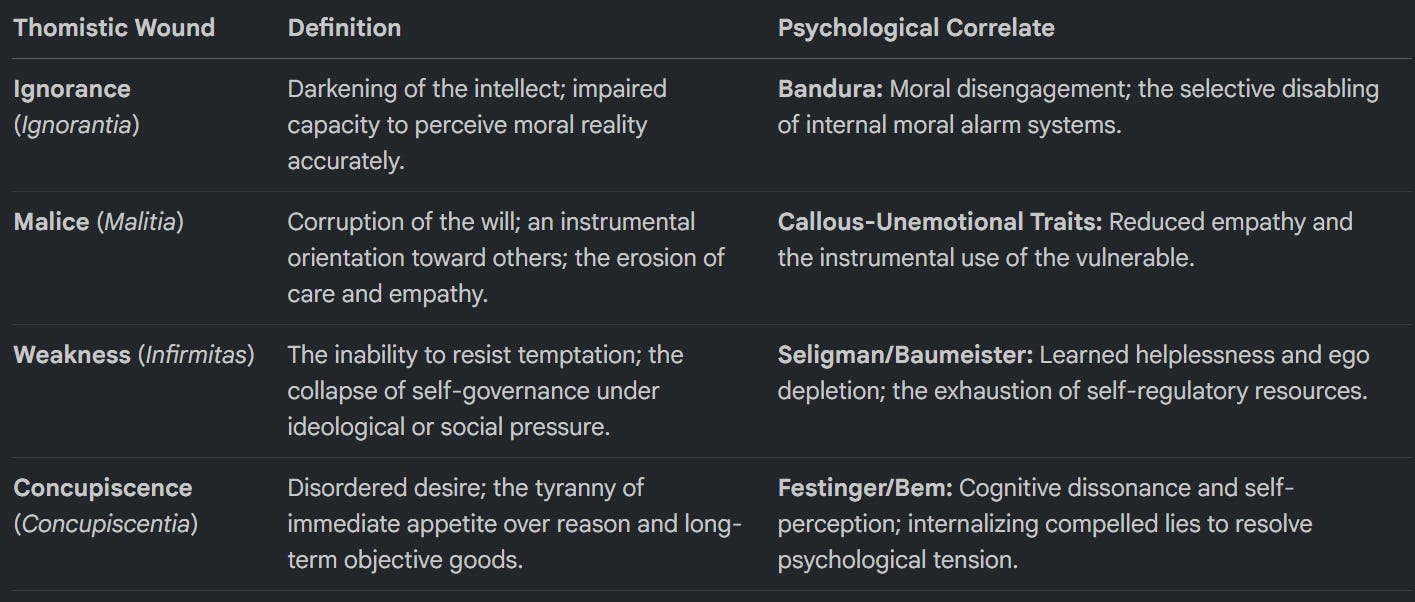
—
The “So What?” of this framework lies in the mechanism of habituation. Aquinas observed that repeated acts against reason carve “grooves in the soul,” making vice progressively automatic and virtue progressively inaccessible. When a moral wrong is normalized by legal mandate and public celebration, the individual encounters no corrective friction. Over five decades, this has led to a geometric deepening of these wounds, creating a generational inheritance of moral atrophy facilitated by the State’s pedagogical power.
3. The Mechanism of Compulsion: Judicial Fiat as a Pedagogical Tool
In the Summa Theologica, Aquinas observes that human law serves as a “moral instructor.” The State signals what a community regards as praiseworthy through its statutes. When the law compels acceptance of a contested moral act, it communicates a lesson that bypasses individual reasoning, creating a fundamental tension between persuasion and coercion.
Legitimate social change must meet the Positive Standard of Legitimate Authority, which includes:
Jurisdictional Legitimacy: Verified authority within the sponsoring office.
Cumulative Consent: Documented and sustained recognition across diverse communities.
Multi-tradition Deliberation: Free exchange among representatives of the principal moral traditions.
Revocability: The capacity for a mandate to be withdrawn by the community.
The 1973 decision failed every metric of this standard. It was an exercise of “raw judicial power” that forced the performance of “the lie” under the State’s coercive power. By institutionalizing a practice previously restrained by custom and stigma, the State required its citizens to fund and tolerate a new moral reality as a background social fact. This initiated a “moral cascade” that has systematically disintegrated the foundational structures of society.
4. The Cascade of Disintegration: Family, Fatherhood, and the Biological Impact
The “Logic of the Moral Cascade” suggests that accepting a primary wrong lowers the threshold of resistance to subsequent ones. Once the principle of state-determined personhood was established, it expanded into the domain of the family, most notably through the marginalization of fatherhood.
4.1 The Two Modes: Maternal Nurture vs. Paternal Voyage
Natural law and developmental psychology identify two complementary goods provided by parents:
Maternal Nurture (The Safe Harbor): Focused on foundational emotional regulation and internal security.
Paternal Voyage (The Horizon): Oriented toward protection, risk-assessment, and the regulation of competitive impulses.
The removal of the father, facilitated by the ideological shift toward autonomy, deprives children of the “paternal voyage.” Critically, this has measurable biological consequences. Research by Ellis et al. (2003) demonstrates a pheromonal and environmental link between father absence and the earlier onset of puberty in daughters. The absence of the biological father’s presence triggers a “fast life history strategy”—a biological adaptation to perceived instability that places daughters at risk of premature sexualization before their moral faculties are formed to manage it.
4.2 The “Captured Grandmother” and Intergenerational Collapse
The most underappreciated factor in this cascade is the ideological capture of the grandmother. Traditionally, the elder woman served as the civilizational anchor and the “calibration mechanism” for female mate selection, guiding daughters toward investment-heavy partners over high-dominance/low-investment males.
The Five Traditional Functions of the Grandmother include:
Spiritual Formation: Daily prayer and domestic catechesis.
Practical Wisdom: Transmission of domestic arts and household economy.
Relationship Guidance: Calibrating mate selection based on multi-decade observation.
Childcare Support: Providing a relational “safe harbor” superior to institutional care.
Social Gatekeeping: Maintaining community moral standards and accountability.
Ideological capture (beginning in the 1960s-70s) inverted these functions. The captured grandmother now often transmits therapeutic self-affirmation rather than faith. Bengtson’s (2013) data reveals the quantitative depth of this loss: when a grandmother is traditionally formed, 63% of grandchildren remain religious; when she is ideologically captured, this falls to a staggering 7%. This 90% decline represents a civilizational failure of wisdom transmission.
5. The Anthropological Shift: Defining ‘Homo Umbrans’ (The Shadow Human)
The culmination of these cascading disintegrations is the emergence of Homo Umbrans, or the “Shadow Human”—an anthropological endpoint characterized by an “interior vacancy.”
Theodore Dalrymple’s analysis of “the lie as an instrument of power” explains the Dalrymplean bifurcation: the psychological torture of being forced to say things one knows to be false (e.g., “abortion is healthcare”). To maintain public standing, the individual must suppress their own rational perception. This creates a bifurcation between private knowledge and public performance, which eventually atrophies the grip on rational self-governance.
Evidence of this “wounded” population was visible during the COVID-19 response, where a population with weakened moral and rational faculties accepted the extra-legal suspension of fundamental civil liberties with negligible resistance. Homo Umbrans does not possess a selfhood formed through virtue, but rather assembles an identity from “identity-fragments” offered by commerce and ideology.
6. Institutional False Witness and Professional Betrayal
In the Thomistic tradition, God is defined as Truth itself (Veritas Ipsum). Therefore, the deliberate propagation of falsehood is a metaphysical violation—a scandalum that leads the community into spiritual and temporal ruin. The professional class has engaged in a “Managed Silence” regarding documented harms, leading to a state of infamia (loss of legitimate reputation).
6.1 The Paradigm of Institutional Lying
The Iraq War serves as the “smoking gun” for this betrayal. The manufacturing of a case for war based on manipulated intelligence resulted in hundreds of thousands of deaths, yet the architects of the lie faced no professional consequences. This signal—that false witness on a catastrophic scale carries no risk—shattered the epistemic foundation of the community.
6.2 Economic False Witness by Omission
The professional class has also maintained a culpable silence regarding the extraction of wealth from the citizenry. Source data confirms a staggering decoupling:
Productivity increase (1979-2024): 80.9%
Real wage increase: Only 29.4%
Single mother poverty: 40% of single mothers now live below the poverty line.
By omitting the costs of housing, education, and healthcare from official inflation narratives, institutions engage in false witness by omission, depriving the public of the empirical framework necessary to perceive the wrongs being done to them.
6.3 The Five Categories of Moral Responsibility
Original Witness: Those who manufacture the lie (e.g., manipulated intelligence).
Enablers: Those providing the institutional framework for the falsehood.
Amplifiers: Those who spread the doctrine without critical examination.
Culpable Silence: Professionals (economists, physicians) who fail their duty to inform the public.
Formative Failure: Guardians who transmit these falsehoods to the next generation.
7. Conclusion: The Path Toward Moral Restoration
Policy correction alone cannot heal fifty years of anthropological damage. The “rectification of names”—naming things correctly as the beginning of wisdom—is the first step. Restoration requires the rebuilding of corrective institutions through a Five-Phase Sequence:
Spiritual Authority: Securing leadership that is doctrinally and sacramentally intact.
Multi-tradition Justice: A justice system represented by the principal traditions of the natural law.
Public Deliberation: Distilling universal standards accessible to human reason.
Fact-based Judicial Activity: Commencing activity on narrowly framed, substantiated causes.
Consented Temporal Mandate: Receiving authority through free and revocable public recognition.
The ultimate “Anthropological Task” is to recover a moral anthropology that grounds human dignity in being rather than legal grant. To heal the wounds of the “Compelled Fall,” society must move from the ambition to compel toward the courage to be persuaded by the Truth.
--------------------------------------------------------------------------------
References
Amato, P. R. (2005). The impact of family formation change on well-being. The Future of Children.
Aquinas, T. (1265–1274). Summa Theologica.
Bandura, A. (1999). Moral disengagement in the perpetration of inhumanities. Personality and Social Psychology Review.
Bengtson, V. L. (2013). Families and Faith: How Religion is Passed Down Across Generations.
Dalrymple, T. (2001). Life at the Bottom.
Ellis, B. J., et al. (2003). Does father absence place daughters at special risk for early sexual activity? Child Development.
Hawkes, K., et al. (1998). Grandmothering and the evolution of human life histories. PNAS.
McLanahan, S., & Sandefur, G. (1994). Growing Up with a Single Parent.
Pruett, K. D. (2000). Fatherneed.
Seligman, M. E. P. (1975). Helplessness.
—
Appendix B: Strategic Framework for the Restoration of Legitimate Corrective Authority: A Five-Phase Roadmap
1. The Ontological Crisis: Diagnosing State-Compelled Moral Acceptance
The stability of any social order rests upon the mechanism by which it adopts and enforces moral norms. Strategically, we must distinguish between moral changes achieved through persuasion—which engages the rational faculties of the citizenry—and those achieved through coercion. The 1973 Roe v. Wade decision represented a profound “moral event” where judicial fiat bypassed democratic deliberation, effectively conscripting the moral imagination of the public under the threat of state power. This was not a mere policy shift; it was an exercise of “raw judicial power” that installed moral positions from above, bypassing the labor of conscience. This transition from deliberation to mandated acceptance created a structural rupture, forcing the citizenry to integrate a background social fact that contradicted the natural law.
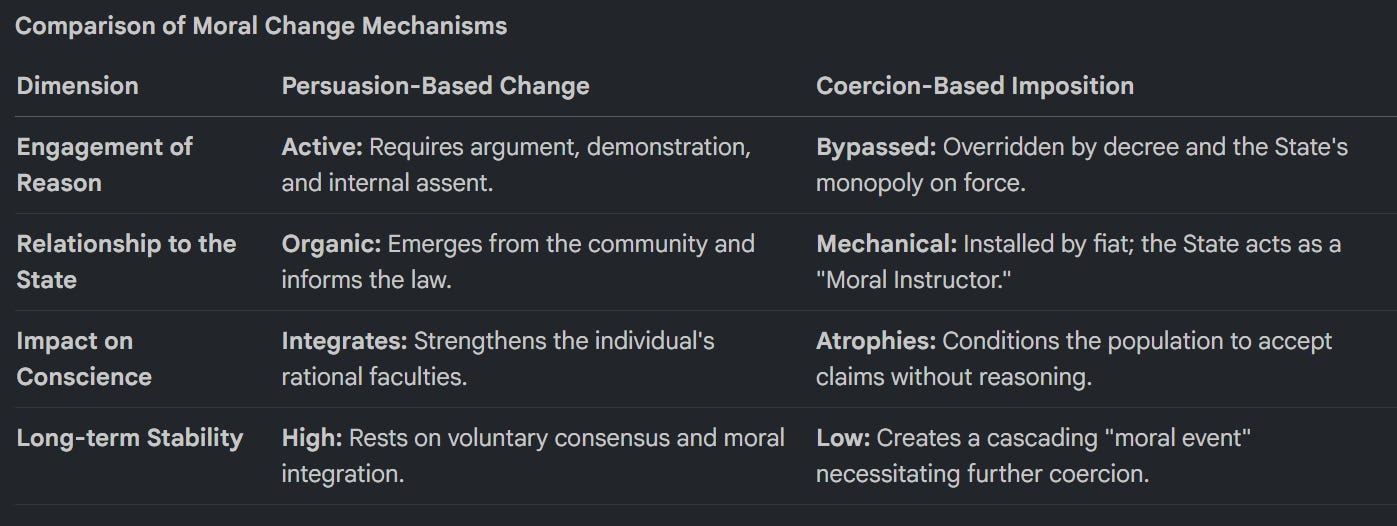
—
The Unique Moral Weight of State Compulsion
The law acts as a primary moral instructor, signaling what a community regards as permissible or praiseworthy. When the State decrees that personhood is a legal grant rather than an ontological given, it communicates a lesson of extraordinary gravity: that bodily autonomy is a supreme value that overrides the life of another. By institutionalizing this subordination of the unborn, the law teaches that the human person is a product of state definition rather than a creature of inherent dignity. This structural rupture necessitates a return to natural law principles—the conformity of human action to the rational order—to prevent further institutional decay and anthropological wreckage.
--------------------------------------------------------------------------------
2. The Theoretical Diagnostic: The Wounding of Human Faculties
The current civilizational crisis is not merely a policy failure; it is an anthropological wounding of the intellect and the will. To understand the depth of this “Compelled Fall,” we must integrate Thomistic metaphysics with modern psychological correlates. Social harm is the functional damage of faculties through which the human person apprehends truth and chooses good.
Thomistic Wounds and Modern Psychological Correlates
Ignorance (Darkening of the Intellect)
Mechanism: Moral Disengagement (Bandura). The selective disabling of the moral alarm system through dehumanization or displacement of responsibility. The intellect ceases to perceive moral reality accurately.
Malice (Corruption of the Will)
Mechanism: Callous-Unemotional (CU) Traits. An instrumental orientation toward others where empathy is eroded by the normalization of harm toward the vulnerable. The will is ordered toward the self at the expense of the other.
Weakness (Inability to Resist Pressure)
Mechanism: Ego Depletion and Learned Helplessness (Seligman). The collapse of self-regulatory capacity. The individual, feeling unable to resist external mandates, surrenders their agency to administrative servitude.
Concupiscence (Disordered Desire)
Mechanism: Reward Dysregulation and Hedonic Adaptation. The tyranny of appetite over reason, where the pursuit of immediate gratification—validated by the culture—renders the individual incapable of sustained commitment to higher goods.
The Dalrymple Effect: The Humiliation of the Lie
The “Dalrymple Effect” identifies the strategic use of enforced dishonesty as an instrument of power. When an institution compels a citizen to repeat obvious falsehoods—for example, that “abortion is healthcare” or that “biological sex is a preference”—the intent is not informational, but psychological. It is a form of humiliation designed to demonstrate that the individual cannot mount even the interior resistance of refusing to speak a lie. This creates a “bifurcation” between private knowledge and public performance. The sustained effort of maintaining this lie requires the habitual suppression of the intellect, eventually creating an “interior vacancy” where the capacity for honest self-assessment is destroyed. This generational erosion ensures that each successive cohort inherits a more damaged moral baseline.
--------------------------------------------------------------------------------
3. The Evidence of Disintegration: Mapping the Downstream Cascade
The “Logic of Moral Cascade” dictates that the acceptance of an upstream wrong—the state-determined definition of personhood—lowers resistance to all subsequent wrongs. Once the principle of life’s inviolability is removed, the faculties of resistance are dimmed, leading to a systematic cascade of disintegration across all sectors of society.
Systematic Marginalization of Fatherhood and Family
The destruction of the family is the primary sociological signature of the 1973 rupture.
Divorce as Ideology: In college-educated populations, women initiate divorce at rates of 70% to 80%, often citing “self-fulfillment”—a therapeutic mask for the wound of concupiscence.
Biological Adaptation: Father absence triggers a “fast life history strategy” in daughters, resulting in measurably earlier puberty and increased relational vulnerability (Ellis et al., 2003).
Male Withdrawal: Prime-age male workforce participation has collapsed from 97.1% in 1960 to 88.4% in 2020. Deprived of the domestic authority of fatherhood, men succumb to the wound of weakness, withdrawing into screen-based entertainment and social disengagement.
Ideological Capture of the Grandmother
The “Grandmother Hypothesis” identifies elder women as civilizational anchors who calibrate female mate selection—guiding young women toward providers and protectors. The “Baby Boomer Grandmother,” however, has been captured by revolutionary ideologies.
The Calibration Failure: By validating disordered choices rather than providing corrective friction, the captured grandmother acts as an accelerant of dissolution.
Faith Transmission: Traditionally formed grandmothers achieve a 63% faith retention rate in grandchildren; ideologically captured grandmothers see this drop to a mere 7% (Bengtson, 2013).
The Logic of the Cascade: Euthanasia, Gender, and COVID-19
Euthanasia (MAID): The principle of state-determined life worthiness has moved from the womb to the elderly and the “mentally distressed,” with the state now offering death as a solution for PTSD and depression.
Medical Harm: The “Cass Review” (2024) confirms the “remarkably weak” evidence for pediatric gender medicine. Yet, captured institutions continue to administer sterilizing medications to minors, a manifestation of the wound of malice.
COVID-19 Response: The extra-legal suspension of civil liberties—closing churches while opening casinos—imposed severe harm on the young to provide marginal risk reduction for the old, an inversion of the natural order made possible by a desensitized public.
Institutional False Witness: The Paradigm of the Iraq War
The most consequential instance of institutional “false witness” in recent history is the Iraq War. On the basis of manufactured intelligence and manipulated claims of WMDs, the professional class facilitated a war of aggression that killed hundreds of thousands. No senior official faced prosecution, signaling to the culture that lying on a global scale carries no consequence.
This is mirrored in the “Lie of Silence” regarding the professional class’s economic betrayal. While worker productivity rose 80.9% (1979–2024), real wages rose only 29.4%. Experts maintain silence on the true cost of living, where inflation in Housing (+482%), Healthcare (+411%), and Tuition (+421%) has far outstripped official narratives. This “False Witness” is a cosmic disorder—a defection from Veritas Ipsum (Truth as the nature of God).
--------------------------------------------------------------------------------
4. The Anthropological Endpoint: The Construct of Homo Umbrans
The cumulative product of five decades of state-mandated moral acceptance is the Homo Umbrans (the Shadow Human). This is the “anthropological wreckage” of the 1973 rupture.
Traits of the Shadow Human
Diminished Rational Agency: An inability to interrogate received propositions or resist social pressure; the “moral alarm system” has been disabled.
Attenuated Moral Perception: A contraction of moral vocabulary to the range of the socially approved; an interior vacancy where conviction used to reside.
Susceptibility to Ideological Direction: A sense of selfhood assembled from identity fragments—commerce, entertainment, and state-sanctioned narratives—rather than interior moral authority.
Institutional Capture: Compliance over Competence
Media, universities, and courts now select for compliance over competence. Credentials have become certifications of conformity, ensuring that the Homo Umbrans is self-reproducing. Institutions no longer contain the “corrective friction” necessary to challenge the cascade. This condition is the primary obstacle to restoration, requiring a rebuilding of trust from the ground up.
--------------------------------------------------------------------------------
5. The Strategic Sequence: Five Phases for Rebuilding Corrective Authority
Correction cannot be achieved through a new imposition or raw power. It must move from judicial fiat back toward a voluntary, cross-traditional moral consensus grounded in natural law. The following are the Strategic Mandates for institutional restoration:
The Phased Restoration Manual
Phase I: Secure Spiritual Authority. Establish leadership that is sacramentally and doctrinally intact. These leaders must be bound by radical transparency and must prioritize the transmission of truth over institutional self-interest.
Phase II: Constitute Multi-Tradition Justice. Free constitution of a justice system with representation from the principal moral traditions of the community. This ensures the system is not merely the organ of a single, captured ideology.
Phase III: Distill Basic Standards. Formulate a minimal catalogue of universal standards (natural law) that are accessible to reason and can receive broad cross-traditional and secular assent. This is the recovery of the “rectification of names.”
Phase IV: Commence Narrow Judicial Activity. Initiate judicial action only on factually substantiated, narrowly framed causes. Establish a track record of restraint, fairness, and mercy to differentiate the new authority from the previous regime of fiat.
Phase V: Receive Consented Temporal Mandate. Authority must be received, not assumed. It is granted through the free and cumulative recognition of the community, which retains the right to revoke consent if the authority fails its mandate.
Principles of Legitimate Corrective Authority
Jurisdictional Limitation: Authority is restricted to fundamental goods (life, family, conscience).
Revocable Consent: Mandates are subject to ongoing communal recognition, not permanent fiat.
Radical Transparency: All judicial and administrative processes must be open to public scrutiny.
No Artificial Immunity: Those in high office bear amplified accountability; the higher the office, the more severe the consequence for false witness.
--------------------------------------------------------------------------------
6. Conclusion: The Mandate for Moral Restoration
The 1973 judicial imposition was the catalyst for a documented cascade of wounding that reaches from the individual soul to the global geopolitical stage. By bypassing reason and compelling acceptance of a fundamental wrong, the State has cultivated a population of Homo Umbrans, whose dimmed faculties are the primary engine of civilizational decline. The “False Witness” of the professional class and the “Administrative Servitude” of the citizenry are symptoms of a deep metaphysical disorder.
The final mandate for leaders is fundamentally anthropological. You must recover the full account of the human being—as a unity of intellect and will ordered toward Truth. You must find the courage to name the wounds inflicted by our culture—the Iraqs, the MAIDs, the sterilizations, and the economic extractions—with both love and uncompromising honesty. Only by naming the wound can the healing of the faculty begin.
—
Appendix C: The Generational Shift: A Thematic Breakdown of Family Dissolution and Ideological Capture
1. Introduction: The Family as a Developmental Ecosystem
In the discipline of developmental anthropology, the family is identified not merely as a social convention but as a Thomistic engine—a functional, ontological unit designed for human flourishing. Within this framework, the family serves as the primary habitat where the human person’s rational faculties (the Intellect and the Will) are ordered toward their proper objects: Truth and the Good. These roles provide specific “developmental goods” that are non-negotiable for a child’s transition into a fully integrated adult capable of self-governance.
However, the functional integrity of this developmental engine is currently compromised by a systematic “wounding” of these faculties. This atrophy was initiated by a profound moral event: the 1973 Roe v. Wade decision. By imposing a contested moral position through judicial fiat rather than democratic deliberation, the State bypassed the “rational labor” of the citizenry. When the law is decreed rather than reasoned toward, the Faculty of the Intellect atrophies from disuse, leading to the following foundational impairments:
Intellect: The capacity to apprehend reality as it actually is. In a wounded state, this manifests as Ignorance—a darkened intellect unable to perceive moral reality accurately.
Will: The ability to pursue what the intellect identifies as genuinely good. Its wound is Weakness (an inability to sustain commitment) and Malice (the corruption of the will toward instrumentalizing others).
Moral Perception: The internal alarm system of the conscience. When wounded, this results in Concupiscence—disordered desire elevated above obligation, effectively institutionalizing vice as virtue.
These documented anthropological signatures indicate a shift from a structure of mutual sacrifice to one of supreme individual autonomy, signaling the mechanism of developmental disruption.
2. The Maternal Mode: From “Safe Harbor” to Supreme Autonomy
The maternal role is the foundational base of human development, traditionally functioning as the “Safe Harbor.” This role is physiologically and psychologically oriented toward stabilizing the infant’s nervous system. Under ideological capture, however, this mode has transitioned toward “Supreme Autonomy,” where personal imperatives supersede developmental requirements.
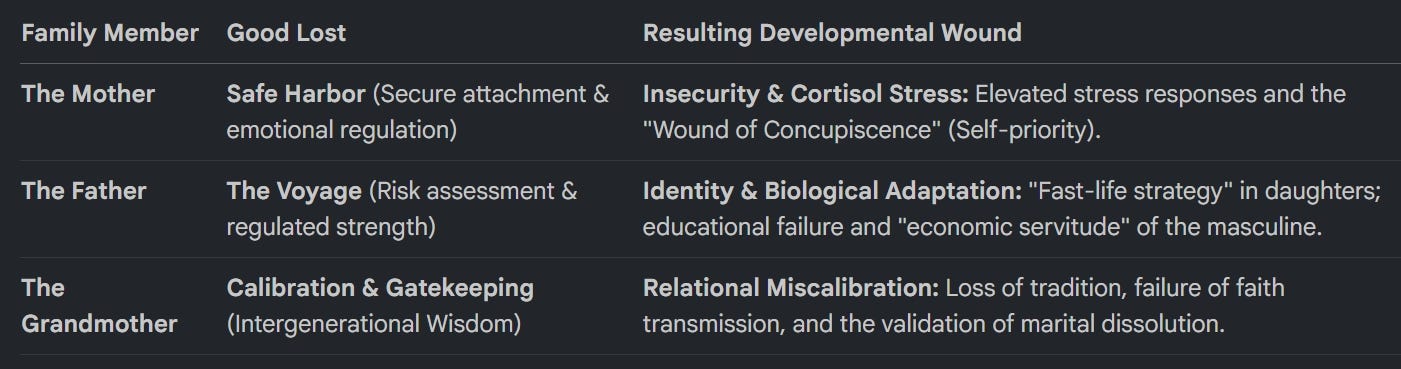
—
Synthesis of Insight: The shift from “Nurture” to “Personal Autonomy” has resulted in a phenomenon of Role Overload. As career imperatives are treated as supreme virtues, the resulting stress often leads to the use of institutional daycare. The source context identifies this as a “managed silence”—a failure to acknowledge that extended non-maternal care in the first year of life is associated with insecure attachment and elevated cortisol stress. In this state, the “Wound of Concupiscence” drives the abandonment of the Safe Harbor for a version of autonomy that views children as secondary to self-actualization.
This maternal foundation is intended to be complemented by the secondary, outward-facing function provided by the father.
3. The Paternal Mode: “The Voyage” and the Marginalized Father
While the mother provides the harbor, the father traditionally facilitates “The Voyage.” Paternal input is oriented toward protection and the expansion of horizons, pushing the child to interact with the world beyond the maternal base.
The four most critical Paternal Goods provided during “The Voyage” are:
Risk Assessment: Navigating environmental dangers and challenges within controlled, safe limits.
Frustration Tolerance: Building the capacity to absorb, process, and recover from failure or external difficulty.
Social Competence: Mastering peer interaction and independence from the domestic center.
Regulation of Strength: Modeling how physical assertiveness and competition are ordered toward the common good.
The Impact of Ideological Capture: In the current anthropological landscape, the father has been reduced to a “financial instrument.” Mechanisms such as “No-Fault Divorce” have created a legal asymmetry that enforces “economic servitude.” The father is required to fund a household from which he is structurally excluded, denying him the presence and authority necessary to provide the “Voyage.”
Synthesis of Consequence: The removal of the paternal role triggers specific biological and psychological adaptations:
For Daughters: The absence of a father triggers a “fast-life strategy.” This is an anthropological adaptation where the body, sensing a damaged ecosystem, prioritizes premature reproductive maturity (early puberty) over stable formation.
For Sons: The removal of the model for regulated strength leads to a crisis of masculine identity. Without paternal formation, sons often exhibit school disengagement, aggression, or a total loss of masculine meaning.
As the nuclear unit fractures, the final anchor of civilizational wisdom is often found in the grandmother.
4. The Grandmother Hypothesis and the Civilizational Anchor
The “Grandmother Hypothesis” is a cross-cultural universal asserting that the post-reproductive lifespan of human females exists to provide intergenerational wisdom. Traditionally, the grandmother serves as a Calibration Function, using practical wisdom to gatekeep family standards and guide the mate selection of younger women.
However, the “Captured Grandmother” (notably the post-1960s generation) has transitioned from an anchor to an “accelerant of dissolution” through the following shifts:
Transmitting Therapy over Faith: Replacing objective virtues and prayer with “therapeutic self-affirmation.”
Validating Dissolution: Using her authority to validate a daughter’s divorce based on self-fulfillment rather than providing the “corrective friction” to save the marriage.
Loss of Gatekeeping: Relinquishing her calibration role, allowing biological preference (short-term attraction) to operate without the oversight of long-term investment wisdom.
The Statistical Faith Gap: Sociologist Vern Bengtson’s data reveals a profound failure in transmission: When a grandmother is traditionally formed, 63% of her grandchildren remain religious. When she is ideologically captured, that transmission rate collapses to 7%, representing a near-total failure in the intergenerational bridge of tradition.
When the final anchor of intergenerational wisdom is severed, the anthropological result is the dimming of the human person into a shadow version of the self.
5. The Anthropological Endpoint: Understanding “Homo Umbrans”
The culmination of wounded faculties and institutionalized vice results in the emergence of “Homo Umbrans” (the Shadow Human). This state is defined by a condition of Bifurcation (as described by Dalrymple)—a split between the individual’s private knowledge of reality and their public performance of approved ideological narratives.
Diminished Rational Agency: A reduced capacity to interrogate propositions or resist coercive social pressure.
Susceptibility to Ideological Direction: An interior vacancy filled by externally managed consensus and identity-fragments from media.
Contracted Moral Vocabulary: A moral sense that only operates within ranges approved by the current social information environment.
Self-Reproducing Decay: This state is self-perpetuating because Homo Umbrans lacks the faculties (Intellect and Will) needed to rebuild the “Safe Harbors” and “Voyages” of the next generation. This decay is exacerbated by the “Professional Class Betrayal” or the “Lie of Silence.” Institutions entrusted with truth—journalism, economics, and medicine—have maintained a managed silence regarding the decoupling of wages from productivity and the health impacts of family dissolution. This Institutional False Witness ensures that Homo Umbrans cannot recognize evil, as their moral alarm system has been desensitized through habituation.
6. Summary Table: The Cascade of Lost Goods: A Map of Developmental Atrophy
—
Final Instructional Summary: The first step toward cultural and anthropological restoration is the rigorous “naming of the wound”—recognizing that the dissolution of these roles has not liberated the person, but has instead systematically atrophied the rational and moral faculties required for human dignity.
—
Appendix D: Conceptual Primer: The Architecture of Moral Perception – Aquinas meets Modern Psychology
1. Introduction: Bridging Eight Centuries of Insight
This primer explores the profound intersection between 13th-century theology and 20th-century behavioral psychology to diagnose a singular phenomenon: the “wounding” of the human faculties. While separated by eight hundred years, St. Thomas Aquinas and modern clinical scientists describe an identical reality—the systematic degradation of the human ability to accurately perceive truth and volitionally choose the good.
For the student of moral philosophy, the “so what?” of this study lies in recognizing that state-level moral shifts are not merely legal adjustments; they are profound psychological interventions. Specifically, when the State imposes a moral shift by judicial fiat—such as the 1973 “Moral Event”—it bypasses the individual’s rational deliberation. This “anthropological rupture” acts as a direct intervention in the individual mind, conscripting the moral imagination under the weight of a decree. This act of compulsion creates a unique category of harm that ripples from the statehouse into the deepest recesses of the soul, forcing the mind to align with a background social fact it did not reason toward.
Having defined this functional anatomy of the wounded soul, we must now observe the specific categories of damage described by St. Thomas Aquinas.
--------------------------------------------------------------------------------
2. The Thomistic Foundation: The Four Wounds of the Soul
In his Summa Theologica, Aquinas argues that human nature flourishes only when the intellect is ordered toward truth and the will toward the good. When an individual or society habitually deviates from this order, “wounds” are inflicted upon the soul’s functional capacities.
The Functional Anatomy of the Wounded Soul
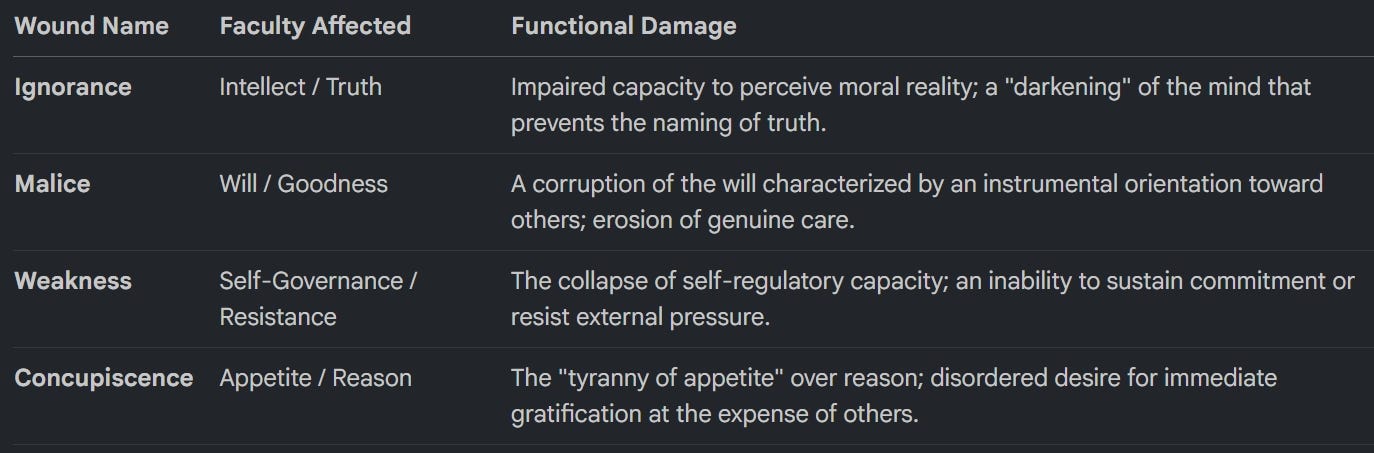
—
The Principle of Habituation
Aquinas posits that these wounds are not static but are deepened through habituation, creating a formative environment for successive generations:
Grooves in the Soul: Repeated actions—especially those normalized by the State—carve cognitive “grooves” that make disordered responses automatic.
Vice Institutionalized as Virtue: When a society celebrates a wound as a right, it removes all “corrective friction,” making the virtuous path increasingly inaccessible.
Generational Erosion: Each generation inherits a baseline where these atrophied faculties are taken for granted, leading to a self-perpetuating cycle of dysfunction.
Having defined the metaphysical diagnosis provided by Aquinas, we must now observe how modern behavioral science provides empirical confirmation of these ancient observations.
--------------------------------------------------------------------------------
3. The Psychological Mirror: Modern Science and Ancient Wisdom
Modern psychological science identifies these same “grooves” and “wounds” using empirical terminology, suggesting that both traditions are tracking the same objective features of human dysfunction.
Ignorance & Moral Disengagement: Albert Bandura’s theory describes how the “moral alarm system” is selectively disabled through dehumanization and the displacement of responsibility. Like the wound of Ignorance, this allows individuals to facilitate harm without the cognitive friction of guilt.
Weakness & Ego Depletion / Learned Helplessness: Roy Baumeister and Martin Seligman describe states where the “active self” is exhausted or conditioned to believe it has no agency. This mirrors the wound of Weakness, particularly as it links to the “Crisis of Meaning” and the “Crisis of the Professional Class,” where individuals lose the capacity for honest self-assessment under institutional pressure.
Malice & Callous-Unemotional Traits: In developmental psychology, these traits represent the wound of Malice. They involve a reduced empathy and an instrumental view of others, often emerging in social environments where harm to the vulnerable is institutionalized.
Concupiscence & Reward Dysregulation: Research into chronic engagement with high-stimulation environments describes the “tyranny of appetite.” Here, reason is enslaved to hedonic hits, mirroring Aquinas’s description of disordered desire overriding the rational good.
As we pivot from individual traits, we must examine how the external environment—specifically the mechanism of the Law—actively influences and hardens these internal psychological states.
--------------------------------------------------------------------------------
4. The Mechanism of Compulsion: How Law Teaches the Mind
The law acts as a moral instructor. There is a fundamental difference between moral change through Persuasion (engaging the reason) and Coercion (imposition by decree). “Judicial Imposition” is a unique psychological event because of its coercive nature:
Bypassing Reason: It does not ask for deliberation; it installs a “background social fact” that the individual must accept regardless of their private moral judgment.
Cognitive Dissonance (Festinger): External compulsion forces an internal attitude shift. To resolve the tension of complying with a mandated wrong, the mind eventually adopts a belief that the mandate is “good.”
Self-Perception (Bem): By forcing individuals to behave in alignment with State mandates, the State eventually changes what the person believes is “true.”
The Dalrymple Bifurcation: The “compelled lie” is an instrument of power designed to break interior resistance. Being forced to publicly affirm what one knows to be false is an act of humiliation for the soul, degrading the faculty of truth-telling.
Institutional False Witness: This mechanism extends to the professional class. For example, the coordinated silence regarding economic extraction—where worker productivity increased 80.9% (1979-2024) while real wages only grew 29.4%—is a form of “managed silence” that deepens the wound of Ignorance.
These psychological shifts do not stop with the individual; they cascade through the primary unit of society: the family.
--------------------------------------------------------------------------------
5. The Cascade Effect: From Family Dissolution to “Homo Umbrans”
When individual moral perception is wounded, the damage cascades into the family, resulting in a systematic disintegration of roles and biological strategies.
The Marginalized Father: The removal of the father eliminates the “Voyage”—the paternal mode of risk-taking and horizon-expansion. This creates a formative vacuum, especially for sons, who lack the regulation of strength.
The Burdened Mother: “Role Overload” forces mothers to provide both nurture and discipline. This degrades the “Safe Harbor” of maternal presence. This shift is fueled by the Wound of Concupiscence; in college-educated populations, women now initiate divorce at rates of 70-80% (65% in the general population), often citing personal fulfillment over commitment.
The Captured Grandmother: Historically the transmitter of wisdom, the grandmother function has been “ideologically captured,” starting with the Baby Boomer generation (1946-1964). This has led to a 90% decline in faith transmission and the loss of her role as a calibration mechanism for female mate selection, where elder wisdom once guided the choice of stable providers.
The Daughter’s Biological Shift: Father absence triggers a “Fast Life History Strategy.” The absence of the biological father’s pheromonal presence acts as a biological signal of instability, triggering earlier puberty, premature sexualization, and increased relational vulnerability.
These cascading damages culminate in the final anthropological result of a wounded society.
--------------------------------------------------------------------------------
6. Defining “Homo Umbrans”: The Shadow Human
Homo Umbrans is the self-sustaining and self-reproducing anthropological endpoint of a society that has abandoned interior moral authority.
Diminished Agency: The loss of the ability to interrogate received propositions. Homo Umbrans lacks the “volitional muscle” to resist social pressure or ideological mandates from the State.
Contracted Vocabulary: A moral language limited only to “socially approved” ranges. Lacking the words to name truth, they lose the ability to think the thoughts required for moral resistance.
External Assembly: A sense of selfhood assembled from ideology and commerce rather than interior moral authority. The self is a product of external management rather than rational self-governance.
Recognizing the depth of this “shadow” state is the first necessary step toward the restoration of human dignity.
--------------------------------------------------------------------------------
7. Conclusion: The Path to Moral Restoration
The architecture of moral perception reveals that societal healing cannot be achieved through policy shifts alone. We must address the functional damage to the human person and recover the faculties of intellect and will.
The Three Pillars of Restoration
Naming the Wound: The necessity of courage and honesty in identifying the specific damage done to our moral and rational faculties by fifty years of state compulsion.
Rebuilding Corrective Institutions: Prioritizing the family, traditional wisdom, and truth-telling institutions that provide the “friction” necessary to resist ideological compliance.
Anthropological Recovery: Recovering a coherent moral anthropology that views human dignity as an inherent ontological reality, rather than a legal grant from the State.
Healing begins only when we possess the courage to recover the truth that has been obscured by the shadows of compulsion.
—